 Add to Chrome
 Add to Firefox
 Add to Edge
Enhancing Hyperspace Analogue to Language (HAL) Representations via Attention-Based Pooling for Text Classification
Mar 20, 2026
The Hyperspace Analogue to Language (HAL) model relies on global word co-occurrence matrices to construct distributional semantic representations. While these representations capture lexical relationships effectively, aggregating them into sentence-level embeddings via standard mean pooling often results in information loss. Mean pooling assigns equal weight to all tokens, thereby diluting the impact of contextually salient words with uninformative structural tokens. In this paper, we address this limitation by integrating a learnable, temperature-scaled additive attention mechanism into the HAL representation pipeline. To mitigate the sparsity and high dimensionality of the raw co-occurrence matrices, we apply Truncated Singular Value Decomposition (SVD) to project the vectors into a dense latent space prior to the attention layer. We evaluate the proposed architecture on the IMDB sentiment analysis dataset. Empirical results demonstrate that the attention-based pooling approach achieves a test accuracy of 82.38%, yielding an absolute improvement of 6.74 percentage points over the traditional mean pooling baseline (75.64%). Furthermore, qualitative analysis of the attention weights indicates that the mechanism successfully suppresses stop-words and selectively attends to sentiment-bearing tokens, improving both classification performance and model interpretability.

Conditional Morphogenesis: Emergent Generation of Structural Digits via Neural Cellular Automata
Dec 09, 2025
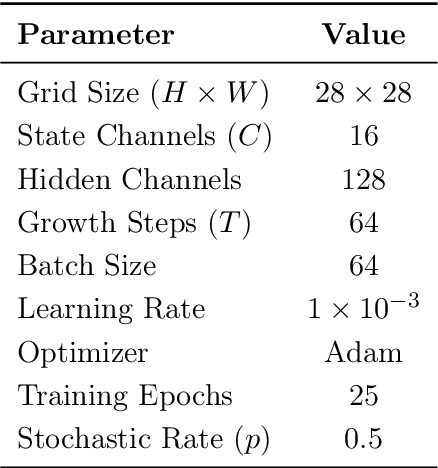
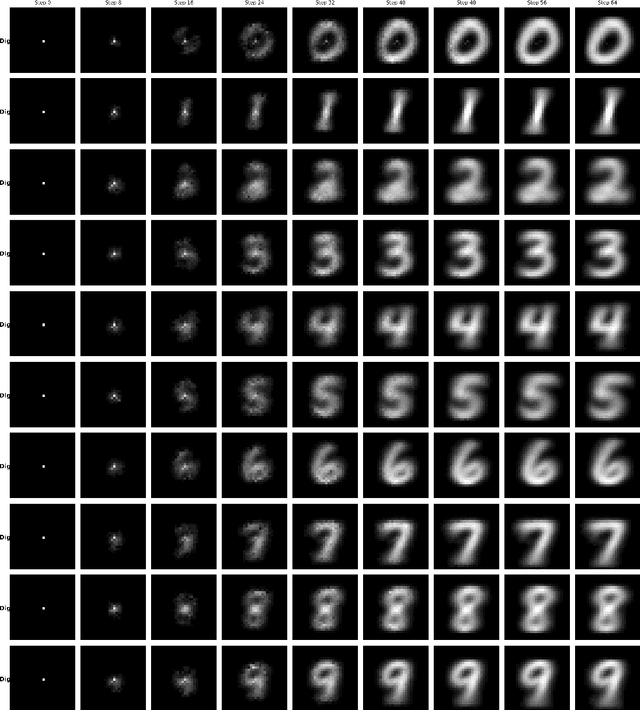
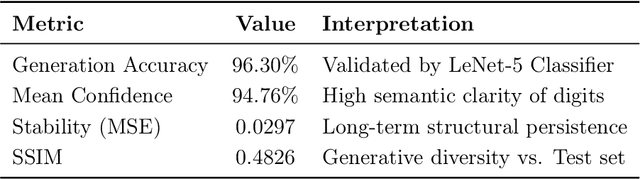
Biological systems exhibit remarkable morphogenetic plasticity, where a single genome can encode various specialized cellular structures triggered by local chemical signals. In the domain of Deep Learning, Differentiable Neural Cellular Automata (NCA) have emerged as a paradigm to mimic this self-organization. However, existing NCA research has predominantly focused on continuous texture synthesis or single-target object recovery, leaving the challenge of class-conditional structural generation largely unexplored. In this work, we propose a novel Conditional Neural Cellular Automata (c-NCA) architecture capable of growing distinct topological structures - specifically MNIST digits - from a single generic seed, guided solely by a spatially broadcasted class vector. Unlike traditional generative models (e.g., GANs, VAEs) that rely on global reception fields, our model enforces strict locality and translation equivariance. We demonstrate that by injecting a one-hot condition into the cellular perception field, a single set of local rules can learn to break symmetry and self-assemble into ten distinct geometric attractors. Experimental results show that our c-NCA achieves stable convergence, correctly forming digit topologies from a single pixel, and exhibits robustness characteristic of biological systems. This work bridges the gap between texture-based NCAs and structural pattern formation, offering a lightweight, biologically plausible alternative for conditional generation.