 Add to Chrome
 Add to Firefox
 Add to Edge
Evidence-Driven Decision Support for AI Model Selection in Research Software Engineering
Dec 12, 2025
The rapid proliferation of artificial intelligence (AI) models and methods presents growing challenges for research software engineers and researchers who must select, integrate, and maintain appropriate models within complex research workflows. Model selection is often performed in an ad hoc manner, relying on fragmented metadata and individual expertise, which can undermine reproducibility, transparency, and overall research software quality. This work proposes a structured and evidence-driven approach to support AI model selection that aligns with both technical and contextual requirements. We conceptualize AI model selection as a Multi-Criteria Decision-Making (MCDM) problem and introduce an evidence-based decision-support framework that integrates automated data collection pipelines, a structured knowledge graph, and MCDM principles. Following the Design Science Research methodology, the proposed framework (ModelSelect) is empirically validated through 50 real-world case studies and comparative experiments against leading generative AI systems. The evaluation results show that ModelSelect produces reliable, interpretable, and reproducible recommendations that closely align with expert reasoning. Across the case studies, the framework achieved high coverage and strong rationale alignment in both model and library recommendation tasks, performing comparably to generative AI assistants while offering superior traceability and consistency. By framing AI model selection as an MCDM problem, this work establishes a rigorous foundation for transparent and reproducible decision support in research software engineering. The proposed framework provides a scalable and explainable pathway for integrating empirical evidence into AI model recommendation processes, ultimately improving the quality and robustness of research software decision-making.

Enhancing Object Detection Performance for Small Objects through Synthetic Data Generation and Proportional Class-Balancing Technique: A Comparative Study in Industrial Scenarios
Jan 29, 2024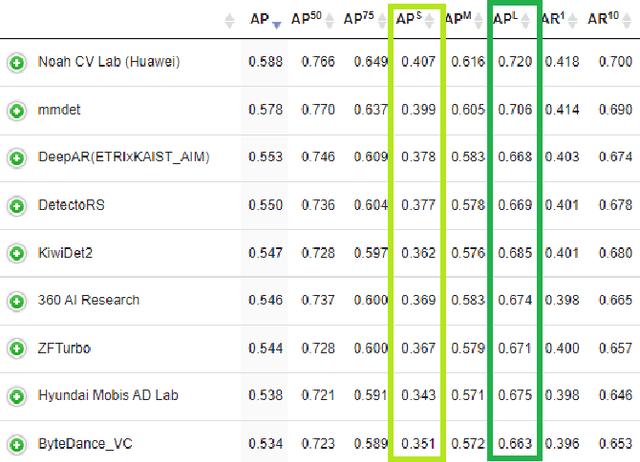
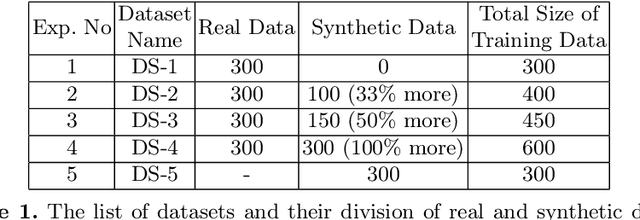
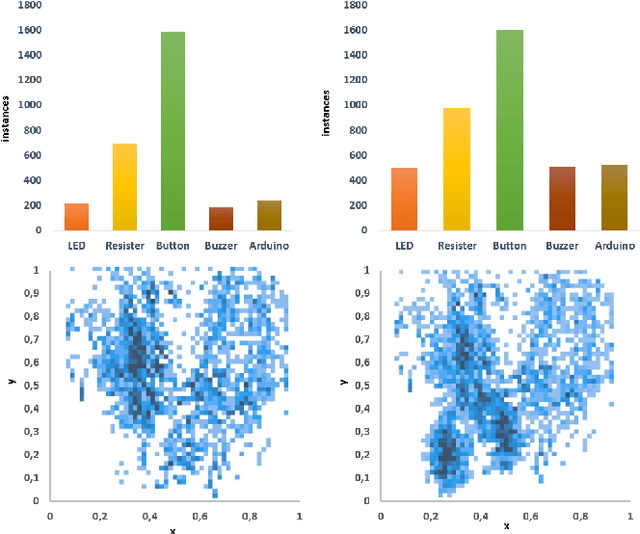
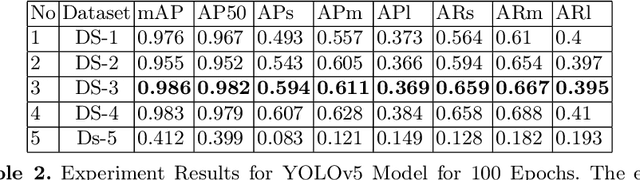
Object Detection (OD) has proven to be a significant computer vision method in extracting localized class information and has multiple applications in the industry. Although many of the state-of-the-art (SOTA) OD models perform well on medium and large sized objects, they seem to under perform on small objects. In most of the industrial use cases, it is difficult to collect and annotate data for small objects, as it is time-consuming and prone to human errors. Additionally, those datasets are likely to be unbalanced and often result in an inefficient model convergence. To tackle this challenge, this study presents a novel approach that injects additional data points to improve the performance of the OD models. Using synthetic data generation, the difficulties in data collection and annotations for small object data points can be minimized and to create a dataset with balanced distribution. This paper discusses the effects of a simple proportional class-balancing technique, to enable better anchor matching of the OD models. A comparison was carried out on the performances of the SOTA OD models: YOLOv5, YOLOv7 and SSD, for combinations of real and synthetic datasets within an industrial use case.