 Add to Chrome
 Add to Firefox
 Add to Edge
ADEPT: A Unified Framework for Deep Learning Test Adequacy
Aug 12, 2026
Over the past decade, many test adequacy metrics have been proposed for deep learning that characterize test dataset adequacy from different perspectives, e.g., neuron activation behavior, latent feature coverage, decision-boundary exploration, etc. However, these metrics are typically released as independent research prototypes with substantially different installation and preprocessing requirements, execution workflows, and configuration mechanisms. These complications make them quite difficult to reproduce, compare, and adopt in research work and practical deployment alike. In this paper, we present the engineering details of ADEPT, a framework that integrates representative adequacy techniques, including neuron-coverage-based metrics, surprise adequacy, input distribution coverage, boundary coverage, and source- and model-level mutation score, under a consistent execution workflow. ADEPT provides a template-based metric interface with well-defined extension points for integrating new adequacy metrics. Furthermore, it provides YAML-based configuration management, preprocessing-cache reuse, and structured result reporting, making it easy to use in any research and development workflows. ADEPT is designed for researchers and practitioners who wish to reproduce and apply adequacy metrics without spending days or weeks implementing missing tooling or configuring disparate research prototypes. A demo video is available at https://aub.ie/ADEPT_video.

Mutation-based Fault Localization of Deep Neural Networks
Sep 10, 2023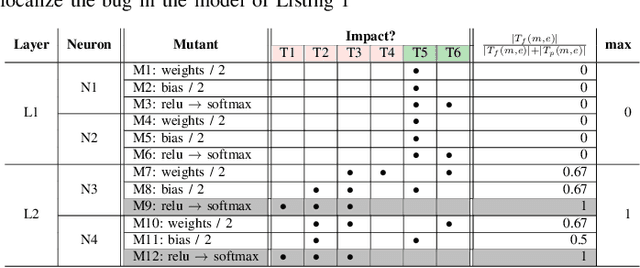
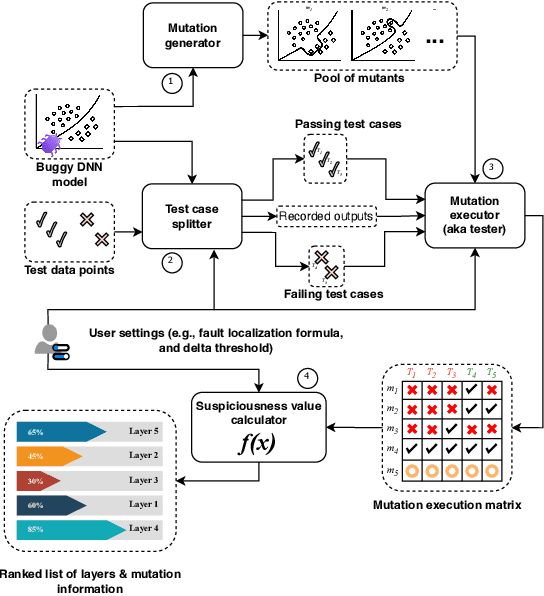
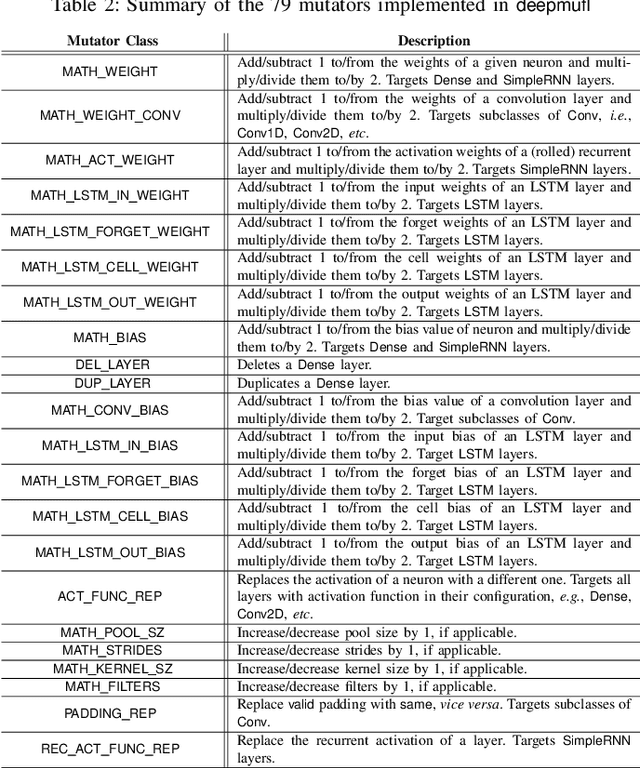
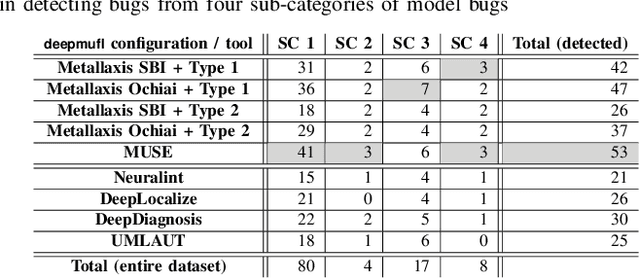
Deep neural networks (DNNs) are susceptible to bugs, just like other types of software systems. A significant uptick in using DNN, and its applications in wide-ranging areas, including safety-critical systems, warrant extensive research on software engineering tools for improving the reliability of DNN-based systems. One such tool that has gained significant attention in the recent years is DNN fault localization. This paper revisits mutation-based fault localization in the context of DNN models and proposes a novel technique, named deepmufl, applicable to a wide range of DNN models. We have implemented deepmufl and have evaluated its effectiveness using 109 bugs obtained from StackOverflow. Our results show that deepmufl detects 53/109 of the bugs by ranking the buggy layer in top-1 position, outperforming state-of-the-art static and dynamic DNN fault localization systems that are also designed to target the class of bugs supported by deepmufl. Moreover, we observed that we can halve the fault localization time for a pre-trained model using mutation selection, yet losing only 7.55% of the bugs localized in top-1 position.