 Add to Chrome
 Add to Firefox
 Add to Edge
JEPAMatch: Geometric Representation Shaping for Semi-Supervised Learning
Apr 22, 2026
Semi-supervised learning has emerged as a powerful paradigm for leveraging large amounts of unlabeled data to improve the performance of machine learning models when labeled data are scarce. Among existing approaches, methods derived from FixMatch have achieved state-of-the-art results in image classification by combining weak and strong data augmentations with confidence-based pseudo-labeling. Despite their strong empirical performance, these methods typically struggle with two critical bottlenecks: majority classes tend to dominate the learning process, which is amplified by incorrect pseudo-labels, leading to biased models. Furthermore, noisy early pseudo-labels prevent the model from forming clear decision boundaries, requiring prolonged training to learn informative representation. In this paper, we introduce a paradigm shift from conventional logical output threshold base, toward an explicit shaping of geometric representations. Our approach is inspired by the recently proposed Latent-Euclidean Joint-Embedding Predictive Architectures (LeJEPA), a theoretically grounded framework asserting that meaningful representations should exhibit an isotropic Gaussian structure in latent space. Building on this principle, we propose a new training objective that combines the classical semi-supervised loss used in FlexMatch, an adaptive extension of FixMatch, with a latent-space regularization term derived from LeJEPA. Our proposed approach, encourages well-structured representations while preserving the advantages of pseudo-labeling strategies. Through extensive experiments on CIFAR-100, STL-10 and Tiny-ImageNet, we demonstrate that the proposed method consistently outperforms existing baselines. In addition, our method significantly accelerates the convergence, drastically reducing the overall computational cost compared to standard FixMatch-based pipelines.

Unified Framework for Neural Network Compression via Decomposition and Optimal Rank Selection
Sep 05, 2024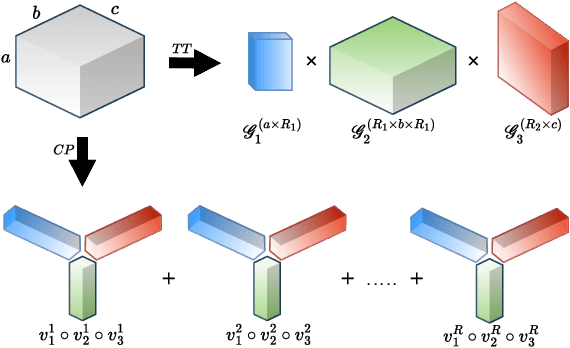
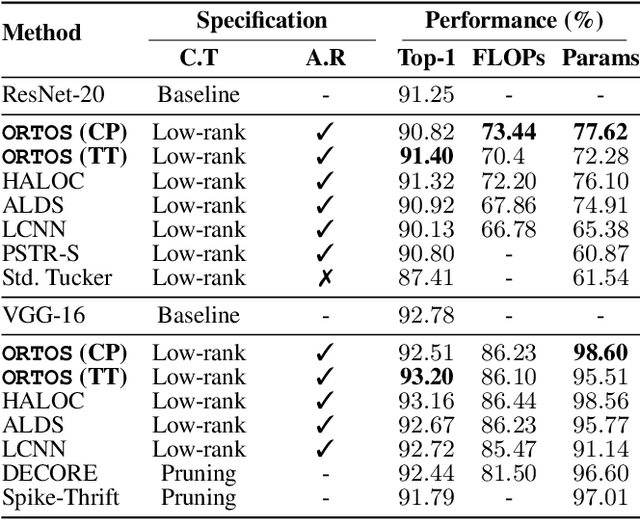
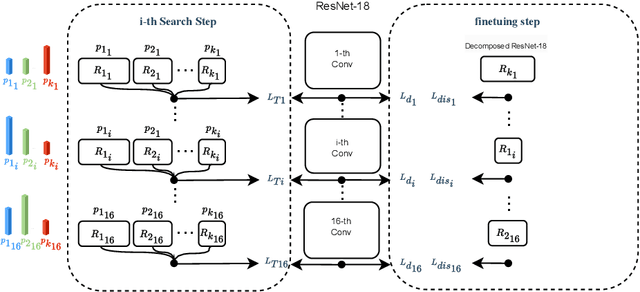
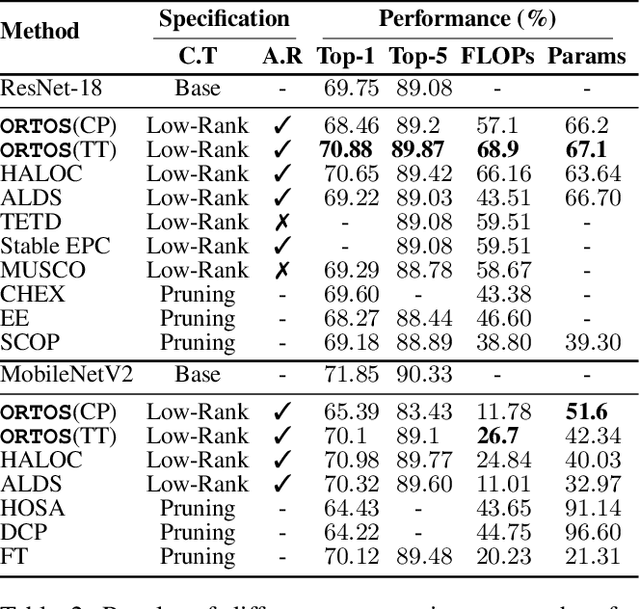
Despite their high accuracy, complex neural networks demand significant computational resources, posing challenges for deployment on resource-constrained devices such as mobile phones and embedded systems. Compression algorithms have been developed to address these challenges by reducing model size and computational demands while maintaining accuracy. Among these approaches, factorization methods based on tensor decomposition are theoretically sound and effective. However, they face difficulties in selecting the appropriate rank for decomposition. This paper tackles this issue by presenting a unified framework that simultaneously applies decomposition and optimal rank selection, employing a composite compression loss within defined rank constraints. Our approach includes an automatic rank search in a continuous space, efficiently identifying optimal rank configurations without the use of training data, making it computationally efficient. Combined with a subsequent fine-tuning step, our approach maintains the performance of highly compressed models on par with their original counterparts. Using various benchmark datasets, we demonstrate the efficacy of our method through a comprehensive analysis.