 Add to Chrome
 Add to Firefox
 Add to Edge
Collision-resistant multi-channel M-ASPM configurations with shared single detection channel
Jun 25, 2026
M-ary Aggregate Spread Pulse Modulation (M-ASPM) is a physical layer (PHY) modulation technique that offers several advantages for low-power wide-area networks (LPWANs). For instance, in conventional LPWAN modulations increasing receiver sensitivity by extending symbol duration - thereby proportionally increasing the time-on-air (ToA) - exacerbates collision exposure. In contrast, M-ASPM payload processing gain can vary over a wide range without impacting the effective packet collision rate. In particular, in this work we demonstrate how short front portions of M-ASPM packets can serve as a separate collision-resistant detection channel that, in addition to performing asynchronous packet detection and synchronization, obtains the carrier frequency offset (CFO) for each packet within a desired range and with the required precision. Then, while raising processing gain, the subsequent payload information can be extracted without expanding the sample window per symbol. Consequently, the receiver sensitivity can be significantly increased without exacerbating packet collisions and thus without reducing network throughput under collision-limited operation. We further establish a multi-channel configuration in which numerous quasi-orthogonal payload channels share a single detection channel that additionally performs payload channel identification and selection. Such sharing is especially useful for scaling and economizing LPWAN deployments under diverse technical requirements and constraints. The presented analysis is validated via extensive simulations under high packet collision rates in wide ranges of payload sizes and processing gains, and for varying noise and interference power levels. The results signify that M-ASPM provides a structurally distinct scaling behavior compared to conventional LPWAN modulations, decoupling range extension from collision-induced throughput degradation.

M-ary Aggregate Spread Pulse Modulation in LPWANs for IoT applications
Jun 18, 2021
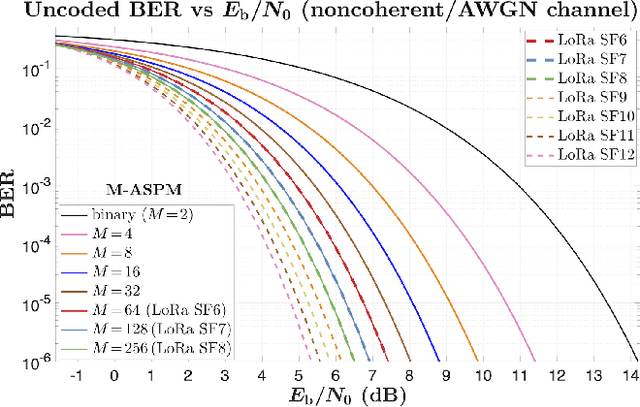

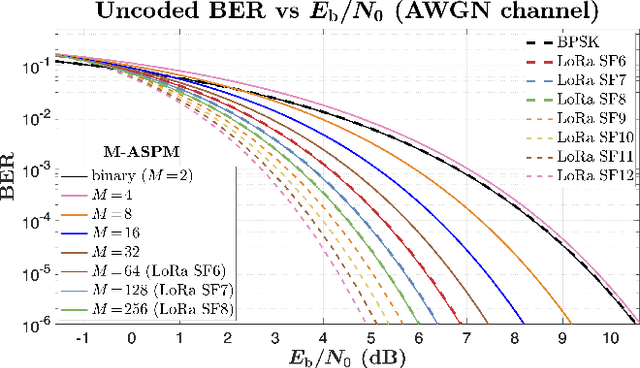
In low-power wide-area networks (LPWANs), various trade-offs among the bandwidth, data rates, and energy per bit have different effects on the quality of service under different propagation conditions (e.g. fading and multipath), interference scenarios, multi-user requirements, and design constraints. Such compromises, and the manner in which they are implemented, further affect other technical aspects, such as system's computational complexity and power efficiency. At the same time, this difference in trade-offs also adds to the technical flexibility in addressing a broader range of IoT applications. This paper addresses a physical layer LPWAN approach based on the Aggregate Spread Pulse Modulation (ASPM) and provides a brief assessment of its properties in additive white Gaussian noise (AWGN) channel. In the binary ASPM the control of the quality of service is performed through the change in the spectral efficiency, i.e., the data rate at a given bandwidth. Implementing M-ary encoding in ASPM further enables controlling service quality through changing the energy per bit (in about an order of magnitude range) as an additional trade-off parameter. Such encoding is especially useful for improving the ASPM's energy per bit performance, thus increasing its range and overall energy efficiency, and making it more attractive for use in LPWANs for IoT applications.