 Add to Chrome
 Add to Firefox
 Add to Edge
From Brain Models to Executable Digital Twins: Execution Semantics and Neuro-Neuromorphic Systems
Apr 15, 2026
Brain digital twins aim to provide faithful, individualized computational representations of brains as dynamical systems, enabling mechanistic understanding and supporting prediction of clinical interventions. Yet current approaches remain fragmented across data pipelines, model classes, temporal scales, and computing platforms, which prevents the preservation of execution semantics across the end-toend workflow. This survey introduces physically constrained executability as a unifying perspective for comparing approaches at the level of execution: whether an execution state is persistent, which events are permitted to update it (simulation, measurement, actuation), and how strongly execution is temporally and causally coupled to neurobiological dynamics. Building on modeling and simulation theory, I propose a taxonomy of execution regimes ranging from isolated offline models to coordinated co-simulation, to continuously executing digital twins sustained by online data assimilation, and ultimately to neuro-neuromorphic physical systems in which biological and computational dynamics are co-executed under shared physical constraints. The executability concept clarifies why accuracy alone is insufficient, and motivates an agenda centered on semantic interoperability, hybrid-time correctness, evaluation protocols, scalable reproducible workflows, and safe closed-loop validation. This survey adopts a systems and runtime-oriented perspective, enabling comparison of heterogeneous approaches based on their execution semantics rather than on model form or application domain alone.

Event-scheduling algorithms with Kalikow decomposition for simulating potentially infinite neuronal networks
Oct 23, 2019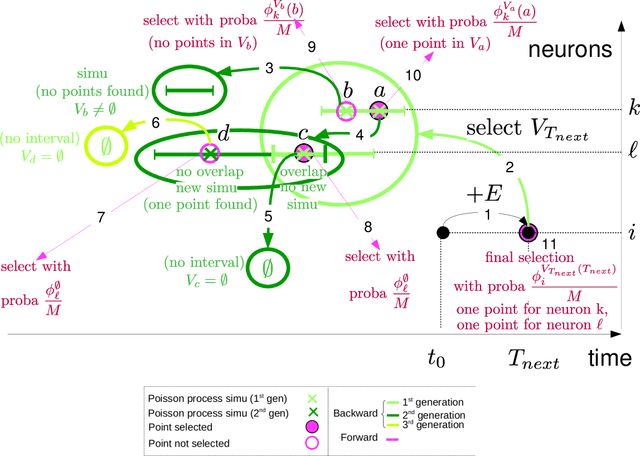
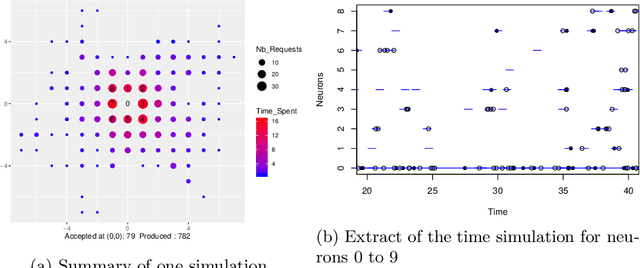
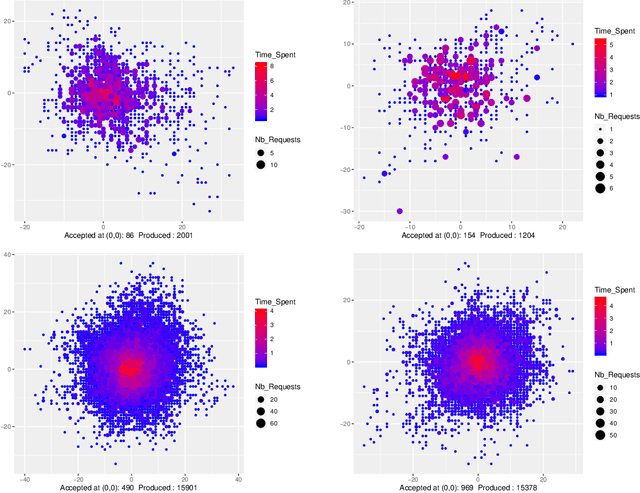
Event-scheduling algorithms can compute in continuous time the next occurrence of points (as events) of a counting process based on their current conditional intensity. In particular event-scheduling algorithms can be adapted to perform the simulation of finite neuronal networks activity. These algorithms are based on Ogata's thinning strategy \cite{Oga81}, which always needs to simulate the whole network to access the behaviour of one particular neuron of the network. On the other hand, for discrete time models, theoretical algorithms based on Kalikow decomposition can pick at random influencing neurons and perform a perfect simulation (meaning without approximations) of the behaviour of one given neuron embedded in an infinite network, at every time step. These algorithms are currently not computationally tractable in continuous time. To solve this problem, an event-scheduling algorithm with Kalikow decomposition is proposed here for the sequential simulation of point processes neuronal models satisfying this decomposition. This new algorithm is applied to infinite neuronal networks whose finite time simulation is a prerequisite to realistic brain modeling.