 Add to Chrome
 Add to Firefox
 Add to Edge
XmoPipe: A Pipeline for Large-Scale In-the-Wild Human Motion Dataset Construction
Jun 17, 2026
Large-scale human motion datasets are essential for training robust motion models for analysis, synthesis, and understanding. While marker-based motion capture provides precise data, it is costly and limited in scale and diversity. Recent advances in monocular motion capture and video-language understanding open the way to extract plausible motion from unconstrained online videos. We present a scalable pipeline for constructing in-the-wild human motion datasets. From a few keywords, the system retrieves videos, extracts 3D body and facial motion, and generates high-level textual descriptions. The pipeline is flexible, enabling targeted collection of various motions, multi-person interactions, or expressive behaviors. We demonstrate its quality by training motion reconstruction and motion generation models, showing performance comparable to models trained on traditional motion capture datasets and strong cross-dataset generalization.

Breast Cancer Diagnosis: A Comprehensive Exploration of Explainable Artificial Intelligence (XAI) Techniques
Jun 01, 2024


Breast cancer (BC) stands as one of the most common malignancies affecting women worldwide, necessitating advancements in diagnostic methodologies for better clinical outcomes. This article provides a comprehensive exploration of the application of Explainable Artificial Intelligence (XAI) techniques in the detection and diagnosis of breast cancer. As Artificial Intelligence (AI) technologies continue to permeate the healthcare sector, particularly in oncology, the need for transparent and interpretable models becomes imperative to enhance clinical decision-making and patient care. This review discusses the integration of various XAI approaches, such as SHAP, LIME, Grad-CAM, and others, with machine learning and deep learning models utilized in breast cancer detection and classification. By investigating the modalities of breast cancer datasets, including mammograms, ultrasounds and their processing with AI, the paper highlights how XAI can lead to more accurate diagnoses and personalized treatment plans. It also examines the challenges in implementing these techniques and the importance of developing standardized metrics for evaluating XAI's effectiveness in clinical settings. Through detailed analysis and discussion, this article aims to highlight the potential of XAI in bridging the gap between complex AI models and practical healthcare applications, thereby fostering trust and understanding among medical professionals and improving patient outcomes.
Learning-based pose edition for efficient and interactive design
Jul 01, 2021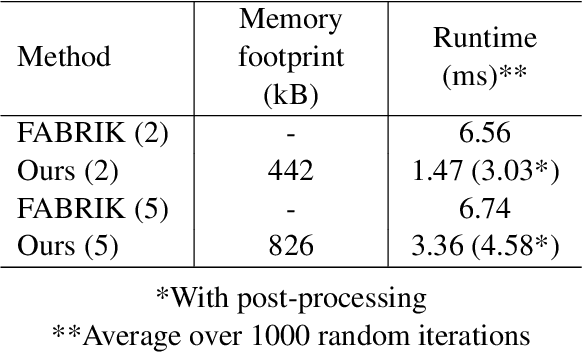
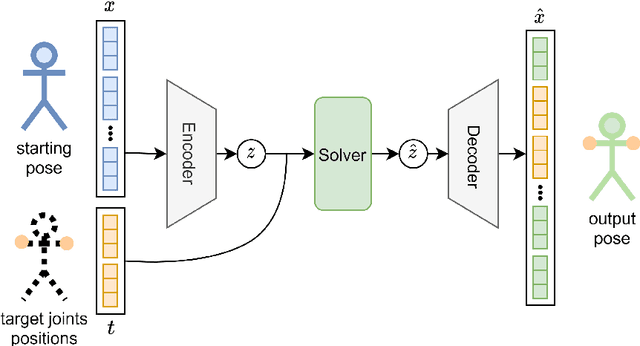
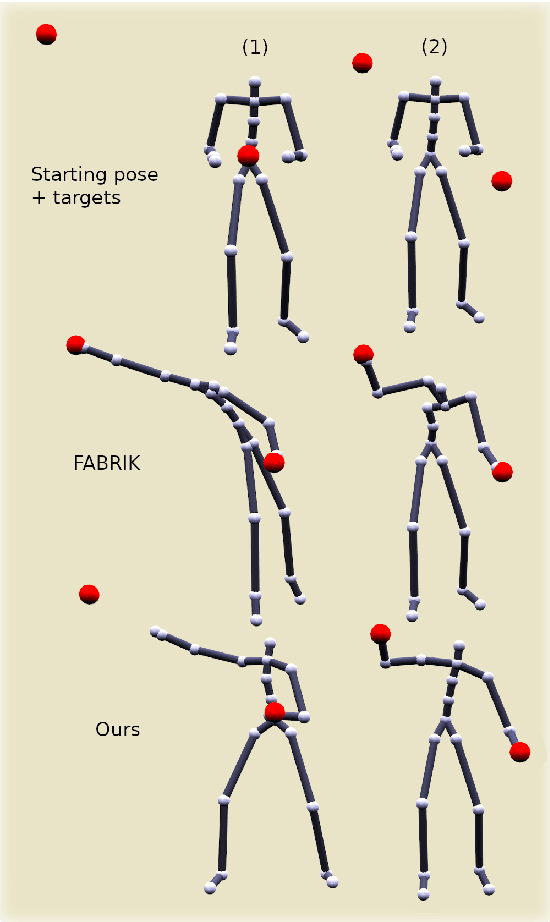
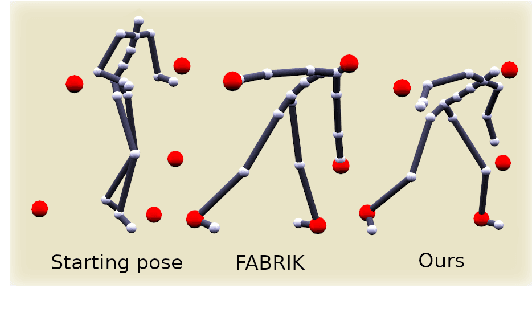
Authoring an appealing animation for a virtual character is a challenging task. In computer-aided keyframe animation artists define the key poses of a character by manipulating its underlying skeletons. To look plausible, a character pose must respect many ill-defined constraints, and so the resulting realism greatly depends on the animator's skill and knowledge. Animation software provide tools to help in this matter, relying on various algorithms to automatically enforce some of these constraints. The increasing availability of motion capture data has raised interest in data-driven approaches to pose design, with the potential of shifting more of the task of assessing realism from the artist to the computer, and to provide easier access to nonexperts. In this article, we propose such a method, relying on neural networks to automatically learn the constraints from the data. We describe an efficient tool for pose design, allowing na{\"i}ve users to intuitively manipulate a pose to create character animations.
A novel database of Children's Spontaneous Facial Expressions
Jan 20, 2019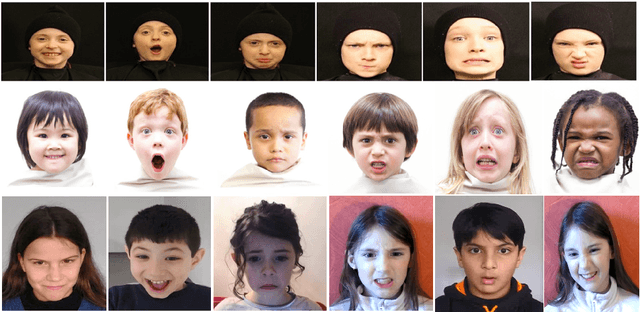


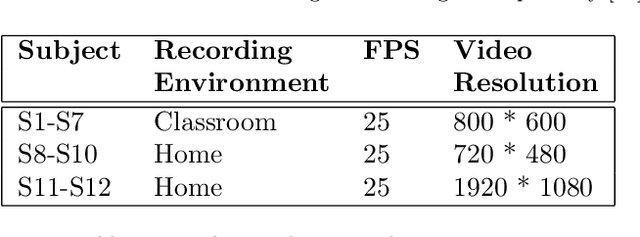
Computing environment is moving towards human-centered designs instead of computer centered designs and human's tend to communicate wealth of information through affective states or expressions. Traditional Human Computer Interaction (HCI) based systems ignores bulk of information communicated through those affective states and just caters for user's intentional input. Generally, for evaluating and benchmarking different facial expression analysis algorithms, standardized databases are needed to enable a meaningful comparison. In the absence of comparative tests on such standardized databases it is difficult to find relative strengths and weaknesses of different facial expression recognition algorithms. In this article we present a novel video database for Children's Spontaneous facial Expressions (LIRIS-CSE). Proposed video database contains six basic spontaneous facial expressions shown by 12 ethnically diverse children between the ages of 6 and 12 years with mean age of 7.3 years. To the best of our knowledge, this database is first of its kind as it records and shows spontaneous facial expressions of children. Previously there were few database of children expressions and all of them show posed or exaggerated expressions which are different from spontaneous or natural expressions. Thus, this database will be a milestone for human behavior researchers. This database will be a excellent resource for vision community for benchmarking and comparing results. In this article, we have also proposed framework for automatic expression recognition based on convolutional neural network (CNN) architecture with transfer learning approach. Proposed architecture achieved average classification accuracy of 75% on our proposed database i.e. LIRIS-CSE.