 Add to Chrome
 Add to Firefox
 Add to Edge
CT-Enabled Patient-Specific Simulation and Contact-Aware Robotic Planning for Cochlear Implantation
Mar 05, 2026
Robotic cochlear-implant (CI) insertion requires precise prediction and regulation of contact forces to minimize intracochlear trauma and prevent failure modes such as locking and buckling. Aligned with the integration of advanced medical imaging and robotics for autonomous, precision interventions, this paper presents a unified CT-to-simulation pipeline for contact-aware insertion planning and validation. We develop a low-dimensional, differentiable Cosserat-rod model of the electrode array coupled with frictional contact and pseudo-dynamics regularization to ensure continuous stick-slip transitions. Patient-specific cochlear anatomy is reconstructed from CT imaging and encoded via an analytic parametrization of the scala-tympani lumen, enabling efficient and differentiable contact queries through closest-point projection. Based on a differentiated equilibrium-constraint formulation, we derive an online direction-update law under an RCM-like constraint that suppresses lateral insertion forces while maintaining axial advancement. Simulations and benchtop experiments validate deformation and force trends, demonstrating reduced locking/buckling risk and improved insertion depth. The study highlights how CT-based imaging enhances modeling, planning, and safety capabilities in robot-assisted inner-ear procedures.

Modeling, Embedded Control and Design of Soft Robots using a Learned Condensed FEM Model
Mar 19, 2025
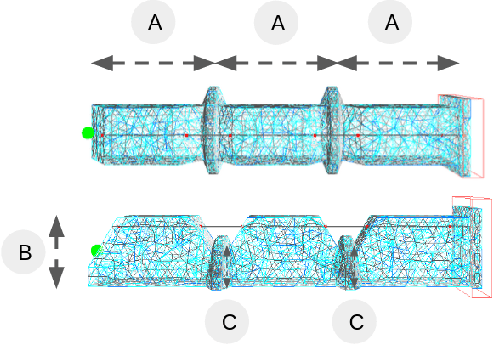

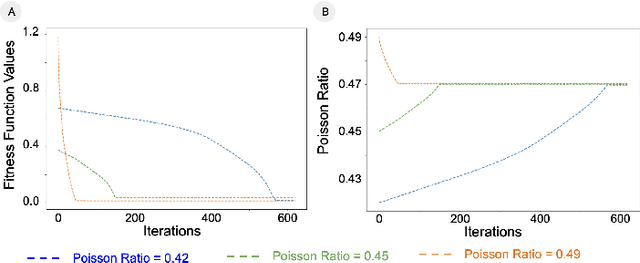
The Finite Element Method (FEM) is a powerful modeling tool for predicting soft robots' behavior, but its computation time can limit practical applications. In this paper, a learning-based approach based on condensation of the FEM model is detailed. The proposed method handles several kinds of actuators and contacts with the environment. We demonstrate that this compact model can be learned as a unified model across several designs and remains very efficient in terms of modeling since we can deduce the direct and inverse kinematics of the robot. Building upon the intuition introduced in [11], the learned model is presented as a general framework for modeling, controlling, and designing soft manipulators. First, the method's adaptability and versatility are illustrated through optimization based control problems involving positioning and manipulation tasks with mechanical contact-based coupling. Secondly, the low memory consumption and the high prediction speed of the learned condensed model are leveraged for real-time embedding control without relying on costly online FEM simulation. Finally, the ability of the learned condensed FEM model to capture soft robot design variations and its differentiability are leveraged in calibration and design optimization applications.
Cosserat-Rod Based Dynamic Modeling of Soft Slender Robot Interacting with Environment
Jul 12, 2023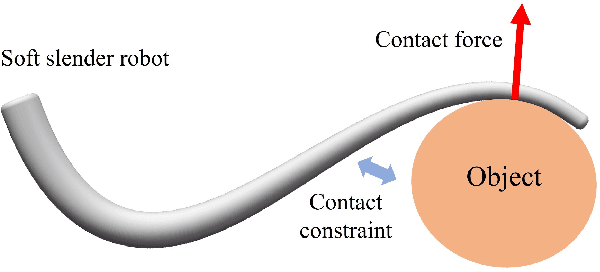


Soft slender robots have attracted more and more research attentions in these years due to their continuity and compliance natures. However, mechanics modeling for soft robots interacting with environment is still an academic challenge because of the non-linearity of deformation and the non-smooth property of the contacts. In this work, starting from a piece-wise local strain field assumption, we propose a nonlinear dynamic model for soft robot via Cosserat rod theory using Newtonian mechanics which handles the frictional contact with environment and transfer them into the nonlinear complementary constraint (NCP) formulation. Moreover, we smooth both the contact and friction constraints in order to convert the inequality equations of NCP to the smooth equality equations. The proposed model allows us to compute the dynamic deformation and frictional contact force under common optimization framework in real time when the soft slender robot interacts with other rigid or soft bodies. In the end, the corresponding experiments are carried out which valid our proposed dynamic model.