 Add to Chrome
 Add to Firefox
 Add to Edge
Towards Fast GNN Surrogates for CO2 Migration in Complex Geological Formations
Jun 15, 2026
This chapter discusses how a data-driven machine learning approach can reproduce key aspects of the physical behavior of multiphase flows in complex geological formations. We propose an end-to-end graph neural surrogate tailored to CO$_2$ plume migration forecasting in geological storage. The method is evaluated on the SPE11A benchmark, a well-known industry test case designed to assess CO$_2$ storage scenarios and characterized by sharp gas-water interfaces, strong advective transport, and rapid convective mixing with fingering development. The benchmark is reformulated as a graph in which nodes represent computational cells and edges encode transmissibility-based interactions enriched with geometric attributes. Directional transport arising from grid geometry, permeability contrasts, and geological heterogeneity is captured through an anisotropic message-passing mechanism, where interaction weights are computed via geometry-conditioned edge embeddings, biasing message aggregation toward physically relevant transport directions. Temporal evolution is modeled in latent space using an autoregressive residual formulation trained with multi-step supervision. The proposed model produces competitive forecasts of gas saturation and liquid-phase density, which are key indicators for CO$_2$ storage monitoring, with cumulative errors that remain moderate over extended forecasting horizons.

Deep learning for lithological classification of carbonate rock micro-CT images
Jul 30, 2020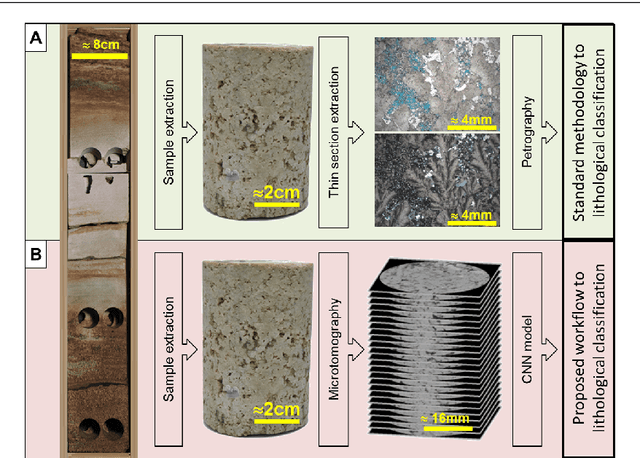
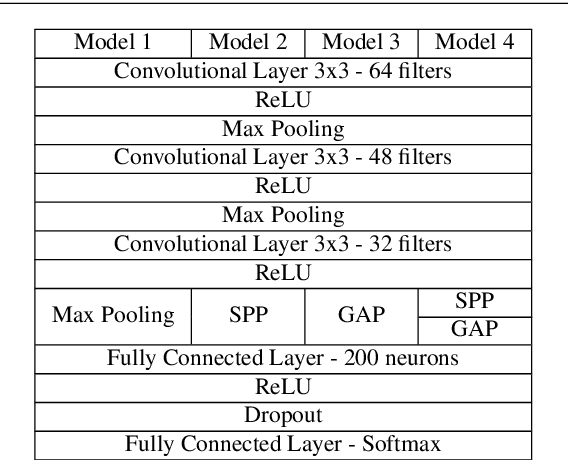
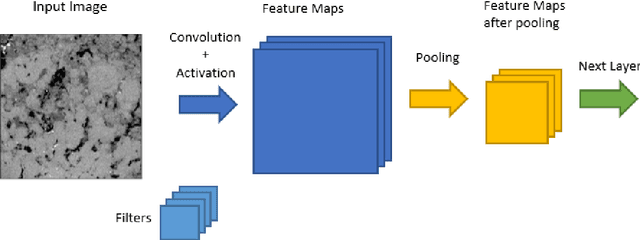
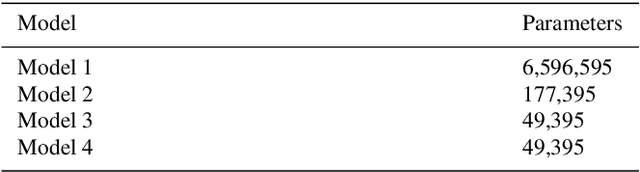
In addition to the ongoing development, pre-salt carbonate reservoir characterization remains a challenge, primarily due to inherent geological particularities. These challenges stimulate the use of well-established technologies, such as artificial intelligence algorithms, for image classification tasks. Therefore, this work intends to present an application of deep learning techniques to identify patterns in Brazilian pre-salt carbonate rock microtomographic images, thus making possible lithological classification. Four convolutional neural network models were proposed. The first model includes three convolutional layers followed by fully connected layers and is used as a base model for the following proposals. In the next two models, we replace the max pooling layer with a spatial pyramid pooling and a global average pooling layer. The last model uses a combination of spatial pyramid pooling followed by global average pooling in place of the last pooling layer. All models are compared using original images, when possible, as well as resized images. The dataset consists of 6,000 images from three different classes. The model performances were evaluated by each image individually, as well as by the most frequently predicted class for each sample. According to accuracy, Model 2 trained on resized images achieved the best results, reaching an average of 75.54% for the first evaluation approach and an average of 81.33% for the second. We developed a workflow to automate and accelerate the lithology classification of Brazilian pre-salt carbonate samples by categorizing microtomographic images using deep learning algorithms in a non-destructive way.