 Add to Chrome
 Add to Firefox
 Add to Edge
Science Consultant Agent
Dec 18, 2025
The Science Consultant Agent is a web-based Artificial Intelligence (AI) tool that helps practitioners select and implement the most effective modeling strategy for AI-based solutions. It operates through four core components: Questionnaire, Smart Fill, Research-Guided Recommendation, and Prototype Builder. By combining structured questionnaires, literature-backed solution recommendations, and prototype generation, the Science Consultant Agent accelerates development for everyone from Product Managers and Software Developers to Researchers. The full pipeline is illustrated in Figure 1.

Stacking machine learning classifiers to identify Higgs bosons at the LHC
May 30, 2017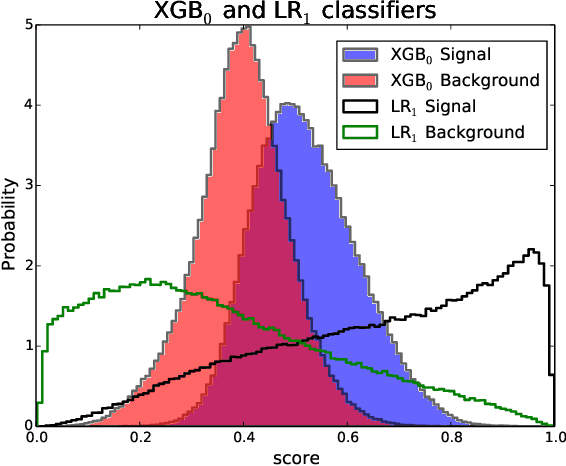
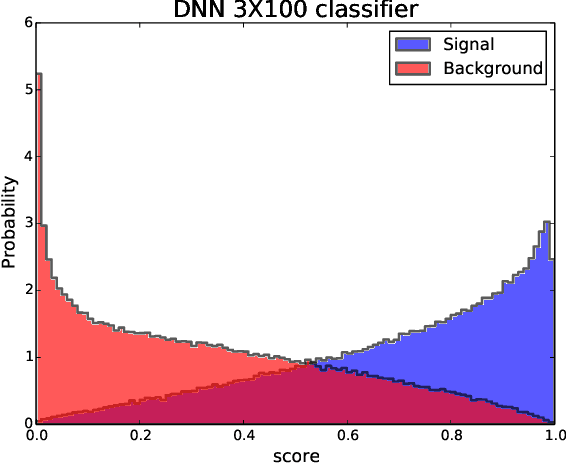
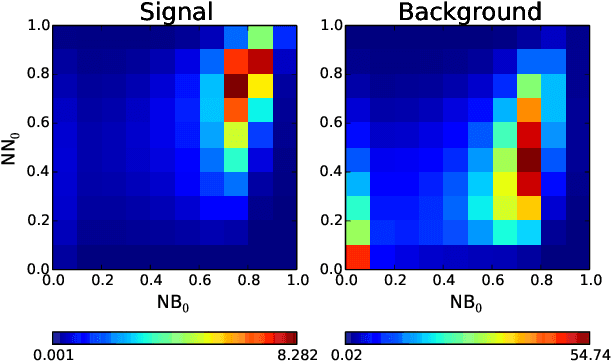

Machine learning (ML) algorithms have been employed in the problem of classifying signal and background events with high accuracy in particle physics. In this paper, we compare the performance of a widespread ML technique, namely, \emph{stacked generalization}, against the results of two state-of-art algorithms: (1) a deep neural network (DNN) in the task of discovering a new neutral Higgs boson and (2) a scalable machine learning system for tree boosting, in the Standard Model Higgs to tau leptons channel, both at the 8 TeV LHC. In a cut-and-count analysis, \emph{stacking} three algorithms performed around 16\% worse than DNN but demanding far less computation efforts, however, the same \emph{stacking} outperforms boosted decision trees. Using the stacked classifiers in a multivariate statistical analysis (MVA), on the other hand, significantly enhances the statistical significance compared to cut-and-count in both Higgs processes, suggesting that combining an ensemble of simpler and faster ML algorithms with MVA tools is a better approach than building a complex state-of-art algorithm for cut-and-count.