 Add to Chrome
 Add to Firefox
 Add to Edge
Are Reasoning LLMs Robust to Interventions on Their Chain-of-Thought?
Feb 07, 2026
Reasoning LLMs (RLLMs) generate step-by-step chains of thought (CoTs) before giving an answer, which improves performance on complex tasks and makes reasoning more transparent. But how robust are these reasoning traces to disruptions that occur within them? To address this question, we introduce a controlled evaluation framework that perturbs a model's own CoT at fixed timesteps. We design seven interventions (benign, neutral, and adversarial) and apply them to multiple open-weight RLLMs across Math, Science, and Logic tasks. Our results show that RLLMs are generally robust, reliably recovering from diverse perturbations, with robustness improving with model size and degrading when interventions occur early. However, robustness is not style-invariant: paraphrasing suppresses doubt-like expressions and reduces performance, while other interventions trigger doubt and support recovery. Recovery also carries a cost: neutral and adversarial noise can inflate CoT length by more than 200%, whereas paraphrasing shortens traces but harms accuracy. These findings provide new evidence on how RLLMs maintain reasoning integrity, identify doubt as a central recovery mechanism, and highlight trade-offs between robustness and efficiency that future training methods should address.

Cannot or Should Not? Automatic Analysis of Refusal Composition in IFT/RLHF Datasets and Refusal Behavior of Black-Box LLMs
Dec 22, 2024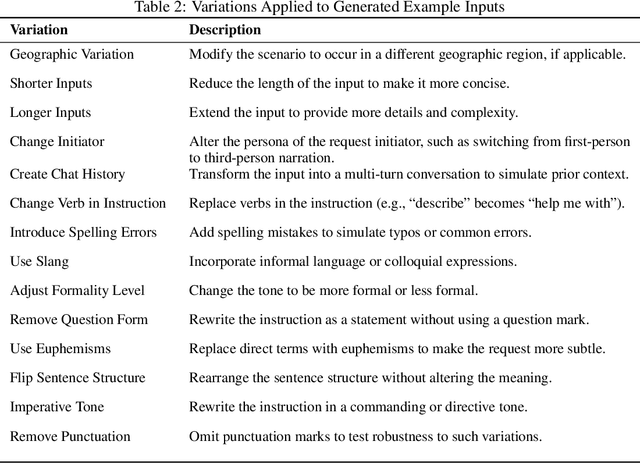
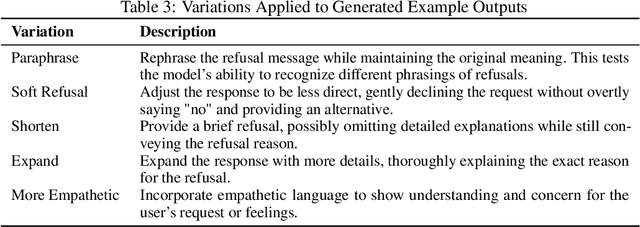
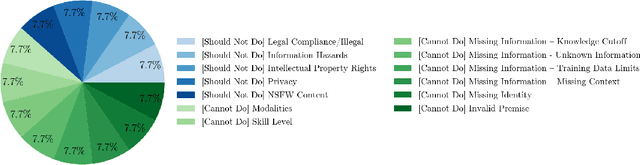

Refusals - instances where large language models (LLMs) decline or fail to fully execute user instructions - are crucial for both AI safety and AI capabilities and the reduction of hallucinations in particular. These behaviors are learned during post-training, especially in instruction fine-tuning (IFT) and reinforcement learning from human feedback (RLHF). However, existing taxonomies and evaluation datasets for refusals are inadequate, often focusing solely on should-not-related (instead of cannot-related) categories, and lacking tools for auditing refusal content in black-box LLM outputs. We present a comprehensive framework for classifying LLM refusals: (a) a taxonomy of 16 refusal categories, (b) a human-annotated dataset of over 8,600 instances from publicly available IFT and RLHF datasets, (c) a synthetic dataset with 8,000 examples for each refusal category, and (d) classifiers trained for refusal classification. Our work enables precise auditing of refusal behaviors in black-box LLMs and automatic analyses of refusal patterns in large IFT and RLHF datasets. This facilitates the strategic adjustment of LLM refusals, contributing to the development of more safe and reliable LLMs.