 Add to Chrome
 Add to Firefox
 Add to Edge
Towards Diverse and Comprehensive Benchmarks for Mutual Information Estimation
Jul 03, 2026
Mutual information (MI) estimation is a central problem in machine learning and statistics; however, existing benchmarks typically evaluate estimators on simplified, low-dimensional distributions, leaving their performance on complex, realistic data largely unexplored. We address this gap with a comprehensive benchmarking framework grounded in a unified copula-theoretic perspective that subsumes existing benchmarks as special cases. Within this framework, we propose two complementary families of tests: a copula-first family that systematically varies ground-truth MI, dimensionality, and marginal complexity using synthetic and flow-based transformations; and a marginals-first family that couples real-world image data with controlled dependency structures, extending the classic same-class-pairing paradigm. We use this suite to extensively evaluate three classes of estimators: non-parametric, discriminative, and generative. Contrary to prevailing assumptions, our results indicate that there is no universal winner: each category can systematically outperform all other estimators under specific setups. By analyzing these cases, we identify fundamental estimation barriers and propose new tests that more effectively stress these specific limitations. We share the open source code at https://github.com/VanessB/mutinfo.

On lower bounds of the density of planar periodic sets without unit distances
Nov 20, 2024Determining the maximal density $m_1(\mathbb{R}^2)$ of planar sets without unit distances is a fundamental problem in combinatorial geometry. This paper investigates lower bounds for this quantity. We introduce a novel approach to estimating $m_1(\mathbb{R}^2)$ by reformulating the problem as a Maximal Independent Set (MIS) problem on graphs constructed from flat torus, focusing on periodic sets with respect to two non-collinear vectors. Our experimental results supported by theoretical justifications of proposed method demonstrate that for a sufficiently wide range of parameters this approach does not improve the known lower bound $0.22936 \le m_1(\mathbb{R}^2)$. The best discrete sets found are approximations of Croft's construction. In addition, several open source software packages for MIS problem are compared on this task.
Efficient Distribution Matching of Representations via Noise-Injected Deep InfoMax
Oct 09, 2024

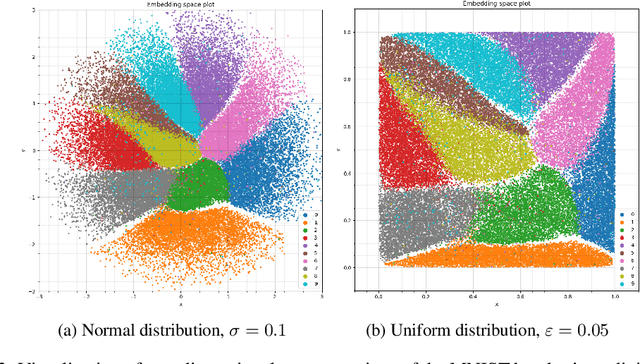

Deep InfoMax (DIM) is a well-established method for self-supervised representation learning (SSRL) based on maximization of the mutual information between the input and the output of a deep neural network encoder. Despite the DIM and contrastive SSRL in general being well-explored, the task of learning representations conforming to a specific distribution (i.e., distribution matching, DM) is still under-addressed. Motivated by the importance of DM to several downstream tasks (including generative modeling, disentanglement, outliers detection and other), we enhance DIM to enable automatic matching of learned representations to a selected prior distribution. To achieve this, we propose injecting an independent noise into the normalized outputs of the encoder, while keeping the same InfoMax training objective. We show that such modification allows for learning uniformly and normally distributed representations, as well as representations of other absolutely continuous distributions. Our approach is tested on various downstream tasks. The results indicate a moderate trade-off between the performance on the downstream tasks and quality of DM.
Mutual Information Estimation via Normalizing Flows
Mar 05, 2024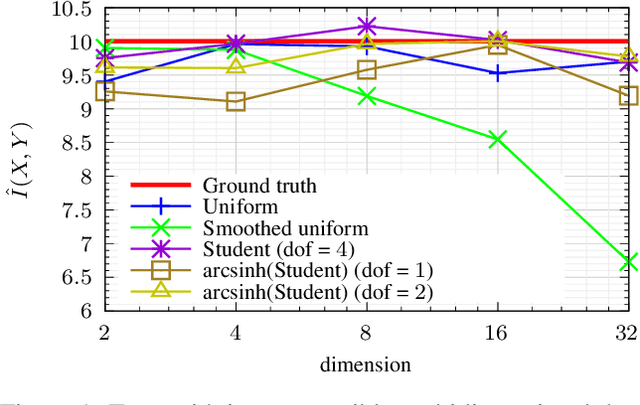

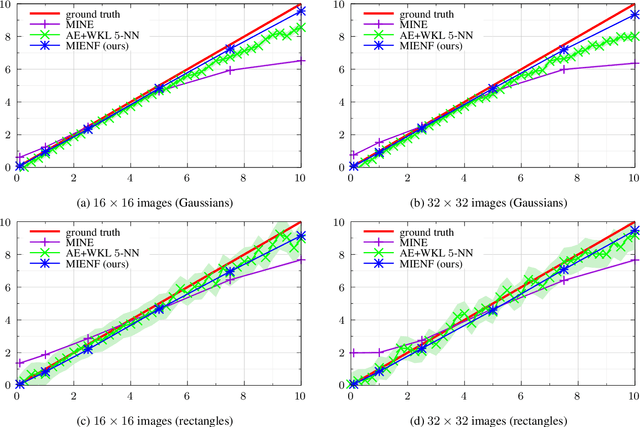
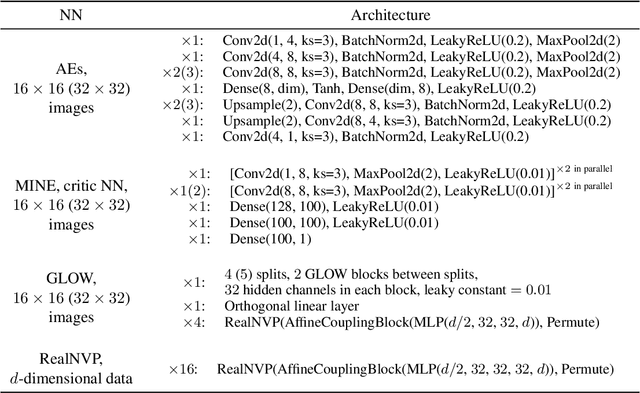
We propose a novel approach to the problem of mutual information (MI) estimation via introducing normalizing flows-based estimator. The estimator maps original data to the target distribution with known closed-form expression for MI. We demonstrate that our approach yields MI estimates for the original data. Experiments with high-dimensional data are provided to show the advantages of the proposed estimator.