 Add to Chrome
 Add to Firefox
 Add to Edge
Woodelf++: A Fast and Unified Partial Dependence Plot Algorithm for Decision Tree Ensembles
May 14, 2026
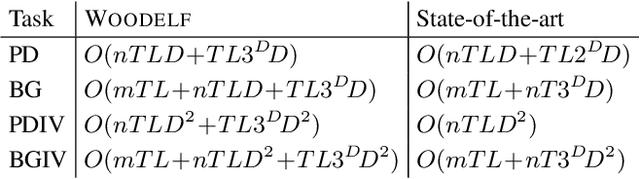
Partial Dependence Plots (PDPs) visualize how changes in a single feature affect the average model prediction. They are widely used in practice to interpret decision tree ensembles and other machine learning models. Joint-PDPs extend this idea to pairs of features, revealing their combined effect. Partial Dependence Interaction Values (PDIVs) measure feature interactions. The Any-Order-PDIVs task computes these interactions for every feature subset across all rows of the dataset. We introduce Woodelf++, a unified and efficient approach for computing all these useful explainability tools on decision tree ensembles, building on Woodelf, an algorithm for efficient SHAP computation. By deriving suitable metrics over pseudo-Boolean functions, Woodelf++ can compute PDPs (exact and approximate), Joint-PDPs, and Any-Order-PDIVs in a unified framework. Our method delivers substantial complexity improvements over the state of the art, including an exponential gain for Any-Order-PDIVs. Additionally, we introduce and efficiently compute Full PDPs, which leverage the model's split thresholds to faithfully capture its behavior across all possible feature values. Woodelf++ is implemented in pure Python and supports GPU acceleration. On a dataset with 400,000 rows, Woodelf++ computes PDP and Joint-PDP up to 6x faster than the state of the art and up to five orders of magnitude faster than scikit-learn. For Any-Order-PDIVs, the gap is even larger: Woodelf++ computes all interaction values in 5 minutes, while the state of the art is estimated to require over 1,000,000 years.

WOODELF-HD: Efficient Background SHAP for High-Depth Decision Trees
Apr 12, 2026Decision-tree ensembles are a cornerstone of predictive modeling, and SHAP is a standard framework for interpreting their predictions. Among its variants, Background SHAP offers high accuracy by modeling missing features using a background dataset. Historically, this approach did not scale well, as the time complexity for explaining n instances using m background samples included an O(mn) component. Recent methods such as Woodelf and PLTreeSHAP reduce this to O(m+n), but introduce a preprocessing bottleneck that grows as 3^D with tree depth D, making them impractical for deep trees. We address this limitation with WoodelfHD, a Woodelf extension that reduces the 3^D factor to 2^D. The key idea is a Strassen-like multiplication scheme that exploits the structure of Woodelf matrices, reducing matrix-vector multiplication from O(k^2) to O(k*log(k)) via a fully vectorized, non-recursive implementation. In addition, we merge path nodes with identical features, reducing cache size and memory usage. When running on standard environments, WoodelfHD enables exact Background SHAP computation for trees with depths up to 21, where previous methods fail due to excessive memory usage. For ensembles of depths 12 and 15, it achieves speedups of 33x and 162x, respectively, over the state-of-the-art.
From Decision Trees to Boolean Logic: A Fast and Unified SHAP Algorithm
Nov 12, 2025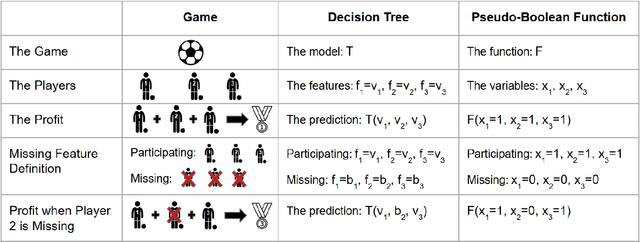
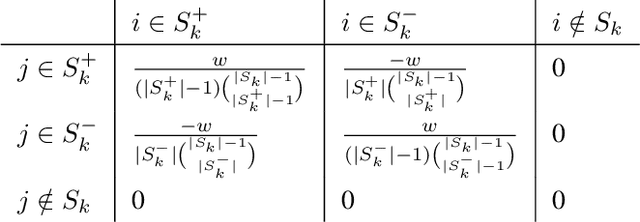
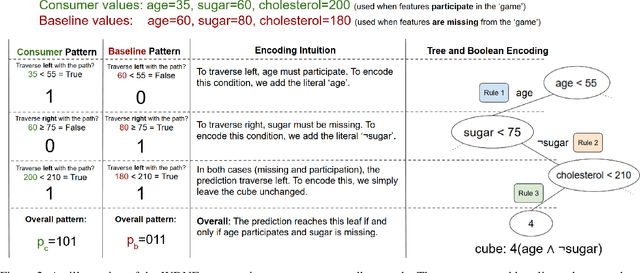
SHapley Additive exPlanations (SHAP) is a key tool for interpreting decision tree ensembles by assigning contribution values to features. It is widely used in finance, advertising, medicine, and other domains. Two main approaches to SHAP calculation exist: Path-Dependent SHAP, which leverages the tree structure for efficiency, and Background SHAP, which uses a background dataset to estimate feature distributions. We introduce WOODELF, a SHAP algorithm that integrates decision trees, game theory, and Boolean logic into a unified framework. For each consumer, WOODELF constructs a pseudo-Boolean formula that captures their feature values, the structure of the decision tree ensemble, and the entire background dataset. It then leverages this representation to compute Background SHAP in linear time. WOODELF can also compute Path-Dependent SHAP, Shapley interaction values, Banzhaf values, and Banzhaf interaction values. WOODELF is designed to run efficiently on CPU and GPU hardware alike. Available via the WOODELF Python package, it is implemented using NumPy, SciPy, and CuPy without relying on custom C++ or CUDA code. This design enables fast performance and seamless integration into existing frameworks, supporting large-scale computation of SHAP and other game-theoretic values in practice. For example, on a dataset with 3,000,000 rows, 5,000,000 background samples, and 127 features, WOODELF computed all Background Shapley values in 162 seconds on CPU and 16 seconds on GPU - compared to 44 minutes required by the best method on any hardware platform, representing 16x and 165x speedups, respectively.