 Add to Chrome
 Add to Firefox
 Add to Edge
The Density of Cross-Persistence Diagrams and Its Applications
Mar 12, 2026
Topological Data Analysis (TDA) provides powerful tools to explore the shape and structure of data through topological features such as clusters, loops, and voids. Persistence diagrams are a cornerstone of TDA, capturing the evolution of these features across scales. While effective for analyzing individual manifolds, persistence diagrams do not account for interactions between pairs of them. Cross-persistence diagrams (cross-barcodes), introduced recently, address this limitation by characterizing relationships between topological features of two point clouds. In this work, we present the first systematic study of the density of cross-persistence diagrams. We prove its existence, establish theoretical foundations for its statistical use, and design the first machine learning framework for predicting cross-persistence density directly from point cloud coordinates and distance matrices. Our statistical approach enables the distinction of point clouds sampled from different manifolds by leveraging the linear characteristics of cross-persistence diagrams. Interestingly, we find that introducing noise can enhance our ability to distinguish point clouds, uncovering its novel utility in TDA applications. We demonstrate the effectiveness of our methods through experiments on diverse datasets, where our approach consistently outperforms existing techniques in density prediction and achieves superior results in point cloud distinction tasks. Our findings contribute to a broader understanding of cross-persistence diagrams and open new avenues for their application in data analysis, including potential insights into time-series domain tasks and the geometry of AI-generated texts. Our code is publicly available at https://github.com/Verdangeta/TDA_experiments
* 19 pages, 20 figures

Edge-wise Topological Divergence Gaps: Guiding Search in Combinatorial Optimization
Dec 16, 2025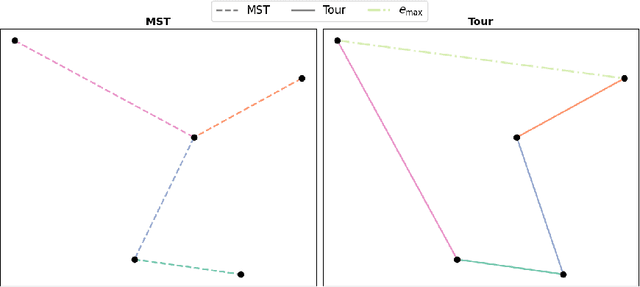
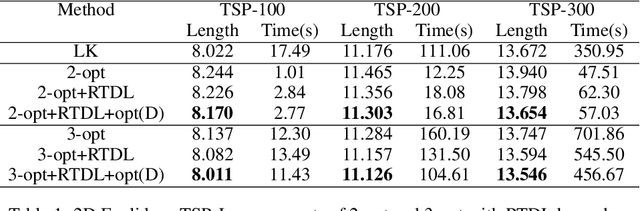
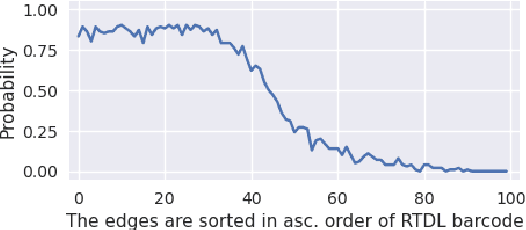
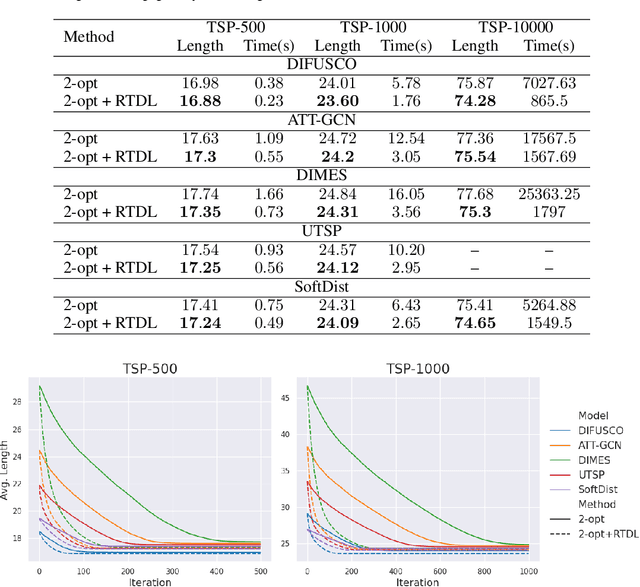
We introduce a topological feedback mechanism for the Travelling Salesman Problem (TSP) by analyzing the divergence between a tour and the minimum spanning tree (MST). Our key contribution is a canonical decomposition theorem that expresses the tour-MST gap as edge-wise topology-divergence gaps from the RTD-Lite barcode. Based on this, we develop a topological guidance for 2-opt and 3-opt heuristics that increases their performance. We carry out experiments with fine-optimization of tours obtained from heatmap-based methods, TSPLIB, and random instances. Experiments demonstrate the topology-guided optimization results in better performance and faster convergence in many cases.