 Add to Chrome
 Add to Firefox
 Add to Edge
CA-Based Interpretable Knowledge Representation and Analysis of Geometric Design Parameters
Mar 18, 2026
In many CAD-based applications, complex geometries are defined by a high number of design parameters. This leads to high-dimensional design spaces that are challenging for downstream engineering processes like simulations, optimization, and design exploration tasks. Therefore, dimension reduction methods such as principal component analysis (PCA) are used. The PCA identifies dominant modes of geometric variation and yields a compact representation of the geometry. While classical PCA excels in the compact representation part, it does not directly recover underlying design parameters of a generated geometry. In this work, we deal with the problem of estimating design parameters from PCA-based representations. Analyzing a recent modification of the PCA dedicated to our field of application, we show that the results are actually identical to the standard PCA. We investigate limitations of this approach and present reasonable conditions under which accurate, interpretable parameter estimation can be obtained. With the help of dedicated experiments, we take a more in-depth look at every stage of the PCA and the possible changes of the geometry during these processes.

Recognition of Geometrical Shapes by Dictionary Learning
Apr 15, 2025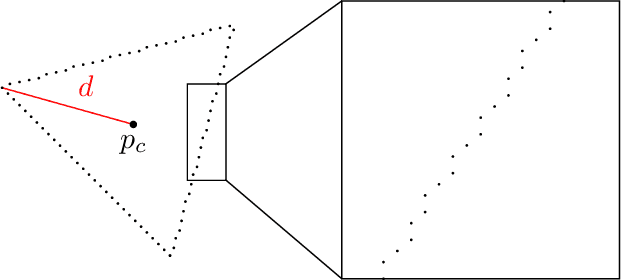
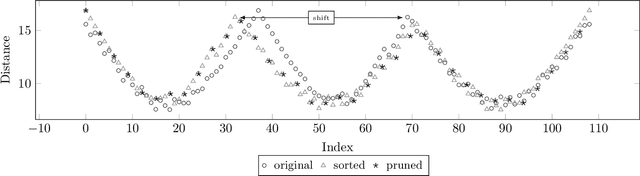
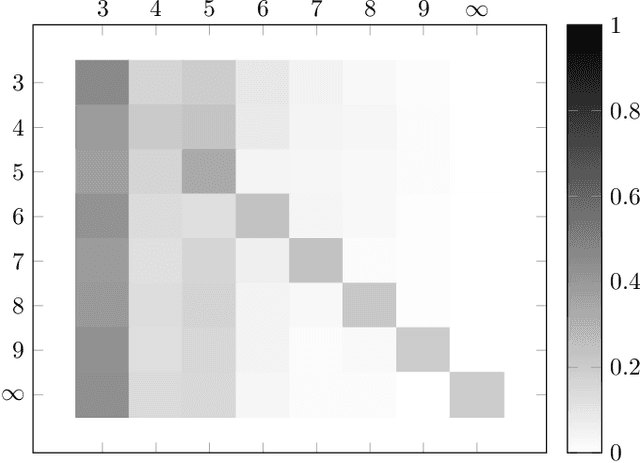
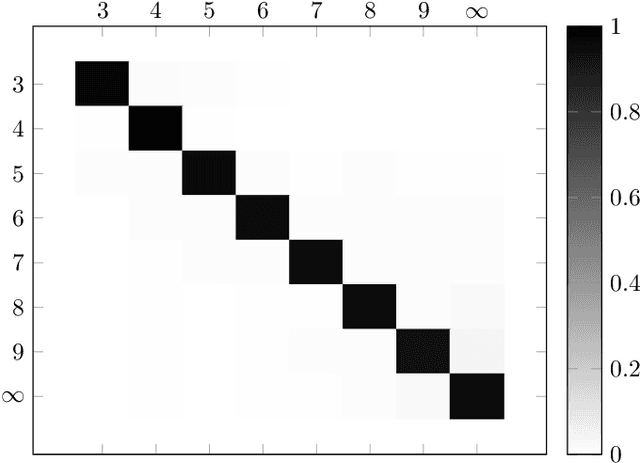
Dictionary learning is a versatile method to produce an overcomplete set of vectors, called atoms, to represent a given input with only a few atoms. In the literature, it has been used primarily for tasks that explore its powerful representation capabilities, such as for image reconstruction. In this work, we present a first approach to make dictionary learning work for shape recognition, considering specifically geometrical shapes. As we demonstrate, the choice of the underlying optimization method has a significant impact on recognition quality. Experimental results confirm that dictionary learning may be an interesting method for shape recognition tasks.
Towards Efficient Time Stepping for Numerical Shape Correspondence
Dec 21, 2023The computation of correspondences between shapes is a principal task in shape analysis. To this end, methods based on partial differential equations (PDEs) have been established, encompassing e.g. the classic heat kernel signature as well as numerical solution schemes for geometric PDEs. In this work we focus on the latter approach. We consider here several time stepping schemes. The goal of this investigation is to assess, if one may identify a useful property of methods for time integration for the shape analysis context. Thereby we investigate the dependence on time step size, since the class of implicit schemes that are useful candidates in this context should ideally yield an invariant behaviour with respect to this parameter. To this end we study integration of heat and wave equation on a manifold. In order to facilitate this study, we propose an efficient, unified model order reduction framework for these models. We show that specific $l_0$ stable schemes are favourable for numerical shape analysis. We give an experimental evaluation of the methods at hand of classical TOSCA data sets.
* 12 pages, 4 figures