 Add to Chrome
 Add to Firefox
 Add to Edge
AlphaQ: Calibration-Free Bit Allocation for Mixture-of-Experts Quantization
Jun 03, 2026
Mixture-of-Experts (MoE) architectures scale model capacity through sparse expert activation, but their deployment remains memory-bound because all expert weights must reside in memory. Mixed-precision quantization can substantially reduce this footprint by assigning different bit-widths to different experts. Existing approaches, however, typically rely on calibration data to estimate expert importance and determine bit allocation. For frontier MoE LLMs, the original training data, and hence the true training distribution, is proprietary and inaccessible. As a result, calibration sets are inevitably imperfect surrogates, and this can misestimate expert utilization and lead to suboptimal bit allocation. Motivated by the substantial cross-expert quality variability observed in modern MoE models, and by the success of Heavy-Tailed Self-Regularization (HT-SR) theory at predicting neural network model quality without access to training or testing data, we propose AlphaQ, a calibration-free bit-allocation method for MoE quantization. AlphaQ draws on HT-SR theory and follows a simple principle: experts with more heavy-tailed weight spectra are typically better trained and hence should receive higher bit-widths, while experts with weaker heavy-tailed structure can be quantized more aggressively. AlphaQ operationalizes this principle by measuring expert-wise spectral heavy-tailedness and solving a budget-constrained optimization problem that minimizes total quantization error under a global bit-budget constraint. Across several MoE models, AlphaQ consistently outperforms calibration-based baselines under matched bit budgets. Notably, on Qwen1.5-MoE, AlphaQ achieves near full-precision accuracy with an average expert precision of only 3.5 bits, while delivering more than 4$\times$ memory compression. Our code is available at https://github.com/Superone77/AlphaQ.

Layer Collapse in Diffusion Language Models
May 07, 2026Diffusion language models (DLMs) have recently emerged as competitive alternatives to autoregressive (AR) language models, yet differences in their activation dynamics remain poorly understood. We characterize these dynamics in LLaDA-8B and identify a striking layer-collapse property: a few early layers exhibit highly similar, collapsed activation patterns dominated by a single large super-outlier persisting over a long token range. Despite its apparent redundancy, this outlier is critical: pruning it causes outputs to degrade into repetitive random token loops. Paradoxically, layers in LLaDA contain more redundant representations overall, with redundancy most pronounced in earlier layers -- the reverse of AR models, where deeper layers grow redundant due to undertraining. Our analysis indicates that layer collapse in DLMs is not driven by undertraining but by overtraining: a dominant outlier becomes an indispensable information carrier while remaining representations collapse into redundant structure. These findings have strong practical implications, verified through controlled pre-training experiments. DLMs are surprisingly robust to compression: LLaDA under 3-bit GPTQ quantization drops only -1.8% on GSM8K, whereas Llama-3.1-8B drops -64.7%. Optimal sparsity allocation also reverses between families: at 50% average sparsity, allocating more to early layers in LLaDA yields +8.4% over the reverse strategy, while the same allocation costs Llama -8.4%. Our findings reveal that the DLM training objective fundamentally reshapes layer dynamics relative to AR models, with direct consequences for compression and deployment. Code: github.com/Conzel/super-outlier-dlm.
Reducing Storage of Pretrained Neural Networks by Rate-Constrained Quantization and Entropy Coding
May 24, 2025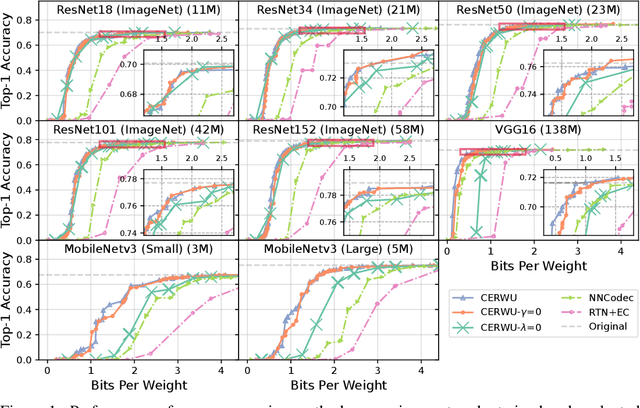
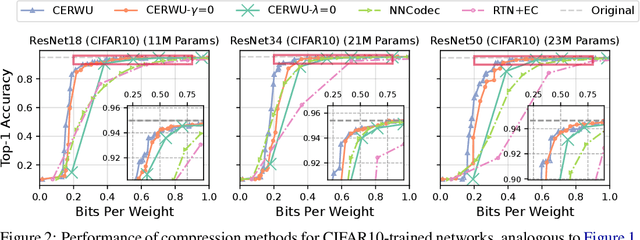
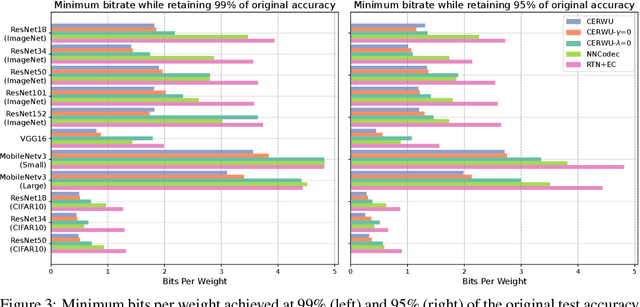
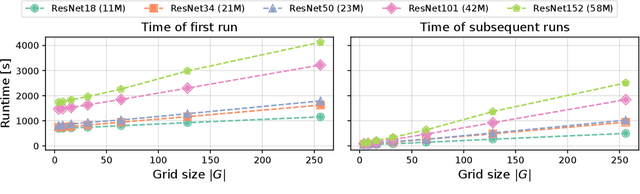
The ever-growing size of neural networks poses serious challenges on resource-constrained devices, such as embedded sensors. Compression algorithms that reduce their size can mitigate these problems, provided that model performance stays close to the original. We propose a novel post-training compression framework that combines rate-aware quantization with entropy coding by (1) extending the well-known layer-wise loss by a quadratic rate estimation, and (2) providing locally exact solutions to this modified objective following the Optimal Brain Surgeon (OBS) method. Our method allows for very fast decoding and is compatible with arbitrary quantization grids. We verify our results empirically by testing on various computer-vision networks, achieving a 20-40\% decrease in bit rate at the same performance as the popular compression algorithm NNCodec. Our code is available at https://github.com/Conzel/cerwu.
Decentralized Task Offloading and Load-Balancing for Mobile Edge Computing in Dense Networks
Jun 24, 2024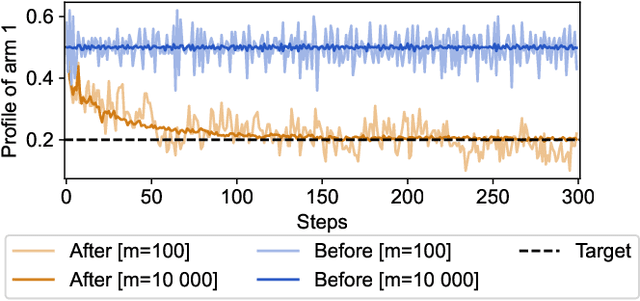
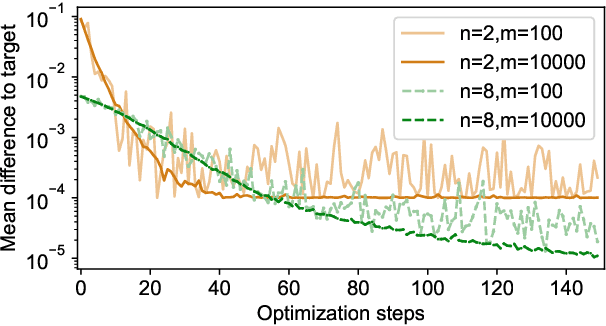
We study the problem of decentralized task offloading and load-balancing in a dense network with numerous devices and a set of edge servers. Solving this problem optimally is complicated due to the unknown network information and random task sizes. The shared network resources also influence the users' decisions and resource distribution. Our solution combines the mean field multi-agent multi-armed bandit (MAB) game with a load-balancing technique that adjusts the servers' rewards to achieve a target population profile despite the distributed user decision-making. Numerical results demonstrate the efficacy of our approach and the convergence to the target load distribution.