 Add to Chrome
 Add to Firefox
 Add to Edge
AI4BayesCode: From Natural Language Descriptions to Validated Modular Stateful Bayesian Samplers
May 18, 2026
Coding and computation remain major bottlenecks in Markov chain Monte Carlo (MCMC) workflows, especially as modern sampling algorithms have become increasingly complex and existing probabilistic programming systems remain limited in model support, extensibility, and composability. We introduce \textbf{AI4BayesCode}, an extensible LLM-driven system that translates natural-language Bayesian model descriptions into runnable, validated MCMC samplers. To improve reliability, AI4BayesCode adopts a modular design that decomposes models into modular sampling blocks and maps each block to a built-in sampling component, reducing the need to implement complex sampling algorithms from scratch. Reliability is further improved through pre-generation validation of model specifications and post-generation validation of generated sampler code. AI4BayesCode also introduces a novel recursively stateful coding paradigm for MCMC, allowing modular sampling components, potentially developed by different contributors, to be composed coherently within larger MCMC procedures. We develop a benchmark suite to evaluate AI4BayesCode for sampler-generation. Experiments show that AI4BayesCode can implement a wide range of Bayesian models from natural-language descriptions alone. As an open-ended system, its capability can continue to expand with improvements in the underlying AI agent and the addition of new built-in blocks.

BART-SIMP: a novel framework for flexible spatial covariate modeling and prediction using Bayesian additive regression trees
Sep 23, 2023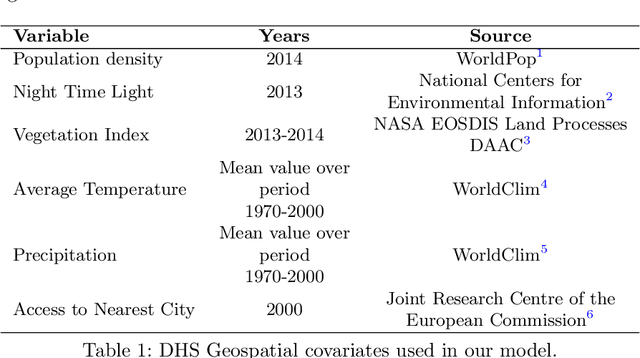
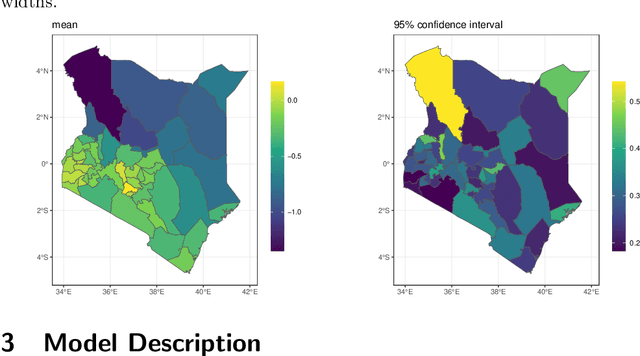
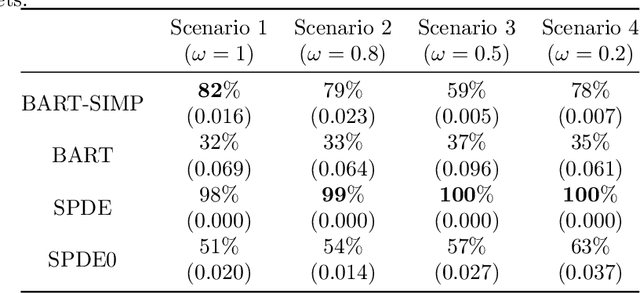
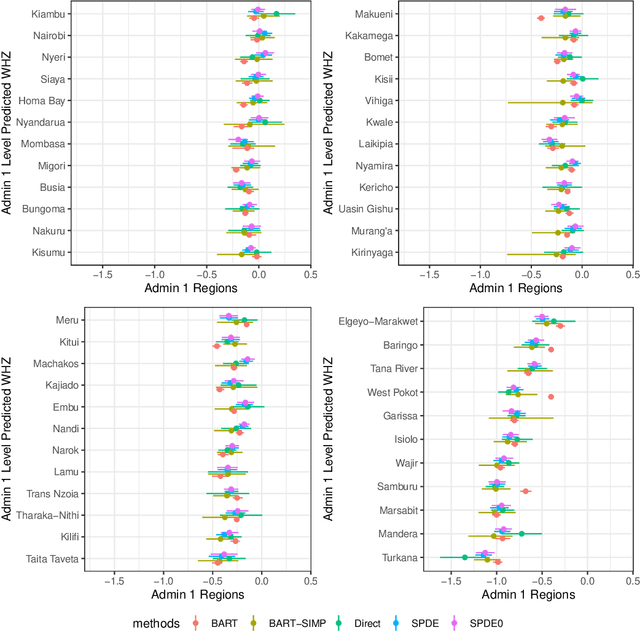
Prediction is a classic challenge in spatial statistics and the inclusion of spatial covariates can greatly improve predictive performance when incorporated into a model with latent spatial effects. It is desirable to develop flexible regression models that allow for nonlinearities and interactions in the covariate structure. Machine learning models have been suggested in the spatial context, allowing for spatial dependence in the residuals, but fail to provide reliable uncertainty estimates. In this paper, we investigate a novel combination of a Gaussian process spatial model and a Bayesian Additive Regression Tree (BART) model. The computational burden of the approach is reduced by combining Markov chain Monte Carlo (MCMC) with the Integrated Nested Laplace Approximation (INLA) technique. We study the performance of the method via simulations and use the model to predict anthropometric responses, collected via household cluster samples in Kenya.