 Add to Chrome
 Add to Firefox
 Add to Edge
Stratified Negation in RDF Rules: A Correct Approach (Extended Version)
Jul 30, 2026
Combining RDF rule languages, such as N3 or SHACL Rules, with default negation is challenging. Existing methods to stratify negation often fail for RDF rules, since individual triples do not carry enough information to meaningfully restrict potential dependencies. Blank nodes in rule heads further complicate the matter, since the order of rule applications may determine whether new values are created, which in turn can change the applicability of rules with negation. To solve these open problems, we propose chain stratification as a robust new condition that guarantees a well-behaved semantics for RDF rules with negation, and existential rules in general. Our condition combines an elaborate analysis of potential multistep derivations with a mechanism for using integrity constraints to discard impossible cases. Applying rules in any order that respects chain stratification is guaranteed to derive an RDF graph that is unique, lean, and justified under the usual negation-as-failure semantics. To show the practicality, we also provide a prototype implementation.

Towards Mass Spectrum Analysis with ASP
Dec 18, 2025We present a new use of Answer Set Programming (ASP) to discover the molecular structure of chemical samples based on the relative abundance of elements and structural fragments, as measured in mass spectrometry. To constrain the exponential search space for this combinatorial problem, we develop canonical representations of molecular structures and an ASP implementation that uses these definitions. We evaluate the correctness of our implementation over a large set of known molecular structures, and we compare its quality and performance to other ASP symmetry-breaking methods and to a commercial tool from analytical chemistry. Under consideration in Theory and Practice of Logic Programming (TPLP).
Nemo: First Glimpse of a New Rule Engine
Aug 30, 2023

This system demonstration presents Nemo, a new logic programming engine with a focus on reliability and performance. Nemo is built for data-centric analytic computations, modelled in a fully declarative Datalog dialect. Its scalability for these tasks matches or exceeds that of leading Datalog systems. We demonstrate uses in reasoning with knowledge graphs and ontologies with 10^5 to 10^8 input facts, all on a laptop. Nemo is written in Rust and available as a free and open source tool.
* In Proceedings ICLP 2023, arXiv:2308.14898
Efficient Dependency Analysis for Rule-Based Ontologies
Jul 20, 2022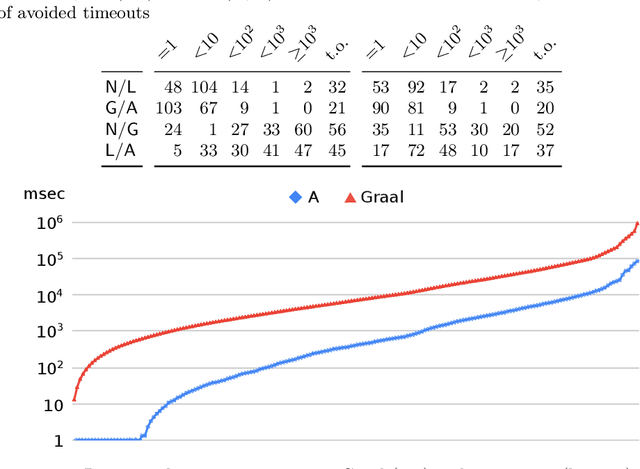
Several types of dependencies have been proposed for the static analysis of existential rule ontologies, promising insights about computational properties and possible practical uses of a given set of rules, e.g., in ontology-based query answering. Unfortunately, these dependencies are rarely implemented, so their potential is hardly realised in practice. We focus on two kinds of rule dependencies -- positive reliances and restraints -- and design and implement optimised algorithms for their efficient computation. Experiments on real-world ontologies of up to more than 100,000 rules show the scalability of our approach, which lets us realise several previously proposed applications as practical case studies. In particular, we can analyse to what extent rule-based bottom-up approaches of reasoning can be guaranteed to yield redundancy-free "lean" knowledge graphs (so-called cores) on practical ontologies.