 Add to Chrome
 Add to Firefox
 Add to Edge
Compiling Temporal Numeric Planning into Discrete PDDL+: Extended Version
Mar 12, 2026
Since the introduction of the PDDL+ modeling language, it was known that temporal planning with durative actions (as in PDDL 2.1) could be compiled into PDDL+. However, no practical compilation was presented in the literature ever since. We present a practical compilation from temporal planning with durative actions into PDDL+, fully capturing the semantics and only assuming the non-self-overlapping of actions. Our compilation is polynomial, retains the plan length up to a constant factor and is experimentally shown to be of practical relevance for hard temporal numeric problems.

Interleaving Scheduling and Motion Planning with Incremental Learning of Symbolic Space-Time Motion Abstractions
Mar 11, 2026Task and Motion Planning combines high-level task sequencing (what to do) with low-level motion planning (how to do it) to generate feasible, collision-free execution plans. However, in many real-world domains, such as automated warehouses, tasks are predefined, shifting the challenge to if, when, and how to execute them safely and efficiently under resource, time and motion constraints. In this paper, we formalize this as the Scheduling and Motion Planning problem for multi-object navigation in shared workspaces. We propose a novel solution framework that interleaves off-the-shelf schedulers and motion planners in an incremental learning loop. The scheduler generates candidate plans, while the motion planner checks feasibility and returns symbolic feedback, i.e., spatial conflicts and timing adjustments, to guide the scheduler towards motion-feasible solutions. We validate our proposal on logistics and job-shop scheduling benchmarks augmented with motion tasks, using state-of-the-art schedulers and sampling-based motion planners. Our results show the effectiveness of our framework in generating valid plans under complex temporal and spatial constraints, where synchronized motion is critical.
Exploiting Symbolic Heuristics for the Synthesis of Domain-Specific Temporal Planning Guidance using Reinforcement Learning
May 19, 2025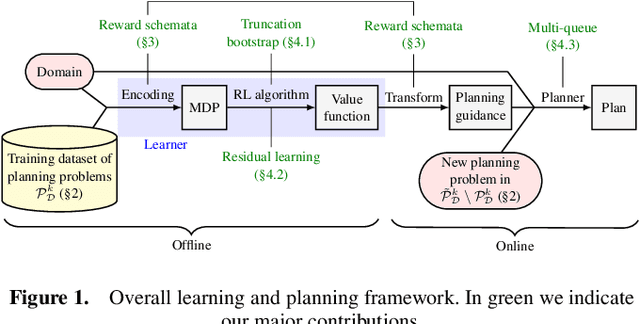
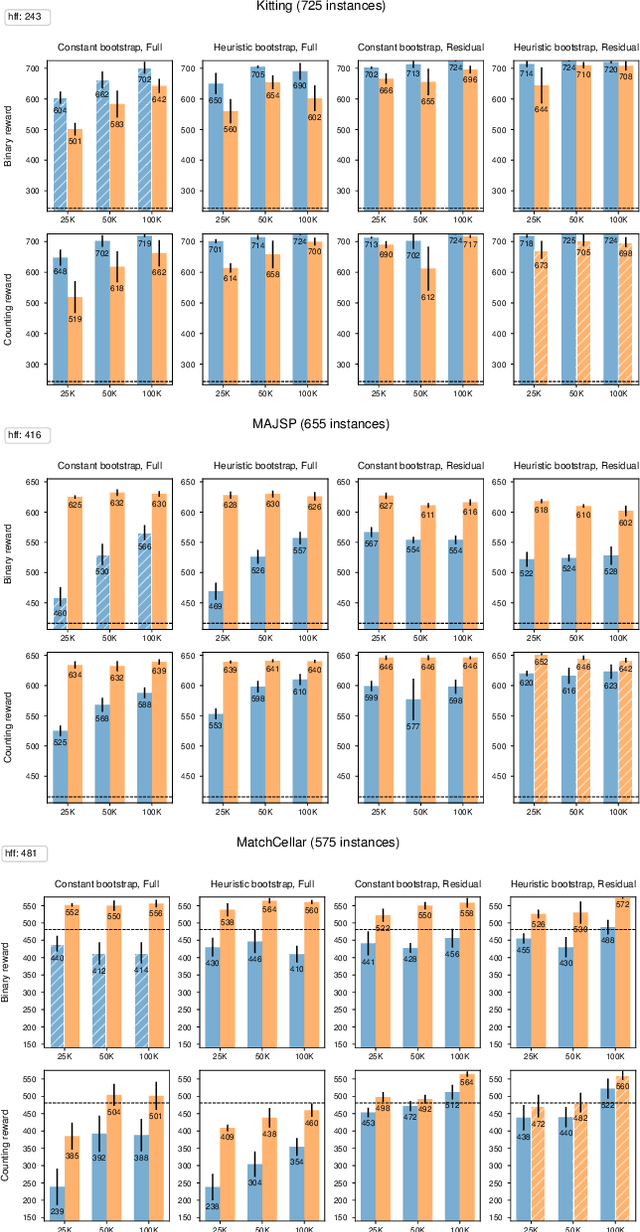
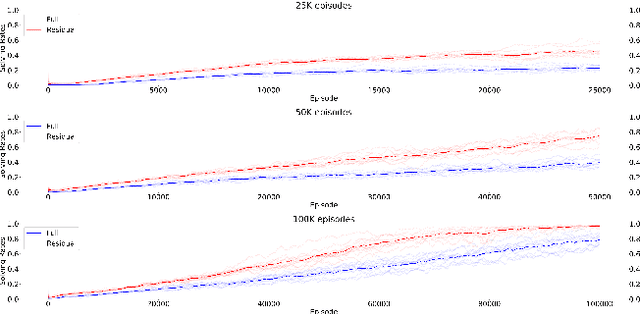
Recent work investigated the use of Reinforcement Learning (RL) for the synthesis of heuristic guidance to improve the performance of temporal planners when a domain is fixed and a set of training problems (not plans) is given. The idea is to extract a heuristic from the value function of a particular (possibly infinite-state) MDP constructed over the training problems. In this paper, we propose an evolution of this learning and planning framework that focuses on exploiting the information provided by symbolic heuristics during both the RL and planning phases. First, we formalize different reward schemata for the synthesis and use symbolic heuristics to mitigate the problems caused by the truncation of episodes needed to deal with the potentially infinite MDP. Second, we propose learning a residual of an existing symbolic heuristic, which is a "correction" of the heuristic value, instead of eagerly learning the whole heuristic from scratch. Finally, we use the learned heuristic in combination with a symbolic heuristic using a multiple-queue planning approach to balance systematic search with imperfect learned information. We experimentally compare all the approaches, highlighting their strengths and weaknesses and significantly advancing the state of the art for this planning and learning schema.
A Meta-Engine Framework for Interleaved Task and Motion Planning using Topological Refinements
Aug 11, 2024Task And Motion Planning (TAMP) is the problem of finding a solution to an automated planning problem that includes discrete actions executable by low-level continuous motions. This field is gaining increasing interest within the robotics community, as it significantly enhances robot's autonomy in real-world applications. Many solutions and formulations exist, but no clear standard representation has emerged. In this paper, we propose a general and open-source framework for modeling and benchmarking TAMP problems. Moreover, we introduce an innovative meta-technique to solve TAMP problems involving moving agents and multiple task-state-dependent obstacles. This approach enables using any off-the-shelf task planner and motion planner while leveraging a geometric analysis of the motion planner's search space to prune the task planner's exploration, enhancing its efficiency. We also show how to specialize this meta-engine for the case of an incremental SMT-based planner. We demonstrate the effectiveness of our approach across benchmark problems of increasing complexity, where robots must navigate environments with movable obstacles. Finally, we integrate state-of-the-art TAMP algorithms into our framework and compare their performance with our achievements.
Temporal Planning with Intermediate Conditions and Effects
Sep 25, 2019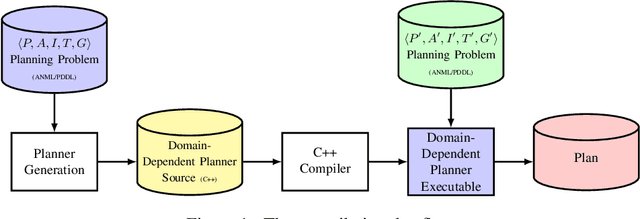
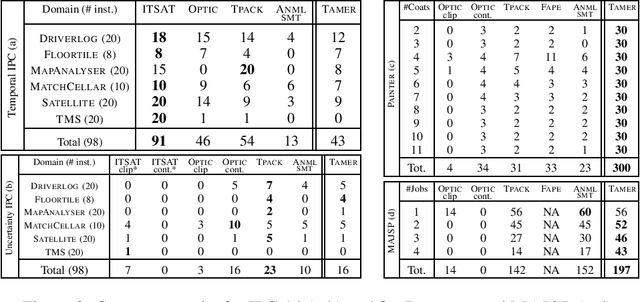
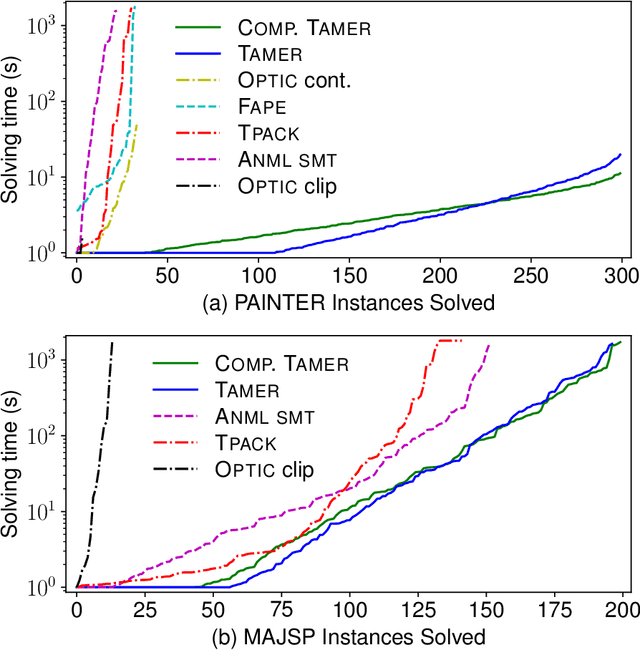
Automated temporal planning is the technology of choice when controlling systems that can execute more actions in parallel and when temporal constraints, such as deadlines, are needed in the model. One limitation of several action-based planning systems is that actions are modeled as intervals having conditions and effects only at the extremes and as invariants, but no conditions nor effects can be specified at arbitrary points or sub-intervals. In this paper, we address this limitation by providing an effective heuristic-search technique for temporal planning, allowing the definition of actions with conditions and effects at any arbitrary time within the action duration. We experimentally demonstrate that our approach is far better than standard encodings in PDDL 2.1 and is competitive with other approaches that can (directly or indirectly) represent intermediate action conditions or effects.