 Add to Chrome
 Add to Firefox
 Add to Edge
Exploring LLM Features in Predictive Process Monitoring for Small-Scale Event-Logs
Jan 16, 2026
Predictive Process Monitoring is a branch of process mining that aims to predict the outcome of an ongoing process. Recently, it leveraged machine-and-deep learning architectures. In this paper, we extend our prior LLM-based Predictive Process Monitoring framework, which was initially focused on total time prediction via prompting. The extension consists of comprehensively evaluating its generality, semantic leverage, and reasoning mechanisms, also across multiple Key Performance Indicators. Empirical evaluations conducted on three distinct event logs and across the Key Performance Indicators of Total Time and Activity Occurrence prediction indicate that, in data-scarce settings with only 100 traces, the LLM surpasses the benchmark methods. Furthermore, the experiments also show that the LLM exploits both its embodied prior knowledge and the internal correlations among training traces. Finally, we examine the reasoning strategies employed by the model, demonstrating that the LLM does not merely replicate existing predictive methods but performs higher-order reasoning to generate the predictions.

Achieving Fairness in Predictive Process Analytics via Adversarial Learning (Extended Version)
Oct 03, 2024
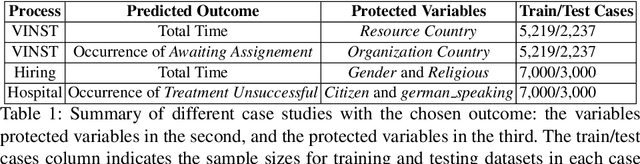
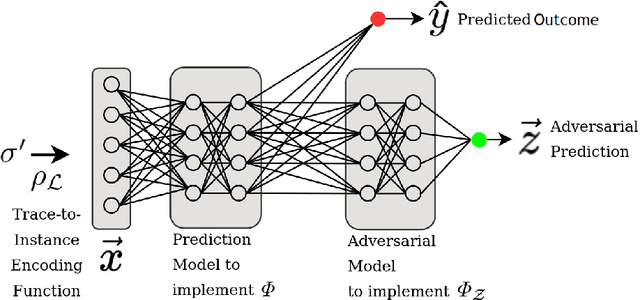
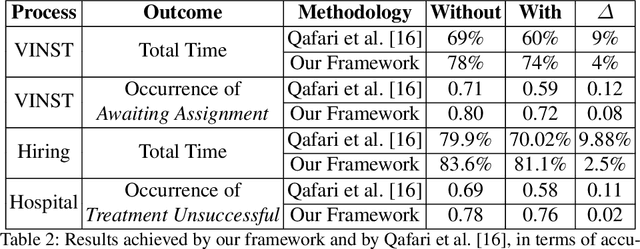
Predictive business process analytics has become important for organizations, offering real-time operational support for their processes. However, these algorithms often perform unfair predictions because they are based on biased variables (e.g., gender or nationality), namely variables embodying discrimination. This paper addresses the challenge of integrating a debiasing phase into predictive business process analytics to ensure that predictions are not influenced by biased variables. Our framework leverages on adversial debiasing is evaluated on four case studies, showing a significant reduction in the contribution of biased variables to the predicted value. The proposed technique is also compared with the state of the art in fairness in process mining, illustrating that our framework allows for a more enhanced level of fairness, while retaining a better prediction quality.