 Add to Chrome
 Add to Firefox
 Add to Edge
Relative Pose-Velocity Estimation Using Dual IMU Measurements and Relative Position Sensing
May 13, 2026
This paper addresses the problem of estimating the relative pose (position and orientation) and velocity of a vehicle with respect to a moving target, where both are equipped with Inertial Measurement Units (IMUs), assuming the availability of relative position or bearing measurements. The body-target relative dynamics are formulated on $\mathbf{SE}_2(3)$ and recast into a linear time-varying (LTV) model in the ambient space $\mathbb{R}^{15}$, on which a deterministic Riccati observer is designed. We analyze the uniform observability (UO) conditions required to guarantee global exponential convergence of the estimation error in the ambient space for both measurement cases. In the case of relative position measurements, UO requires only a persistence-of-excitation condition on the target acceleration, whereas for bearing measurements, additional conditions are required. Building on this, a nonlinear complementary filter on $\mathbf{SO}(3)$ is designed to provide a smooth estimate of the orientation component of the state with almost global asymptotic stability. Finally, simulation results are provided to validate the proposed solution.

Complementary Filtering on SO(3) for Attitude Estimation with Scalar Measurements
Apr 09, 2026Attitude estimation using scalar measurements, corresponding to partial vectorial observations, arises naturally when inertial vectors are not fully observed but only measured along specific body-frame vectors. Such measurements arise in problems involving incomplete vector measurements or attitude constraints derived from heterogeneous sensor information. Building on the classical complementary filter on SO(3), we propose an observer with a modified innovation term tailored to this scalar-output structure. The main result shows that almost-global asymptotic stability is recovered, under suitable persistence of excitation conditions, when at least three inertial vectors are measured along a common body-frame vector, which is consistent with the three-dimensional structure of SO(3). For two-scalar configurations - corresponding either to one inertial vector measured along two body-frame vectors, or to two inertial vectors measured along a common body-frame vector - we further derive sufficient conditions guaranteeing convergence within a reduced basin of attraction. Different examples and numerical results demonstrate the effectiveness of the proposed scalar-based complementary filter for attitude estimation in challenging scenarios involving reduced sensing and/or novel sensing modalities.
Scalar-Measurement Attitude Estimation on $\mathbf{SO}(3)$ with Bias Compensation
Mar 03, 2026Attitude estimation methods typically rely on full vector measurements from inertial sensors such as accelerometers and magnetometers. This paper shows that reliable estimation can also be achieved using only scalar measurements, which naturally arise either as components of vector readings or as independent constraints from other sensing modalities. We propose nonlinear deterministic observers on $\mathbf{SO}(3)$ that incorporate gyroscope bias compensation and guarantee uniform local exponential stability under suitable observability conditions. A key feature of the framework is its robustness to partial sensing: accurate estimation is maintained even when only a subset of vector components is available. Experimental validation on the BROAD dataset confirms consistent performance across progressively reduced measurement configurations, with estimation errors remaining small even under severe information loss. To the best of our knowledge, this is the first work to establish fundamental observability results showing that two scalar measurements under suitable excitation suffice for attitude estimation, and that three are enough in the static case. These results position scalar-measurement-based observers as a practical and reliable alternative to conventional vector-based approaches.
Vision-Aided Relative State Estimation for Approach and Landing on a Moving Platform with Inertial Measurements
Dec 22, 2025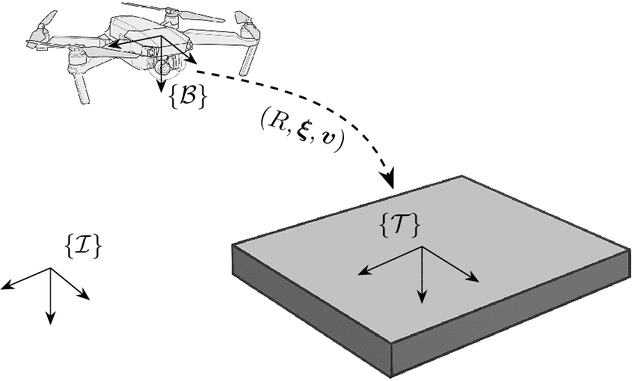
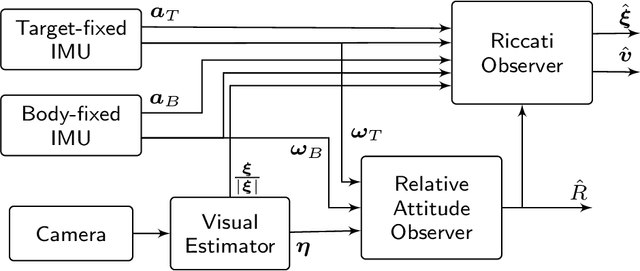
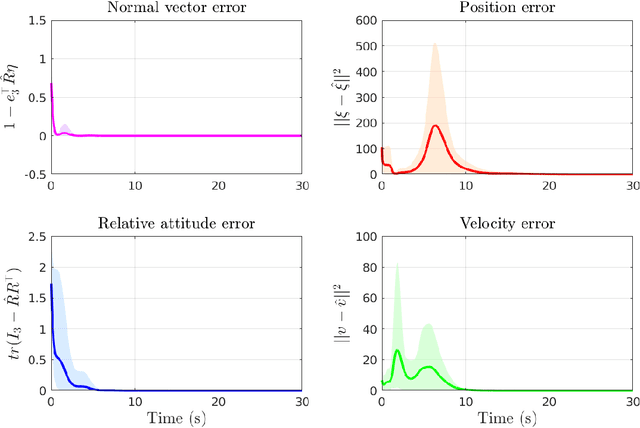
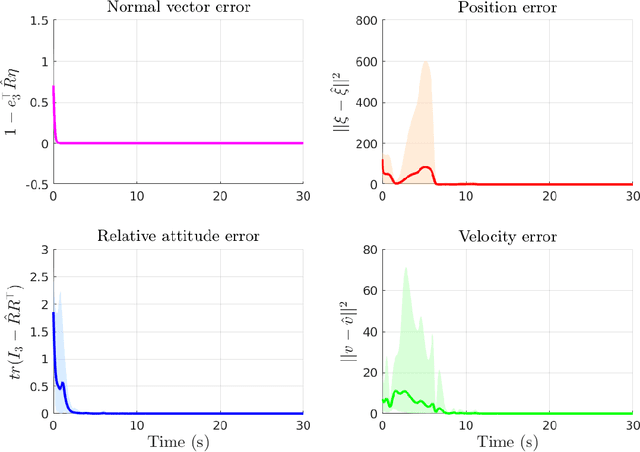
This paper tackles the problem of estimating the relative position, orientation, and velocity between a UAV and a planar platform undergoing arbitrary 3D motion during approach and landing. The estimation relies on measurements from Inertial Measurement Units (IMUs) mounted on both systems, assuming there is a suitable communication channel to exchange data, together with visual information provided by an onboard monocular camera, from which the bearing (line-of-sight direction) to the platform's center and the normal vector of its planar surface are extracted. We propose a cascade observer with a complementary filter on SO(3) to reconstruct the relative attitude, followed by a linear Riccati observer for relative position and velocity estimation. Convergence of both observers is established under persistently exciting conditions, and the cascade is shown to be almost globally asymptotically and locally exponentially stable. We further extend the design to the case where the platform's rotation is restricted to its normal axis and show that its measured linear acceleration can be exploited to recover the remaining unobservable rotation angle. A sufficient condition to ensure local exponential convergence in this setting is provided. The performance of the proposed observers is validated through extensive simulations.