 Add to Chrome
 Add to Firefox
 Add to Edge
Mapping Uncharted Symmetries: Machine Discovery in Combinatorics
May 18, 2026
Inspired by long-standing open problems in algebraic combinatorics, we show that modern machine learning can meaningfully contribute to verifiable mathematical discoveries. In particular, we focus on the construction of simple mathematical functions under exact distributional constraints, a setting we formalize as Simple Learning Under Rigid Proportions (SLURP). We tackle this problem by introducing two methods: MapSeek-Functional, which models the desired function alternating pseudo-labeling and supervised training steps; and MapSeek-Symbolic, designed to directly produce symbolic formulas. We successfully apply both methods to a research problem in algebraic combinatorics, discovering a new combinatorial interpretation of the $q,t$-Narayana polynomials arising from representation theory. To our knowledge, this is the first such interpretation based on noncrossing partitions. Using one discovered statistic, we find a combinatorial proof of the symmetry of these polynomials in a previously unsolved case. To streamline verification and reproducibility, we release all code, including a formalization of all the mathematical discoveries of this paper in Lean 4.

Learning to Play 7 Wonders Duel Without Human Supervision
Jun 02, 2024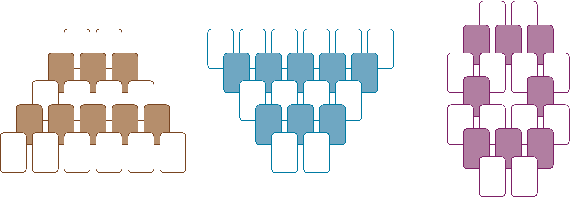
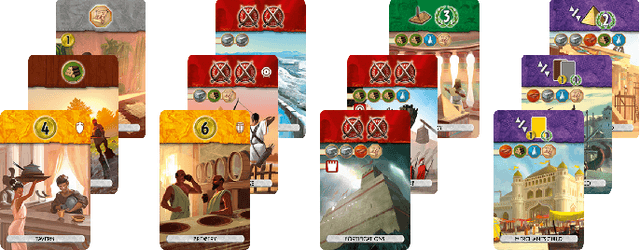
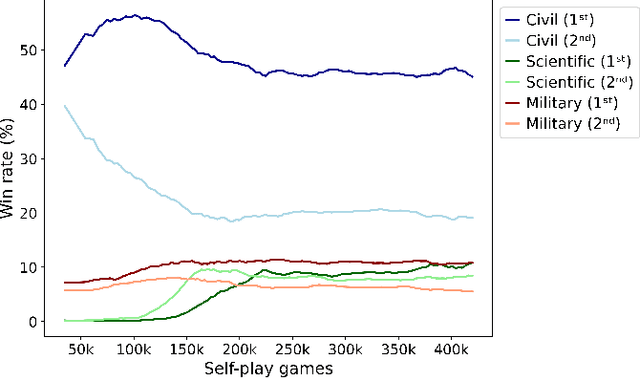
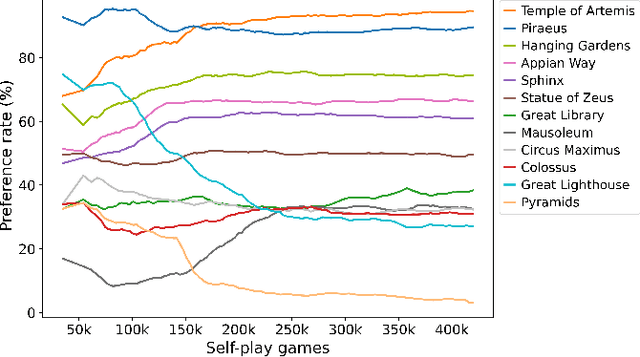
This paper introduces ZeusAI, an artificial intelligence system developed to play the board game 7 Wonders Duel. Inspired by the AlphaZero reinforcement learning algorithm, ZeusAI relies on a combination of Monte Carlo Tree Search and a Transformer Neural Network to learn the game without human supervision. ZeusAI competes at the level of top human players, develops both known and novel strategies, and allows us to test rule variants to improve the game's balance. This work demonstrates how AI can help in understanding and enhancing board games.