 Add to Chrome
 Add to Firefox
 Add to Edge
Graphon Pooling for Reducing Dimensionality of Signals and Convolutional Operators on Graphs
Dec 15, 2022


In this paper we propose a pooling approach for convolutional information processing on graphs relying on the theory of graphons and limits of dense graph sequences. We present three methods that exploit the induced graphon representation of graphs and graph signals on partitions of [0, 1]2 in the graphon space. As a result we derive low dimensional representations of the convolutional operators, while a dimensionality reduction of the signals is achieved by simple local interpolation of functions in L2([0, 1]). We prove that those low dimensional representations constitute a convergent sequence of graphs and graph signals, respectively. The methods proposed and the theoretical guarantees that we provide show that the reduced graphs and signals inherit spectral-structural properties of the original quantities. We evaluate our approach with a set of numerical experiments performed on graph neural networks (GNNs) that rely on graphon pooling. We observe that graphon pooling performs significantly better than other approaches proposed in the literature when dimensionality reduction ratios between layers are large. We also observe that when graphon pooling is used we have, in general, less overfitting and lower computational cost.

Convolutional Filtering on Sampled Manifolds
Nov 20, 2022The increasing availability of geometric data has motivated the need for information processing over non-Euclidean domains modeled as manifolds. The building block for information processing architectures with desirable theoretical properties such as invariance and stability is convolutional filtering. Manifold convolutional filters are defined from the manifold diffusion sequence, constructed by successive applications of the Laplace-Beltrami operator to manifold signals. However, the continuous manifold model can only be accessed by sampling discrete points and building an approximate graph model from the sampled manifold. Effective linear information processing on the manifold requires quantifying the error incurred when approximating manifold convolutions with graph convolutions. In this paper, we derive a non-asymptotic error bound for this approximation, showing that convolutional filtering on the sampled manifold converges to continuous manifold filtering. Our findings are further demonstrated empirically on a problem of navigation control.
Tangent Bundle Filters and Neural Networks: from Manifolds to Cellular Sheaves and Back
Nov 18, 2022In this work we introduce a convolution operation over the tangent bundle of Riemannian manifolds exploiting the Connection Laplacian operator. We use the convolution to define tangent bundle filters and tangent bundle neural networks (TNNs), novel continuous architectures operating on tangent bundle signals, i.e. vector fields over manifolds. We discretize TNNs both in space and time domains, showing that their discrete counterpart is a principled variant of the recently introduced Sheaf Neural Networks. We formally prove that this discrete architecture converges to the underlying continuous TNN. We numerically evaluate the effectiveness of the proposed architecture on a denoising task of a tangent vector field over the unit 2-sphere.
Stable and Transferable Hyper-Graph Neural Networks
Nov 11, 2022
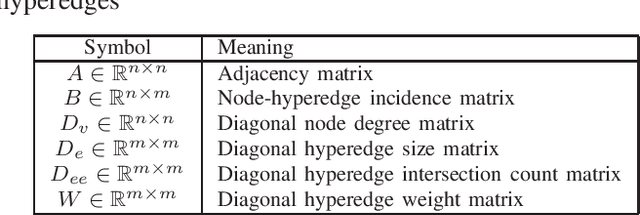

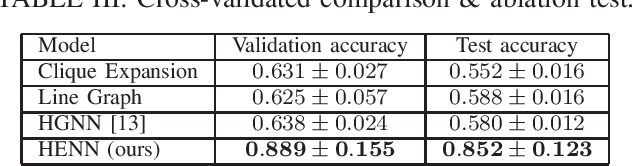
We introduce an architecture for processing signals supported on hypergraphs via graph neural networks (GNNs), which we call a Hyper-graph Expansion Neural Network (HENN), and provide the first bounds on the stability and transferability error of a hypergraph signal processing model. To do so, we provide a framework for bounding the stability and transferability error of GNNs across arbitrary graphs via spectral similarity. By bounding the difference between two graph shift operators (GSOs) in the positive semi-definite sense via their eigenvalue spectrum, we show that this error depends only on the properties of the GNN and the magnitude of spectral similarity of the GSOs. Moreover, we show that existing transferability results that assume the graphs are small perturbations of one another, or that the graphs are random and drawn from the same distribution or sampled from the same graphon can be recovered using our approach. Thus, both GNNs and our HENNs (trained using normalized Laplacians as graph shift operators) will be increasingly stable and transferable as the graphs become larger. Experimental results illustrate the importance of considering multiple graph representations in HENN, and show its superior performance when transferability is desired.
A State-Augmented Approach for Learning Optimal Resource Management Decisions in Wireless Networks
Nov 09, 2022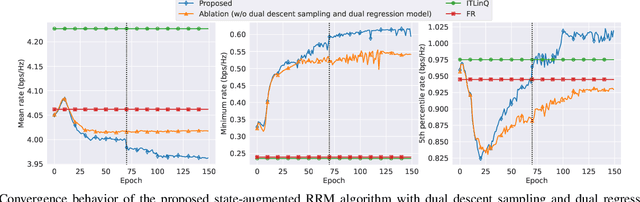
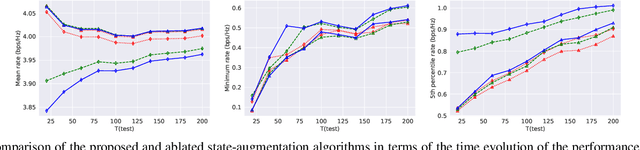
We consider a radio resource management (RRM) problem in a multi-user wireless network, where the goal is to optimize a network-wide utility function subject to constraints on the ergodic average performance of users. We propose a state-augmented parameterization for the RRM policy, where alongside the instantaneous network states, the RRM policy takes as input the set of dual variables corresponding to the constraints. We provide theoretical justification for the feasibility and near-optimality of the RRM decisions generated by the proposed state-augmented algorithm. Focusing on the power allocation problem with RRM policies parameterized by a graph neural network (GNN) and dual variables sampled from the dual descent dynamics, we numerically demonstrate that the proposed approach achieves a superior trade-off between mean, minimum, and 5th percentile rates than baseline methods.
Algebraic Convolutional Filters on Lie Group Algebras
Oct 31, 2022
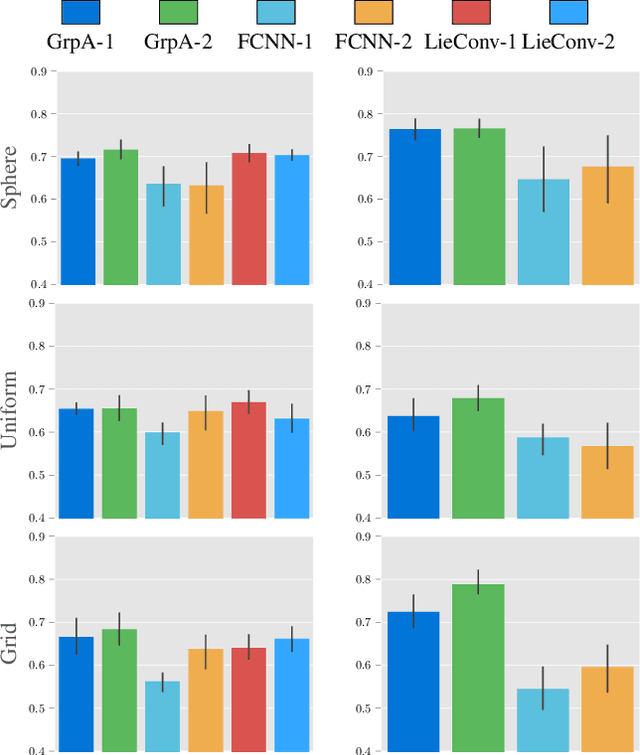
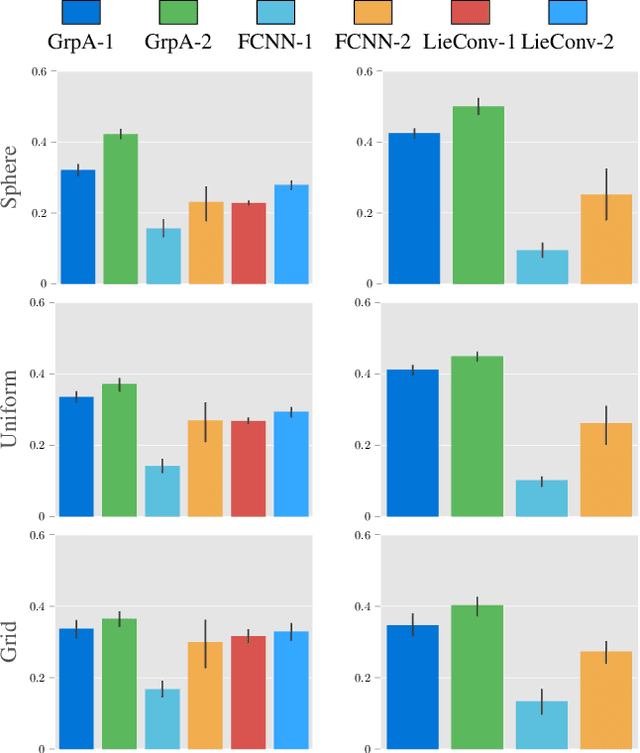
Group convolutional neural networks are a useful tool for utilizing symmetries known to be in a signal; however, they require that the signal is defined on the group itself. Existing approaches either work directly with group signals, or they impose a lifting step with heuristics to compute the convolution which can be computationally costly. Taking an algebraic signal processing perspective, we propose a novel convolutional filter from the Lie group algebra directly, thereby removing the need to lift altogether. Furthermore, we establish stability of the filter by drawing connections to multigraph signal processing. The proposed filter is evaluated on a classification problem on two datasets with $SO(3)$ group symmetries.
Predicting Brain Age using Transferable coVariance Neural Networks
Oct 28, 2022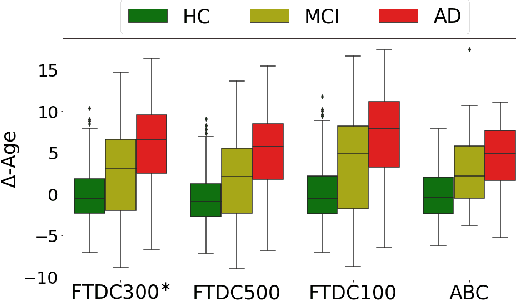
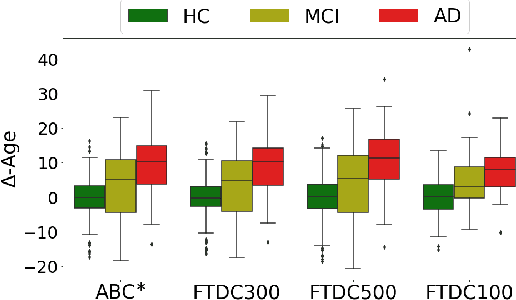
The deviation between chronological age and biological age is a well-recognized biomarker associated with cognitive decline and neurodegeneration. Age-related and pathology-driven changes to brain structure are captured by various neuroimaging modalities. These datasets are characterized by high dimensionality as well as collinearity, hence applications of graph neural networks in neuroimaging research routinely use sample covariance matrices as graphs. We have recently studied covariance neural networks (VNNs) that operate on sample covariance matrices using the architecture derived from graph convolutional networks, and we showed VNNs enjoy significant advantages over traditional data analysis approaches. In this paper, we demonstrate the utility of VNNs in inferring brain age using cortical thickness data. Furthermore, our results show that VNNs exhibit multi-scale and multi-site transferability for inferring {brain age}. In the context of brain age in Alzheimer's disease (AD), our experiments show that i) VNN outputs are interpretable as brain age predicted using VNNs is significantly elevated for AD with respect to healthy subjects for different datasets; and ii) VNNs can be transferable, i.e., VNNs trained on one dataset can be transferred to another dataset with different dimensions without retraining for brain age prediction.
Space-Time Graph Neural Networks with Stochastic Graph Perturbations
Oct 28, 2022
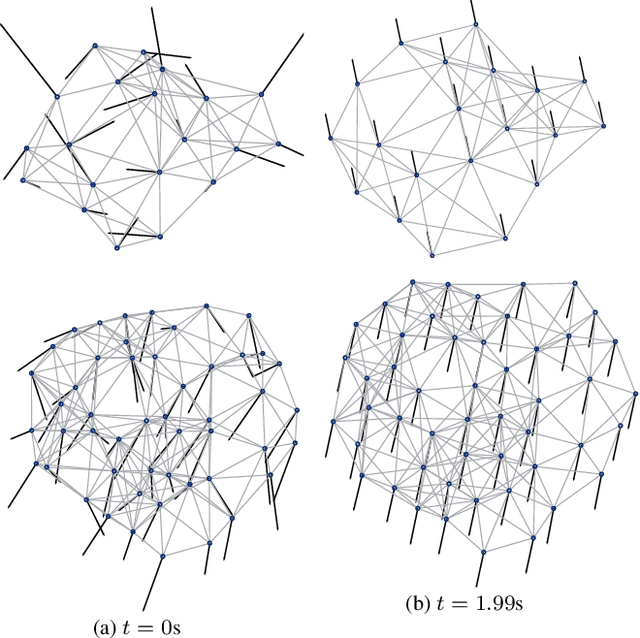
Space-time graph neural networks (ST-GNNs) are recently developed architectures that learn efficient graph representations of time-varying data. ST-GNNs are particularly useful in multi-agent systems, due to their stability properties and their ability to respect communication delays between the agents. In this paper we revisit the stability properties of ST-GNNs and prove that they are stable to stochastic graph perturbations. Our analysis suggests that ST-GNNs are suitable for transfer learning on time-varying graphs and enables the design of generalized convolutional architectures that jointly process time-varying graphs and time-varying signals. Numerical experiments on decentralized control systems validate our theoretical results and showcase the benefits of traditional and generalized ST-GNN architectures.
Deep Convolutional Neural Networks for Multi-Target Tracking: A Transfer Learning Approach
Oct 28, 2022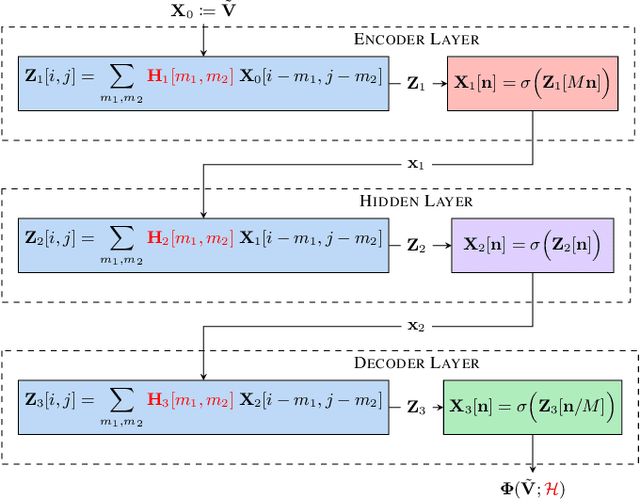
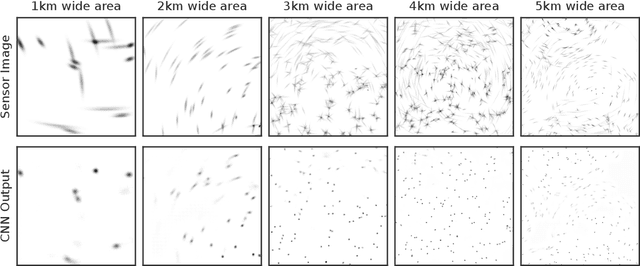
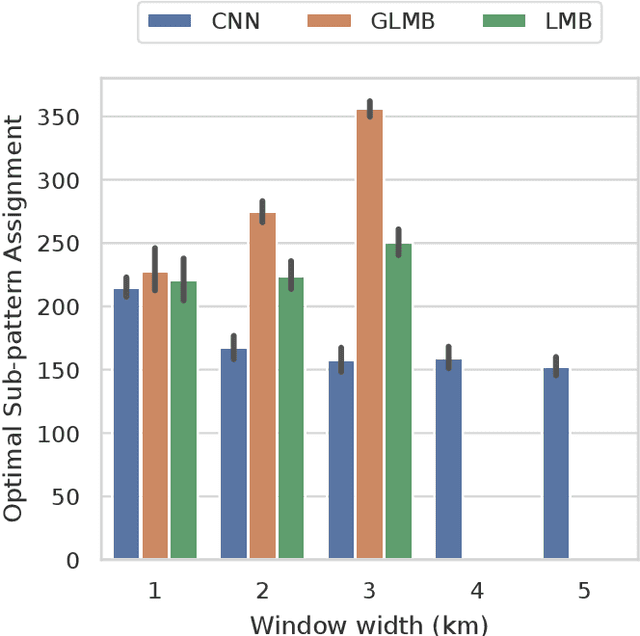
Multi-target tracking (MTT) is a traditional signal processing task, where the goal is to estimate the states of an unknown number of moving targets from noisy sensor measurements. In this paper, we revisit MTT from a deep learning perspective and propose convolutional neural network (CNN) architectures to tackle it. We represent the target states and sensor measurements as images. Thereby we recast the problem as a image-to-image prediction task for which we train a fully convolutional model. This architecture is motivated by a novel theoretical bound on the transferability error of CNN. The proposed CNN architecture outperforms a GM-PHD filter on the MTT task with 10 targets. The CNN performance transfers without re-training to a larger MTT task with 250 targets with only a $13\%$ increase in average OSPA.
Learning with Multigraph Convolutional Filters
Oct 28, 2022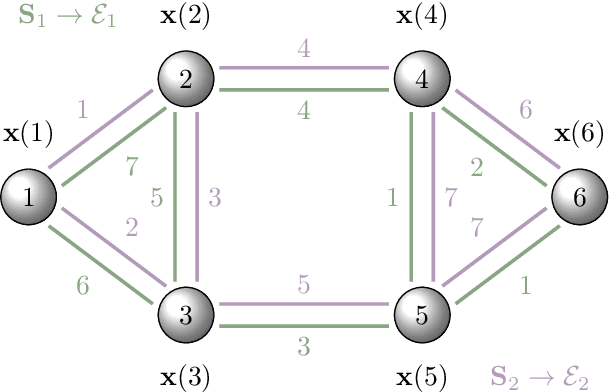
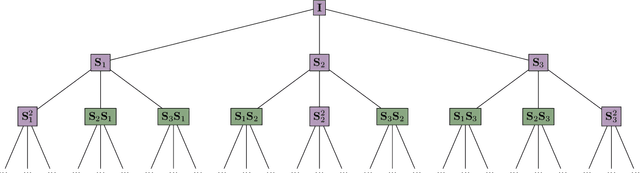
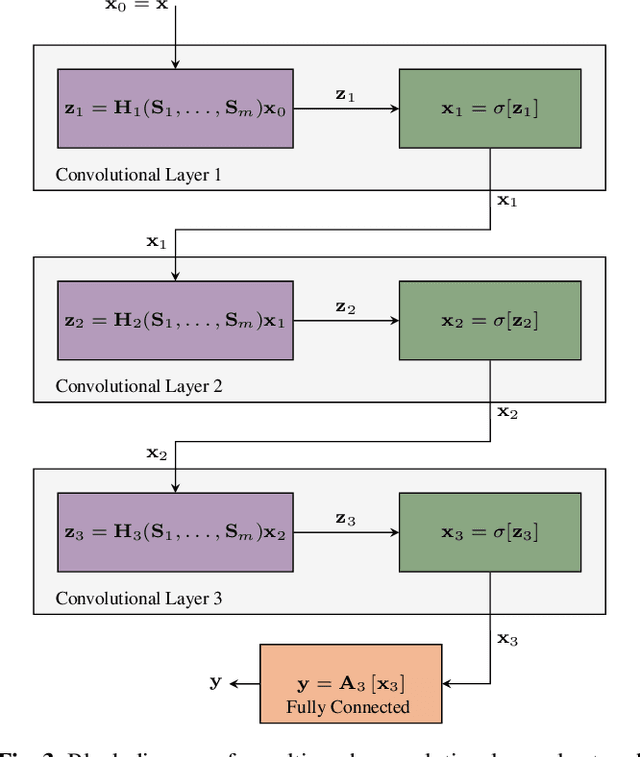
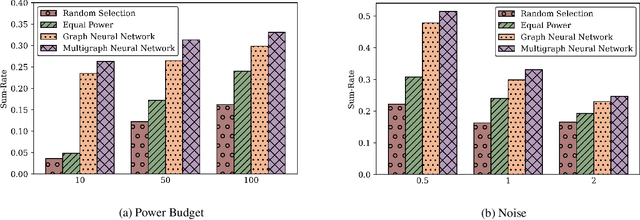
In this paper, we introduce a convolutional architecture to perform learning when information is supported on multigraphs. Exploiting algebraic signal processing (ASP), we propose a convolutional signal processing model on multigraphs (MSP). Then, we introduce multigraph convolutional neural networks (MGNNs) as stacked and layered structures where information is processed according to an MSP model. We also develop a procedure for tractable computation of filter coefficients in the MGNN and a low cost method to reduce the dimensionality of the information transferred between layers. We conclude by comparing the performance of MGNNs against other learning architectures on an optimal resource allocation task for multi-channel communication systems.