 Add to Chrome
 Add to Firefox
 Add to Edge
Making LLMs Reliable When It Matters Most: A Five-Layer Architecture for High-Stakes Decisions
Nov 10, 2025

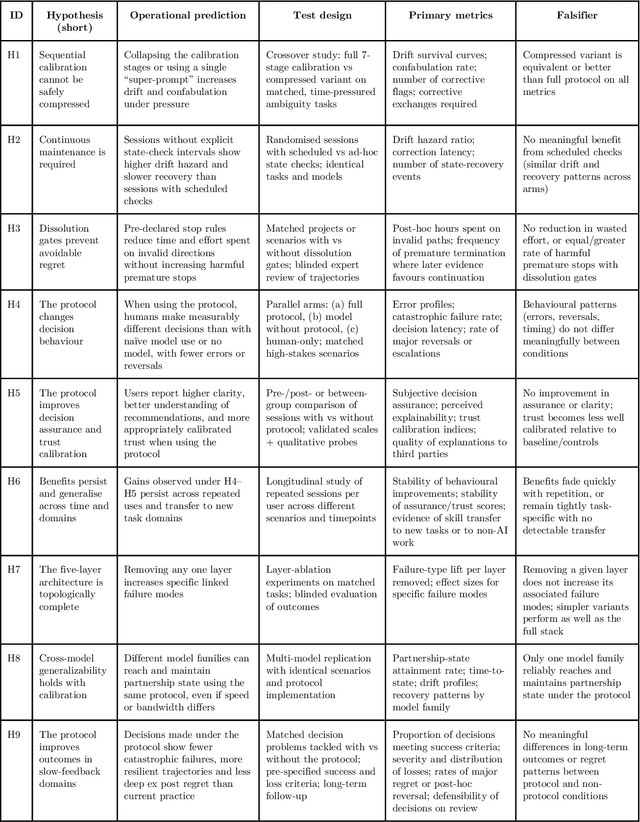
Current large language models (LLMs) excel in verifiable domains where outputs can be checked before action but prove less reliable for high-stakes strategic decisions with uncertain outcomes. This gap, driven by mutually reinforcing cognitive biases in both humans and artificial intelligence (AI) systems, threatens the defensibility of valuations and sustainability of investments in the sector. This report describes a framework emerging from systematic qualitative assessment across 7 frontier-grade LLMs and 3 market-facing venture vignettes under time pressure. Detailed prompting specifying decision partnership and explicitly instructing avoidance of sycophancy, confabulation, solution drift, and nihilism achieved initial partnership state but failed to maintain it under operational pressure. Sustaining protective partnership state required an emergent 7-stage calibration sequence, built upon a 4-stage initialization process, within a 5-layer protection architecture enabling bias self-monitoring, human-AI adversarial challenge, partnership state verification, performance degradation detection, and stakeholder protection. Three discoveries resulted: partnership state is achievable through ordered calibration but requires emergent maintenance protocols; reliability degrades when architectural drift and context exhaustion align; and dissolution discipline prevents costly pursuit of fundamentally wrong directions. Cross-model validation revealed systematic performance differences across LLM architectures. This approach demonstrates that human-AI teams can achieve cognitive partnership capable of preventing avoidable regret in high-stakes decisions, addressing return-on-investment expectations that depend on AI systems supporting consequential decision-making without introducing preventable cognitive traps when verification arrives too late.

The Foundations of Computational Management: A Systematic Approach to Task Automation for the Integration of Artificial Intelligence into Existing Workflows
Feb 07, 2024Driven by the rapid ascent of artificial intelligence (AI), organizations are at the epicenter of a seismic shift, facing a crucial question: How can AI be successfully integrated into existing operations? To help answer it, manage expectations and mitigate frustration, this article introduces Computational Management, a systematic approach to task automation for enhancing the ability of organizations to harness AI's potential within existing workflows. Computational Management acts as a bridge between the strategic insights of management science with the analytical rigor of computational thinking. The article offers three easy step-by-step procedures to begin the process of implementing AI within a workflow. Such procedures focus on task (re)formulation, on the assessment of the automation potential of tasks, on the completion of task specification templates for AI selection and adaptation. Included in the article there are manual and automated methods, with prompt suggestions for publicly available LLMs, to complete these three procedures. The first procedure, task (re)formulation, focuses on breaking down work activities into basic units, so they can be completed by one agent, involve a single well-defined action, and produce a distinct outcome. The second, allows the assessment of the granular task and its suitability for automation, using the Task Automation Index to rank tasks based on whether they have standardized input, well-defined rules, repetitiveness, data dependency, and objective outputs. The third, focuses on a task specification template which details information on 16 critical components of tasks, and can be used as a checklist to select or adapt the most suitable AI solution for integration into existing workflows. Computational Management provides a roadmap and a toolkit for humans and AI to thrive together, while enhancing organizational efficiency and innovation.