 Add to Chrome
 Add to Firefox
 Add to Edge
Rare-Aware Autoencoding: Reconstructing Spatially Imbalanced Data
Apr 02, 2026
Autoencoders can be challenged by spatially non-uniform sampling of image content. This is common in medical imaging, biology, and physics, where informative patterns occur rarely at specific image coordinates, as background dominates these locations in most samples, biasing reconstructions toward the majority appearance. In practice, autoencoders are biased toward dominant patterns resulting in the loss of fine-grained detail and causing blurred reconstructions for rare spatial inputs especially under spatial data imbalance. We address spatial imbalance by two complementary components: (i) self-entropy-based loss that upweights statistically uncommon spatial locations and (ii) Sample Propagation, a replay mechanism that selectively re-exposes the model to hard to reconstruct samples across batches during training. We benchmark existing data balancing strategies, originally developed for supervised classification, in the unsupervised reconstruction setting. Drawing on the limitations of these approaches, our method specifically targets spatial imbalance by encouraging models to focus on statistically rare locations, improving reconstruction consistency compared to existing baselines. We validate in a simulated dataset with controlled spatial imbalance conditions, and in three, uncontrolled, diverse real-world datasets spanning physical, biological, and astronomical domains. Our approach outperforms baselines on various reconstruction metrics, particularly under spatial imbalance distributions. These results highlight the importance of data representation in a batch and emphasize rare samples in unsupervised image reconstruction. We will make all code and related data available.

Learning Physics From Video: Unsupervised Physical Parameter Estimation for Continuous Dynamical Systems
Oct 02, 2024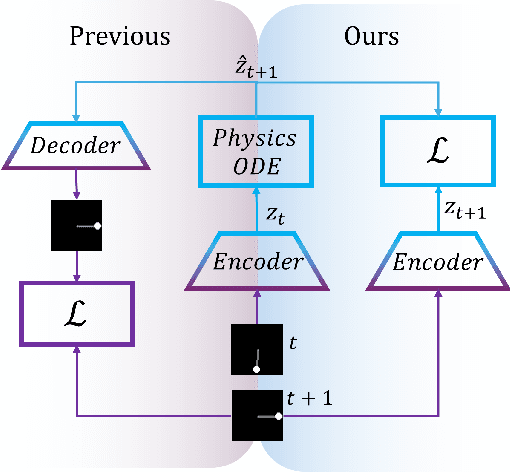
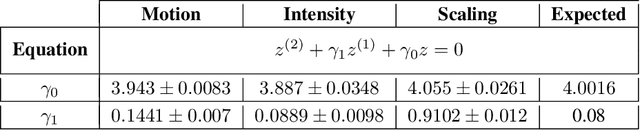
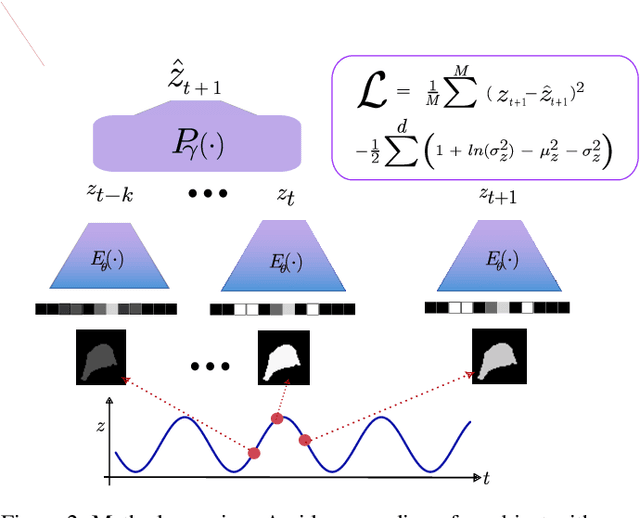

Extracting physical dynamical system parameters from videos is of great interest to applications in natural science and technology. The state-of-the-art in automatic parameter estimation from video is addressed by training supervised deep networks on large datasets. Such datasets require labels, which are difficult to acquire. While some unsupervised techniques -- which depend on frame prediction -- exist, they suffer from long training times, instability under different initializations, and are limited to hand-picked motion problems. In this work, we propose a method to estimate the physical parameters of any known, continuous governing equation from single videos; our solution is suitable for different dynamical systems beyond motion and is robust to initialization compared to previous approaches. Moreover, we remove the need for frame prediction by implementing a KL-divergence-based loss function in the latent space, which avoids convergence to trivial solutions and reduces model size and compute.