 Add to Chrome
 Add to Firefox
 Add to Edge
Room Impulse Response Completion Using Signal-Prediction Diffusion Models Conditioned on Simulated Early Reflections
Mar 16, 2026
Room impulse responses (RIRs) are fundamental to audio data augmentation, acoustic signal processing, and immersive audio rendering. While geometric simulators such as the image source method (ISM) can efficiently generate early reflections, they lack the realism of measured RIRs due to missing acoustic wave effects. We propose a diffusion-based RIR completion method using signal-prediction conditioned on ISM-simulated direct-path and early reflections. Unlike state-of-the-art methods, our approach imposes no fixed duration constraint on the input early reflections. We further incorporate classifier-free guidance to steer generation toward a target distribution learned from physically realistic RIRs simulated with the Treble SDK. Objective evaluation demonstrates that the proposed method outperforms a state-of-the-art baseline in early RIR completion and energy decay curve reconstruction.

Simulating room transfer functions between transducers mounted on audio devices using a modified image source method
Sep 07, 2023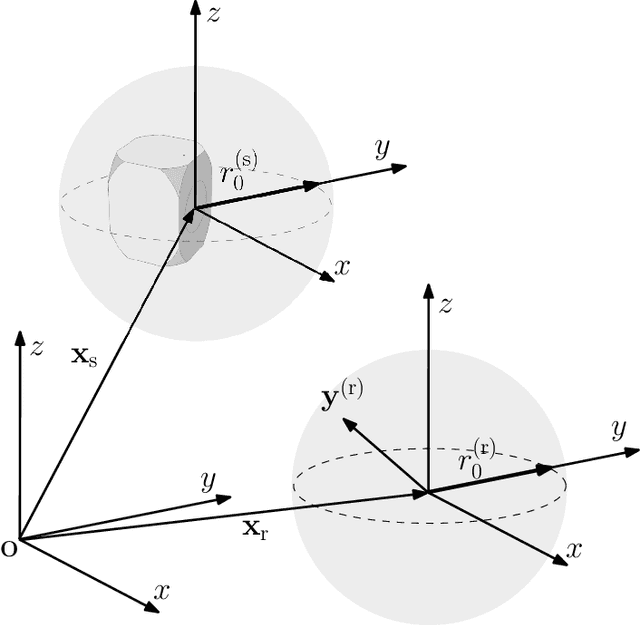
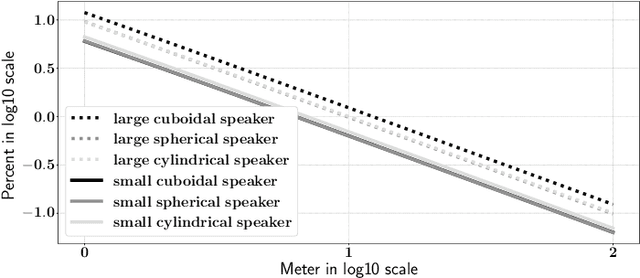
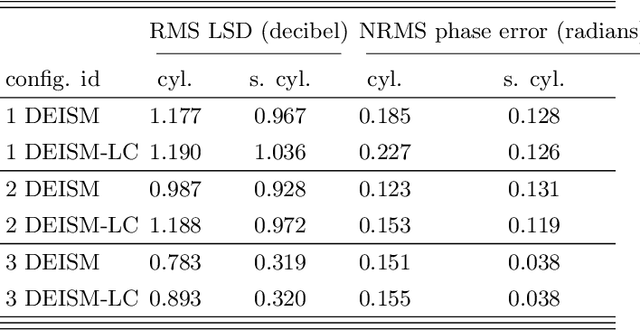
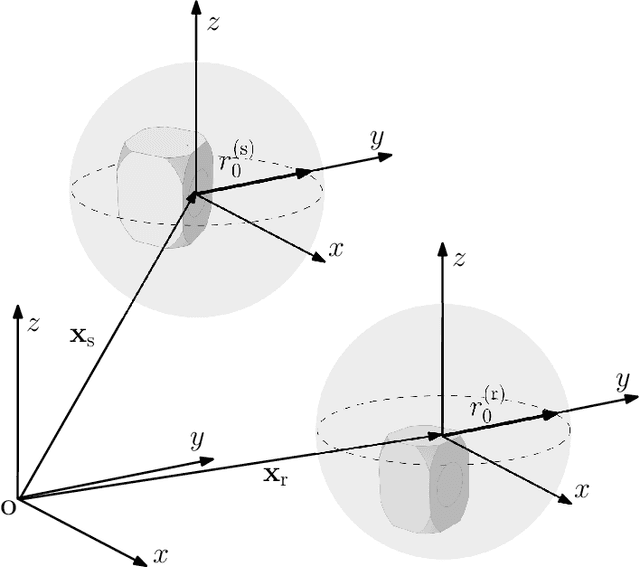
The image source method (ISM) is often used to simulate room acoustics due to its ease of use and computational efficiency. The standard ISM is limited to simulations of room impulse responses between point sources and omnidirectional receivers. In this work, the ISM is extended using spherical harmonic directivity coefficients to include acoustic diffraction effects due to source and receiver transducers mounted on physical devices, which are typically encountered in practical situations. The proposed method is verified using finite element simulations of various loudspeaker and microphone configurations in a rectangular room. It is shown that the accuracy of the proposed method is related to the sizes, shapes, number, and positions of the devices inside a room. A simplified version of the proposed method, which can significantly reduce computational effort, is also presented. The proposed method and its simplified version can simulate room transfer functions more accurately than currently available image source methods and can aid the development and evaluation of speech and acoustic signal processing algorithms, including speech enhancement, acoustic scene analysis, and acoustic parameter estimation.