 Add to Chrome
 Add to Firefox
 Add to Edge
Spatio-Semantic Expert Routing Architecture with Mixture-of-Experts for Referring Image Segmentation
Mar 13, 2026
Referring image segmentation aims to produce a pixel-level mask for the image region described by a natural-language expression. Although pretrained vision-language models have improved semantic grounding, many existing methods still rely on uniform refinement strategies that do not fully match the diverse reasoning requirements of referring expressions. Because of this mismatch, predictions often contain fragmented regions, inaccurate boundaries, or even the wrong object, especially when pretrained backbones are frozen for computational efficiency. To address these limitations, we propose SERA, a Spatio-Semantic Expert Routing Architecture for referring image segmentation. SERA introduces lightweight, expression-aware expert refinement at two complementary stages within a vision-language framework. First, we design SERA-Adapter, which inserts an expression-conditioned adapter into selected backbone blocks to improve spatial coherence and boundary precision through expert-guided refinement and cross-modal attention. We then introduce SERA-Fusion, which strengthens intermediate visual representations by reshaping token features into spatial grids and applying geometry-preserving expert transformations before multimodal interaction. In addition, a lightweight routing mechanism adaptively weights expert contributions while remaining compatible with pretrained representations. To make this routing stable under frozen encoders, SERA uses a parameter-efficient tuning strategy that updates only normalization and bias terms, affecting less than 1% of the backbone parameters. Experiments on standard referring image segmentation benchmarks show that SERA consistently outperforms strong baselines, with especially clear gains on expressions that require accurate spatial localization and precise boundary delineation.

Deformable Attentive Visual Enhancement for Referring Segmentation Using Vision-Language Model
May 25, 2025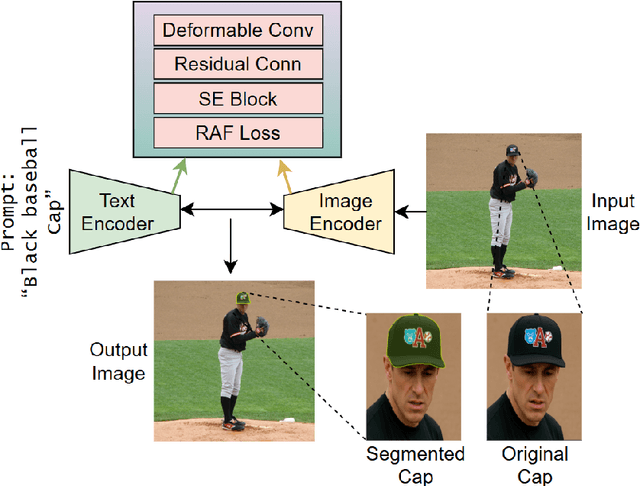
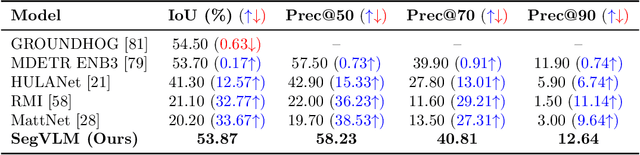
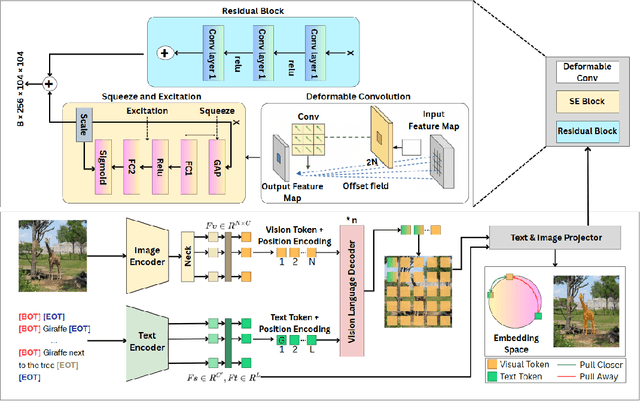

Image segmentation is a fundamental task in computer vision, aimed at partitioning an image into semantically meaningful regions. Referring image segmentation extends this task by using natural language expressions to localize specific objects, requiring effective integration of visual and linguistic information. In this work, we propose SegVLM, a vision-language model that incorporates architectural improvements to enhance segmentation accuracy and cross-modal alignment. The model integrates squeeze-and-excitation (SE) blocks for dynamic feature recalibration, deformable convolutions for geometric adaptability, and residual connections for deep feature learning. We also introduce a novel referring-aware fusion (RAF) loss that balances region-level alignment, boundary precision, and class imbalance. Extensive experiments and ablation studies demonstrate that each component contributes to consistent performance improvements. SegVLM also shows strong generalization across diverse datasets and referring expression scenarios.