 Add to Chrome
 Add to Firefox
 Add to Edge
Learning from Limited Labels: Transductive Graph Label Propagation for Indian Music Analysis
Jan 07, 2026
Supervised machine learning frameworks rely on extensive labeled datasets for robust performance on real-world tasks. However, there is a lack of large annotated datasets in audio and music domains, as annotating such recordings is resource-intensive, laborious, and often require expert domain knowledge. In this work, we explore the use of label propagation (LP), a graph-based semi-supervised learning technique, for automatically labeling the unlabeled set in an unsupervised manner. By constructing a similarity graph over audio embeddings, we propagate limited label information from a small annotated subset to a larger unlabeled corpus in a transductive, semi-supervised setting. We apply this method to two tasks in Indian Art Music (IAM): Raga identification and Instrument classification. For both these tasks, we integrate multiple public datasets along with additional recordings we acquire from Prasar Bharati Archives to perform LP. Our experiments demonstrate that LP significantly reduces labeling overhead and produces higher-quality annotations compared to conventional baseline methods, including those based on pretrained inductive models. These results highlight the potential of graph-based semi-supervised learning to democratize data annotation and accelerate progress in music information retrieval.
* Published at Journal of Acoustical Society of India, 2025

SyncNet: Using Causal Convolutions and Correlating Objective for Time Delay Estimation in Audio Signals
Mar 28, 2022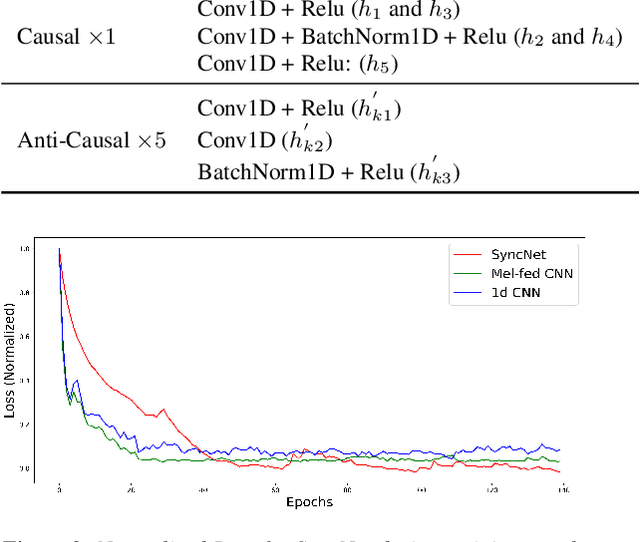
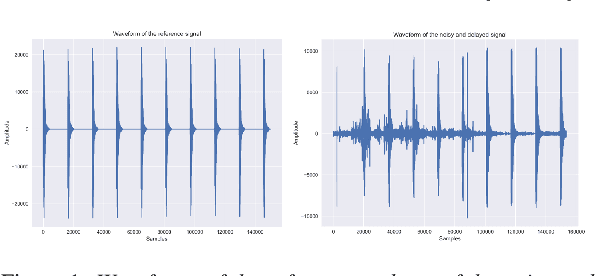
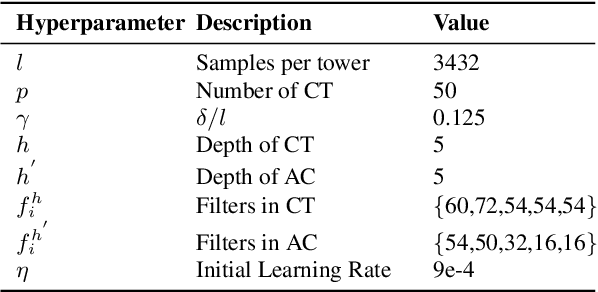
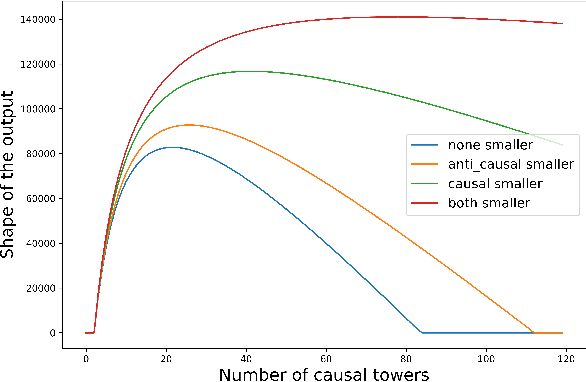
This paper addresses the task of performing robust and reliable time-delay estimation in audio-signals in noisy and reverberating environments. In contrast to the popular signal processing based methods, this paper proposes machine learning based method, i.e., a semi-causal convolutional neural network consisting of a set of causal and anti-causal layers with a novel correlation-based objective function. The causality in the network ensures non-leakage of representations from future time-intervals and the proposed loss function makes the network generate sequences with high correlation at the actual time delay. The proposed approach is also intrinsically interpretable as it does not lose time information. Even a shallow convolution network is able to capture local patterns in sequences, while also correlating them globally. SyncNet outperforms other classical approaches in estimating mutual time delays for different types of audio signals including pulse, speech and musical beats.