 Add to Chrome
 Add to Firefox
 Add to Edge
Decisive: Guiding User Decisions with Optimal Preference Elicitation from Unstructured Documents
Apr 20, 2026
Decision-making is a cognitively intensive task that requires synthesizing relevant information from multiple unstructured sources, weighing competing factors, and incorporating subjective user preferences. Existing methods, including large language models and traditional decision-support systems, fall short: they often overwhelm users with information or fail to capture nuanced preferences accurately. We present Decisive, an interactive decision-making framework that combines document-grounded reasoning with Bayesian preference inference. Our approach grounds decisions in an objective option-scoring matrix extracted from source documents, while actively learning a user's latent preference vector through targeted elicitation. Users answer pairwise tradeoff questions adaptively selected to maximize information gain over the final decision. This process converges efficiently, minimizing user effort while ensuring recommendations remain transparent and personalized. Through extensive experiments, we demonstrate that our approach significantly outperforms both general-purpose LLMs and existing decision-making frameworks achieving up to 20% improvement in decision accuracy over strong baselines across domains.

FiRST: Finetuning Router-Selective Transformers for Input-Adaptive Latency Reduction
Oct 16, 2024
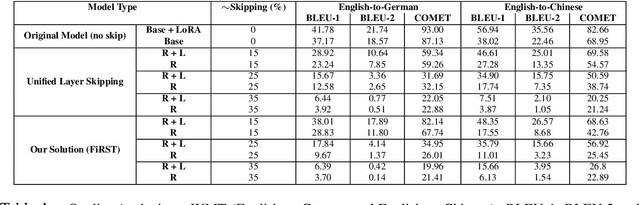
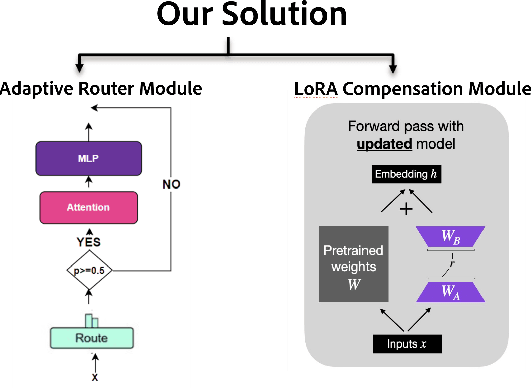

Auto-regressive Large Language Models (LLMs) demonstrate remarkable performance across domanins such as vision and language processing. However, due to sequential processing through a stack of transformer layers, autoregressive decoding faces significant computation/latency challenges, particularly in resource constrained environments like mobile and edge devices. Existing approaches in literature that aim to improve latency via skipping layers have two distinct flavors - 1) Early exit 2) Input-agnostic heuristics where tokens exit at pre-determined layers irrespective of input sequence. Both the above strategies have limitations - the former cannot be applied to handle KV Caching necessary for speed-ups in modern framework and the latter does not capture the variation in layer importance across tasks or more generally, across input sequences. To address both limitations, we propose FIRST, an algorithm that reduces inference latency by using layer-specific routers to select a subset of transformer layers adaptively for each input sequence - the prompt (during prefill stage) decides which layers will be skipped during decoding. FIRST preserves compatibility with KV caching enabling faster inference while being quality-aware. FIRST is model-agnostic and can be easily enabled on any pre-trained LLM. We further improve performance by incorporating LoRA adapters for fine-tuning on external datasets, enhancing task-specific accuracy while maintaining latency benefits. Our approach reveals that input adaptivity is critical - indeed, different task-specific middle layers play a crucial role in evolving hidden representations depending on task. Extensive experiments show that FIRST significantly reduces latency while retaining competitive performance (as compared to baselines), making our approach an efficient solution for LLM deployment in low-resource environments.