 Add to Chrome
 Add to Firefox
 Add to Edge
Constraint-Based Analysis of Reasoning Shortcuts in Neurosymbolic Learning
Apr 25, 2026
Neurosymbolic systems can satisfy logical constraints during learning without achieving the intended concept-label correspondence; this is a problem known as reasoning shortcuts. We formalize reasoning shortcuts as a constraint satisfaction problem and investigate under which conditions concept mappings are uniquely determined by the constraints. We prove that a discrimination property (requiring that no valid concept mapping can be transformed into another valid mapping by swapping two concept values) is necessary for shortcut-freeness under bijective mappings, but demonstrate via a counterexample that it is insufficient even when the constraint graph is connected. We develop an ASP-based algorithm that verifies whether a given constraint set uniquely determines the intended concept mapping, with proven soundness and completeness. When shortcuts are detected, a greedy repair algorithm eliminates them by augmenting the constraint set, converging in at most $k$ iterations, where $k$ is the number of alternative valid mappings. We further provide a complexity classification: deciding shortcut-freeness is coNP-complete, counting shortcuts is #P-complete, and finding minimal repairs is NP-hard. We also establish sample complexity bounds showing that logarithmically many label queries suffice for disambiguation in favorable cases, while querying all ambiguous positions suffices in the worst case. Experiments across eight benchmark domains validate our approach.

Formally Explaining Decision Tree Models with Answer Set Programming
Jan 07, 2026Decision tree models, including random forests and gradient-boosted decision trees, are widely used in machine learning due to their high predictive performance. However, their complex structures often make them difficult to interpret, especially in safety-critical applications where model decisions require formal justification. Recent work has demonstrated that logical and abductive explanations can be derived through automated reasoning techniques. In this paper, we propose a method for generating various types of explanations, namely, sufficient, contrastive, majority, and tree-specific explanations, using Answer Set Programming (ASP). Compared to SAT-based approaches, our ASP-based method offers greater flexibility in encoding user preferences and supports enumeration of all possible explanations. We empirically evaluate the approach on a diverse set of datasets and demonstrate its effectiveness and limitations compared to existing methods.
* In Proceedings ICLP 2025, arXiv:2601.00047
Generating Global and Local Explanations for Tree-Ensemble Learning Methods by Answer Set Programming
Oct 14, 2024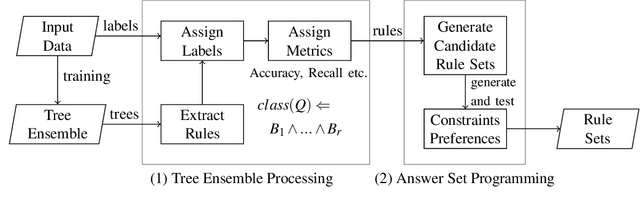
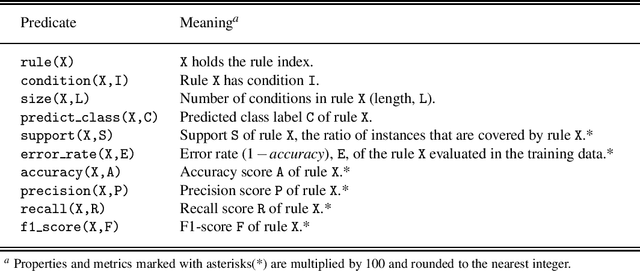
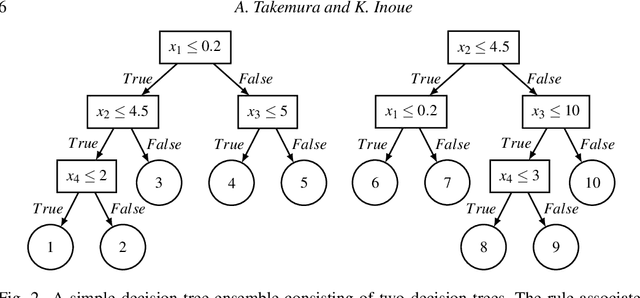
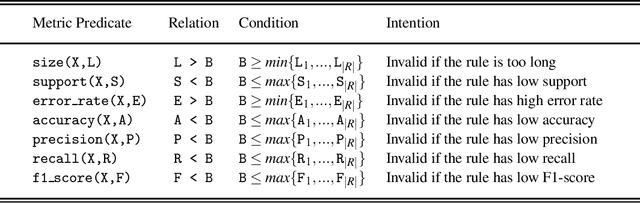
We propose a method for generating rule sets as global and local explanations for tree-ensemble learning methods using Answer Set Programming (ASP). To this end, we adopt a decompositional approach where the split structures of the base decision trees are exploited in the construction of rules, which in turn are assessed using pattern mining methods encoded in ASP to extract explanatory rules. For global explanations, candidate rules are chosen from the entire trained tree-ensemble models, whereas for local explanations, candidate rules are selected by only considering rules that are relevant to the particular predicted instance. We show how user-defined constraints and preferences can be represented declaratively in ASP to allow for transparent and flexible rule set generation, and how rules can be used as explanations to help the user better understand the models. Experimental evaluation with real-world datasets and popular tree-ensemble algorithms demonstrates that our approach is applicable to a wide range of classification tasks. Under consideration in Theory and Practice of Logic Programming (TPLP).
Differentiable Logic Programming for Distant Supervision
Aug 22, 2024We introduce a new method for integrating neural networks with logic programming in Neural-Symbolic AI (NeSy), aimed at learning with distant supervision, in which direct labels are unavailable. Unlike prior methods, our approach does not depend on symbolic solvers for reasoning about missing labels. Instead, it evaluates logical implications and constraints in a differentiable manner by embedding both neural network outputs and logic programs into matrices. This method facilitates more efficient learning under distant supervision. We evaluated our approach against existing methods while maintaining a constant volume of training data. The findings indicate that our method not only matches or exceeds the accuracy of other methods across various tasks but also speeds up the learning process. These results highlight the potential of our approach to enhance both accuracy and learning efficiency in NeSy applications.
Towards end-to-end ASP computation
Jun 13, 2023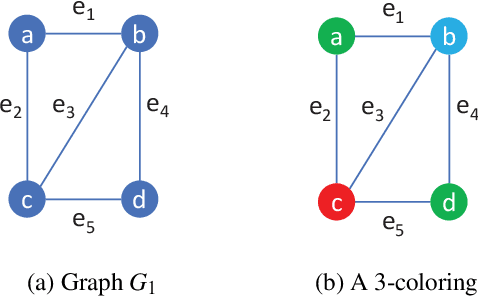
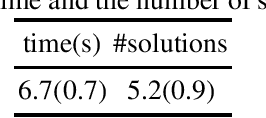
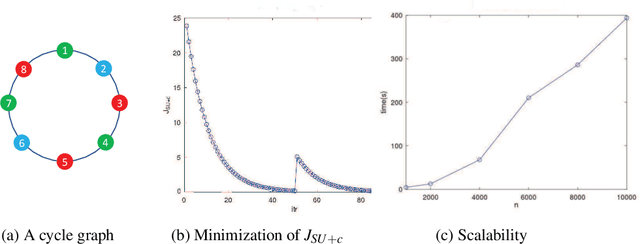

We propose an end-to-end approach for answer set programming (ASP) and linear algebraically compute stable models satisfying given constraints. The idea is to implement Lin-Zhao's theorem \cite{Lin04} together with constraints directly in vector spaces as numerical minimization of a cost function constructed from a matricized normal logic program, loop formulas in Lin-Zhao's theorem and constraints, thereby no use of symbolic ASP or SAT solvers involved in our approach. We also propose precomputation that shrinks the program size and heuristics for loop formulas to reduce computational difficulty. We empirically test our approach with programming examples including the 3-coloring and Hamiltonian cycle problems. As our approach is purely numerical and only contains vector/matrix operations, acceleration by parallel technologies such as many-cores and GPUs is expected.
Generating Explainable Rule Sets from Tree-Ensemble Learning Methods by Answer Set Programming
Sep 17, 2021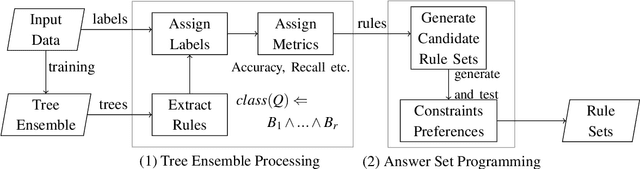
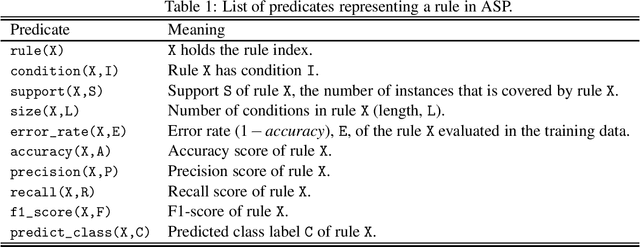
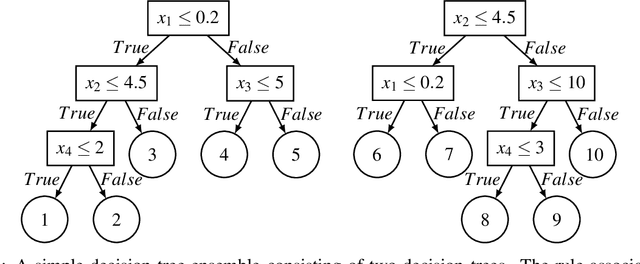
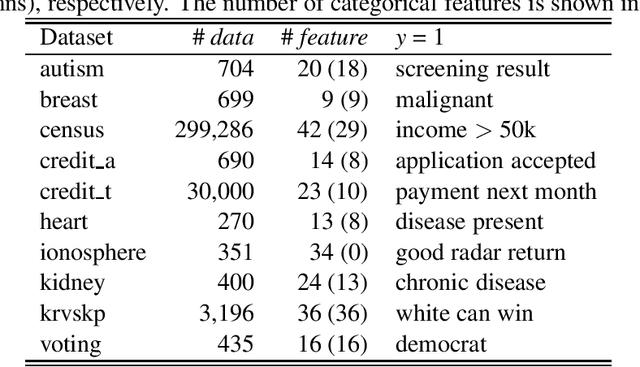
We propose a method for generating explainable rule sets from tree-ensemble learners using Answer Set Programming (ASP). To this end, we adopt a decompositional approach where the split structures of the base decision trees are exploited in the construction of rules, which in turn are assessed using pattern mining methods encoded in ASP to extract interesting rules. We show how user-defined constraints and preferences can be represented declaratively in ASP to allow for transparent and flexible rule set generation, and how rules can be used as explanations to help the user better understand the models. Experimental evaluation with real-world datasets and popular tree-ensemble algorithms demonstrates that our approach is applicable to a wide range of classification tasks.
* In Proceedings ICLP 2021, arXiv:2109.07914