 Add to Chrome
 Add to Firefox
 Add to Edge
ARMOR: Adaptive Resilience Against Model Poisoning Attacks in Continual Federated Learning for Mobile Indoor Localization
Mar 20, 2026
Indoor localization has become increasingly essential for applications ranging from asset tracking to delivering personalized services. Federated learning (FL) offers a privacy-preserving approach by training a centralized global model (GM) using distributed data from mobile devices without sharing raw data. However, real-world deployments require a continual federated learning (CFL) setting, where the GM receives continual updates under device heterogeneity and evolving indoor environments. In such dynamic conditions, erroneous or biased updates can cause the GM to deviate from its expected learning trajectory, gradually degrading internal GM representations and GM localization performance. This vulnerability is further exacerbated by adversarial model poisoning attacks. To address this challenge, we propose ARMOR, a novel CFL-based framework that monitors and safeguards the GM during continual updates. ARMOR introduces a novel state-space model (SSM) that learns the historical evolution of GM weight tensors and predicts the expected next state of weight tensors of the GM. By comparing incoming local updates with this SSM projection, ARMOR detects deviations and selectively mitigates corrupted updates before local updates are aggregated with the GM. This mechanism enables robust adaptation to temporal environmental dynamics and mitigate the effects of model poisoning attacks while preventing GM corruption. Experimental evaluations in real-world conditions indicate that ARMOR achieves notable improvements, with up to 8.0x reduction in mean error and 4.97x reduction in worst-case error compared to state-of-the-art indoor localization frameworks, demonstrating strong resilience against model corruption tested using real-world data and mobile devices.

DAILOC: Domain-Incremental Learning for Indoor Localization using Smartphones
Jun 18, 2025Wi-Fi fingerprinting-based indoor localization faces significant challenges in real-world deployments due to domain shifts arising from device heterogeneity and temporal variations within indoor environments. Existing approaches often address these issues independently, resulting in poor generalization and susceptibility to catastrophic forgetting over time. In this work, we propose DAILOC, a novel domain-incremental learning framework that jointly addresses both temporal and device-induced domain shifts. DAILOC introduces a novel disentanglement strategy that separates domain shifts from location-relevant features using a multi-level variational autoencoder. Additionally, we introduce a novel memory-guided class latent alignment mechanism to address the effects of catastrophic forgetting over time. Experiments across multiple smartphones, buildings, and time instances demonstrate that DAILOC significantly outperforms state-of-the-art methods, achieving up to 2.74x lower average error and 4.6x lower worst-case error.
SAFELOC: Overcoming Data Poisoning Attacks in Heterogeneous Federated Machine Learning for Indoor Localization
Nov 13, 2024


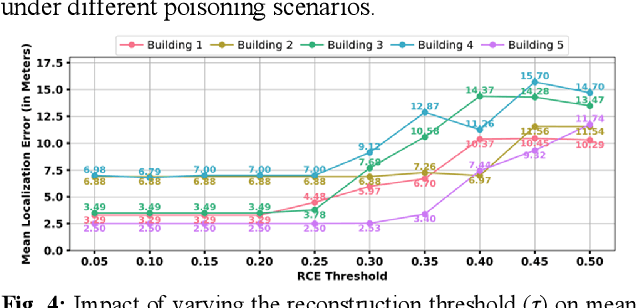
Machine learning (ML) based indoor localization solutions are critical for many emerging applications, yet their efficacy is often compromised by hardware/software variations across mobile devices (i.e., device heterogeneity) and the threat of ML data poisoning attacks. Conventional methods aimed at countering these challenges show limited resilience to the uncertainties created by these phenomena. In response, in this paper, we introduce SAFELOC, a novel framework that not only minimizes localization errors under these challenging conditions but also ensures model compactness for efficient mobile device deployment. Our framework targets a distributed and co-operative learning environment that uses federated learning (FL) to preserve user data privacy and assumes heterogeneous mobile devices carried by users (just like in most real-world scenarios). Within this heterogeneous FL context, SAFELOC introduces a novel fused neural network architecture that performs data poisoning detection and localization, with a low model footprint. Additionally, a dynamic saliency map-based aggregation strategy is designed to adapt based on the severity of the detected data poisoning scenario. Experimental evaluations demonstrate that SAFELOC achieves improvements of up to 5.9x in mean localization error, 7.8x in worst-case localization error, and a 2.1x reduction in model inference latency compared to state-of-the-art indoor localization frameworks, across diverse building floorplans, mobile devices, and ML data poisoning attack scenarios.