 Add to Chrome
 Add to Firefox
 Add to Edge
Lost in Serialization: Invariance and Generalization of LLM Graph Reasoners
Nov 13, 2025
While promising, graph reasoners based on Large Language Models (LLMs) lack built-in invariance to symmetries in graph representations. Operating on sequential graph serializations, LLMs can produce different outputs under node reindexing, edge reordering, or formatting changes, raising robustness concerns. We systematically analyze these effects, studying how fine-tuning impacts encoding sensitivity as well generalization on unseen tasks. We propose a principled decomposition of graph serializations into node labeling, edge encoding, and syntax, and evaluate LLM robustness to variations of each of these factors on a comprehensive benchmarking suite. We also contribute a novel set of spectral tasks to further assess generalization abilities of fine-tuned reasoners. Results show that larger (non-fine-tuned) models are more robust. Fine-tuning reduces sensitivity to node relabeling but may increase it to variations in structure and format, while it does not consistently improve performance on unseen tasks.

SeasFire as a Multivariate Earth System Datacube for Wildfire Dynamics
Dec 22, 2023
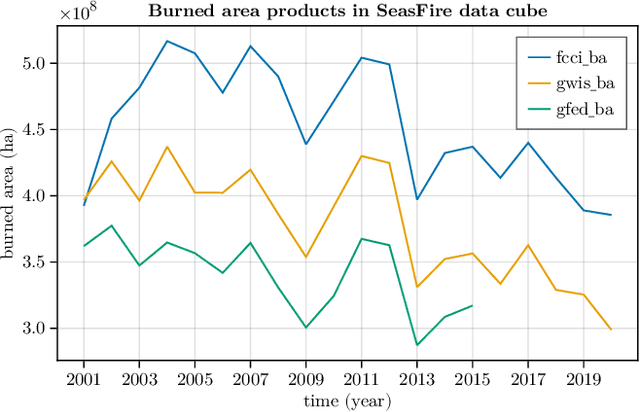


The global occurrence, scale, and frequency of wildfires pose significant threats to ecosystem services and human livelihoods. To effectively quantify and attribute the antecedent conditions for wildfires, a thorough understanding of Earth system dynamics is imperative. In response, we introduce the SeasFire datacube, a meticulously curated spatiotemporal dataset tailored for global sub-seasonal to seasonal wildfire modeling via Earth observation. The SeasFire datacube comprises of 59 variables encompassing climate, vegetation, oceanic indices, and human factors, has an 8-day temporal resolution and a spatial resolution of 0.25$^{\circ}$, and spans from 2001 to 2021. We showcase the versatility of SeasFire for exploring the variability and seasonality of wildfire drivers, modeling causal links between ocean-climate teleconnections and wildfires, and predicting sub-seasonal wildfire patterns across multiple timescales with a Deep Learning model. We publicly release the SeasFire datacube and appeal to Earth system scientists and Machine Learning practitioners to use it for an improved understanding and anticipation of wildfires.
Deep Learning for Global Wildfire Forecasting
Nov 06, 2022


Climate change is expected to aggravate wildfire activity through the exacerbation of fire weather. Improving our capabilities to anticipate wildfires on a global scale is of uttermost importance for mitigating their negative effects. In this work, we create a global fire dataset and demonstrate a prototype for predicting the presence of global burned areas on a sub-seasonal scale with the use of segmentation deep learning models. Particularly, we present an open-access global analysis-ready datacube, which contains a variety of variables related to the seasonal and sub-seasonal fire drivers (climate, vegetation, oceanic indices, human-related variables), as well as the historical burned areas and wildfire emissions for 2001-2021. We train a deep learning model, which treats global wildfire forecasting as an image segmentation task and skillfully predicts the presence of burned areas 8, 16, 32 and 64 days ahead of time. Our work motivates the use of deep learning for global burned area forecasting and paves the way towards improved anticipation of global wildfire patterns.