 Add to Chrome
 Add to Firefox
 Add to Edge
When Metrics Disagree: A Meta-Analysis of Knowledge-Graph-Completion Model Benchmarking
Jun 09, 2026
Evaluating Knowledge Graph Completion (KGC) models remains challenging because standard assessment relies on isolated rank-based metrics such as MRR, Hits$@$k, and Mean Rank, which often produce conflicting model orderings across datasets. A model that leads on MRR may trail on Hits@1, and strong performance on one dataset may not generalize to another. This fragmentation hinders comparison, enables selective reporting, and obscures real progress. We reframe KGC evaluation as a Multi-Criteria Decision-Making (MCDM) problem and present a meta-analysis of seven aggregators across five tests: consistency, cross-dataset stability, metric independence, robustness under noise, and generalizability. Each test is averaged over leave-one-model-out (LOMO) and leave-one-group-out (LOGO) removals so that reliability reflects aggregator behavior across diverse model subsets. Across tail $(h,r,?)$ and relation $(h,?,t)$ prediction, Pareto-optimal analysis identifies Z-score as the most balanced aggregator, which ranks DualE highest for tail prediction and FMS (Flow-Modulated Scoring) highest for relation prediction. A test-sensitivity analysis using the same removals shows that consistency and stability are largely removal-invariant, while generalizability and independence are the most sensitive. The framework resolves evaluation inconsistencies and offers evidence-based guidance for aggregator selection and model benchmarking in KGC.

MuCoS: Efficient Drug Target Discovery via Multi Context Aware Sampling in Knowledge Graphs
Mar 11, 2025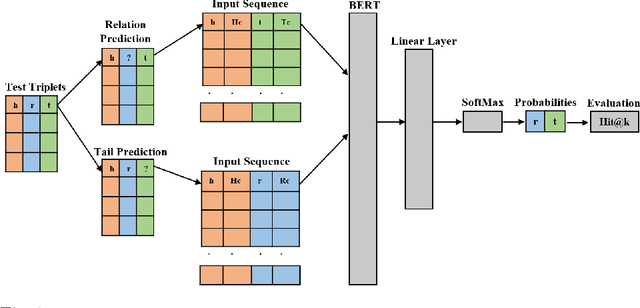
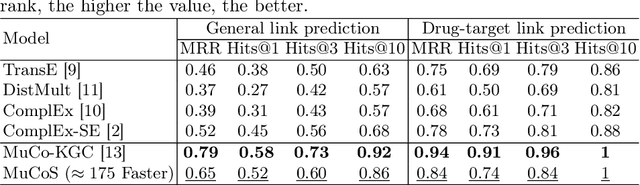

Accurate prediction of drug target interactions is critical for accelerating drug discovery and elucidating complex biological mechanisms. In this work, we frame drug target prediction as a link prediction task on heterogeneous biomedical knowledge graphs (KG) that integrate drugs, proteins, diseases, pathways, and other relevant entities. Conventional KG embedding methods such as TransE and ComplEx SE are hindered by their reliance on computationally intensive negative sampling and their limited generalization to unseen drug target pairs. To address these challenges, we propose Multi Context Aware Sampling (MuCoS), a novel framework that prioritizes high-density neighbours to capture salient structural patterns and integrates these with contextual embeddings derived from BERT. By unifying structural and textual modalities and selectively sampling highly informative patterns, MuCoS circumvents the need for negative sampling, significantly reducing computational overhead while enhancing predictive accuracy for novel drug target associations and drug targets. Extensive experiments on the KEGG50k dataset demonstrate that MuCoS outperforms state-of-the-art baselines, achieving up to a 13\% improvement in mean reciprocal rank (MRR) in predicting any relation in the dataset and a 6\% improvement in dedicated drug target relation prediction.
MuCo-KGC: Multi-Context-Aware Knowledge Graph Completion
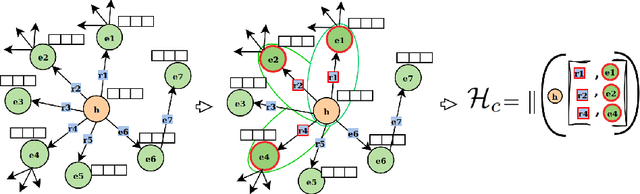
Mar 05, 2025Knowledge graph completion (KGC) seeks to predict missing entities (e.g., heads or tails) or relationships in knowledge graphs (KGs), which often contain incomplete data. Traditional embedding-based methods, such as TransE and ComplEx, have improved tail entity prediction but struggle to generalize to unseen entities during testing. Textual-based models mitigate this issue by leveraging additional semantic context; however, their reliance on negative triplet sampling introduces high computational overhead, semantic inconsistencies, and data imbalance. Recent approaches, like KG-BERT, show promise but depend heavily on entity descriptions, which are often unavailable in KGs. Critically, existing methods overlook valuable structural information in the KG related to the entities and relationships. To address these challenges, we propose Multi-Context-Aware Knowledge Graph Completion (MuCo-KGC), a novel model that utilizes contextual information from linked entities and relations within the graph to predict tail entities. MuCo-KGC eliminates the need for entity descriptions and negative triplet sampling, significantly reducing computational complexity while enhancing performance. Our experiments on standard datasets, including FB15k-237, WN18RR, CoDEx-S, and CoDEx-M, demonstrate that MuCo-KGC outperforms state-of-the-art methods on three datasets. Notably, MuCo-KGC improves MRR on WN18RR, and CoDEx-S and CoDEx-M datasets by $1.63\%$, and $3.77\%$ and $20.15\%$ respectively, demonstrating its effectiveness for KGC tasks.