 Add to Chrome
 Add to Firefox
 Add to Edge
DuaDeep-SeqAffinity: Dual-Stream Deep Learning Framework for Sequence-Only Antigen-Antibody Affinity Prediction
Dec 26, 2025
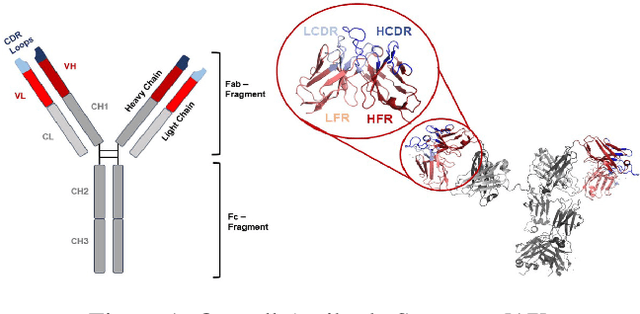

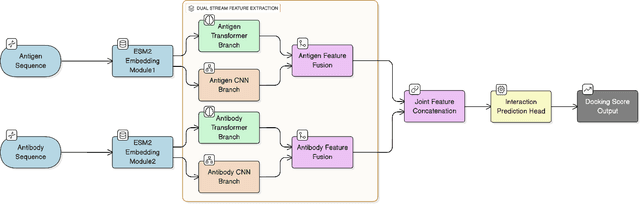

Predicting the binding affinity between antigens and antibodies is fundamental to drug discovery and vaccine development. Traditional computational approaches often rely on experimentally determined 3D structures, which are scarce and computationally expensive to obtain. This paper introduces DuaDeep-SeqAffinity, a novel sequence-only deep learning framework that predicts affinity scores solely from their amino acid sequences using a dual-stream hybrid architecture. Our approach leverages pre-trained ESM-2 protein language model embeddings, combining 1D Convolutional Neural Networks (CNNs) for local motif detection with Transformer encoders for global contextual representation. A subsequent fusion module integrates these multi-faceted features, which are then passed to a fully connected network for final score regression. Experimental results demonstrate that DuaDeep-SeqAffinity significantly outperforms individual architectural components and existing state-of-the-art (SOTA) methods. DuaDeep achieved a superior Pearson correlation of 0.688, an R^2 of 0.460, and a Root Mean Square Error (RMSE) of 0.737, surpassing single-branch variants ESM-CNN and ESM-Transformer. Notably, the model achieved an Area Under the Curve (AUC) of 0.890, outperforming sequence-only benchmarks and even surpassing structure-sequence hybrid models. These findings prove that high-fidelity sequence embeddings can capture essential binding patterns typically reserved for structural modeling. By eliminating the reliance on 3D structures, DuaDeep-SeqAffinity provides a highly scalable and efficient solution for high-throughput screening of vast sequence libraries, significantly accelerating the therapeutic discovery pipeline.

VAMP-Net: An Interpretable Multi-Path Framework of Genomic Permutation-Invariant Set Attention and Quality-Aware 1D-CNN for MTB Drug Resistance
Dec 25, 2025Genomic prediction of drug resistance in Mycobacterium tuberculosis remains challenging due to complex epistatic interactions and highly variable sequencing data quality. We present a novel Interpretable Variant-Aware Multi-Path Network (VAMP-Net) that addresses both challenges through complementary machine learning pathways. Path-1 employs a Set Attention Transformer processing permutation-invariant variant sets to capture epistatic interactions between genomic loci. Path-2 utilizes a 1D Convolutional Neural Network that analyzes Variant Call Format quality metrics to learn adaptive confidence scores. A fusion module combines both pathways for final resistance classification. We conduct comparative evaluations of unmasked versus padding-masked Set Attention Blocks, and demonstrate that our multi-path architecture achieves superior performance over baseline CNN and MLP models, with accuracy exceeding 95% and AUC around 97% for Rifampicin (RIF) and Rifabutin (RFB) resistance prediction. The framework provides dual-layer interpretability: Attention Weight Analysis reveals Epistatic networks, and Integrated Gradients (IG) was applied for critical resistance loci (notably rpoB), while gradient-based feature importance from the CNN pathway uncovers drug-specific dependencies on data quality metrics. This architecture advances clinical genomics by delivering state-of-the-art predictive performance alongside auditable interpretability at two distinct levels, genetic causality of mutation sets and technical confidence of sequencing evidence, establishing a new paradigm for robust, clinically-actionable resistance prediction.