 Add to Chrome
 Add to Firefox
 Add to Edge
Phase-Shifted Pilot Design for NOMA-Empowered Uplink ISAC Systems
Apr 02, 2026
The deployment of multiple transmitters (TXs) in integrated sensing and communication (ISAC) networks necessitates efficient resource sharing to overcome the limitations of orthogonal allocation. While conventional interleaved (CI) pilots combined with non-orthogonal multiple access (NOMA) improve spectral efficiency (SE), they inherently compromise sensing resolution due to spectral sparsity, rendering the CI nulling (CIN) extension a strictly limited remedy. This paper proposes a phase-shifted (PS) pilot design and its novel PS nulling (PSN) variant to integrate a communication TX (CTX) over the PS-ISAC framework. The PSN variant strategically punctures sensing signals at CTX pilot locations to preserve initial channel estimates, enabling a dense data overlay. To resolve the resulting multi-TX interference, joint iterative interference cancellation (IIC) is adapted for non-nulling configurations and sequential IIC is adapted for nulling variants, optimizing for both detection robustness and convergence speed. Simulation results across varying STX densities and modulation orders demonstrate that the phase-shifted frameworks maintain sensing integrity while explicitly reducing receiver-side computational complexities by $18.8\%$ and $21.0\%$ against their respective interleaved baselines.

An Efficient Low-Complexity RSMA Scheme for Multi-User Decode-and-Forward Relay Systems
Sep 13, 2024
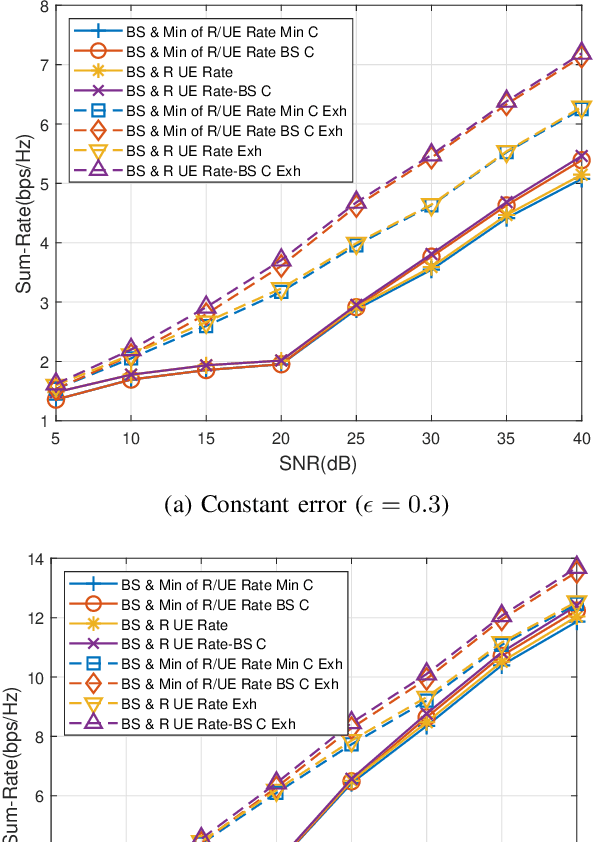
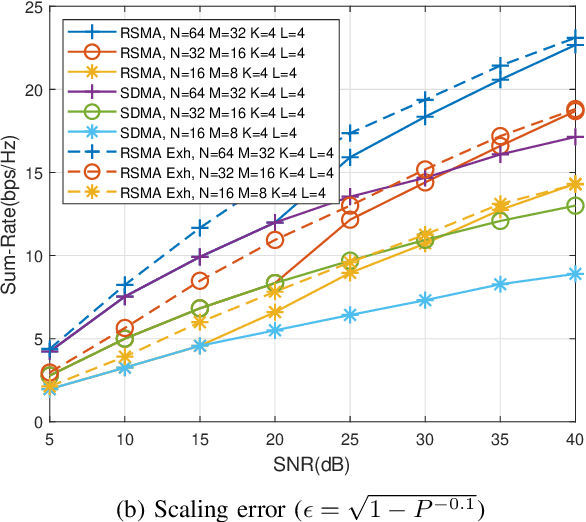
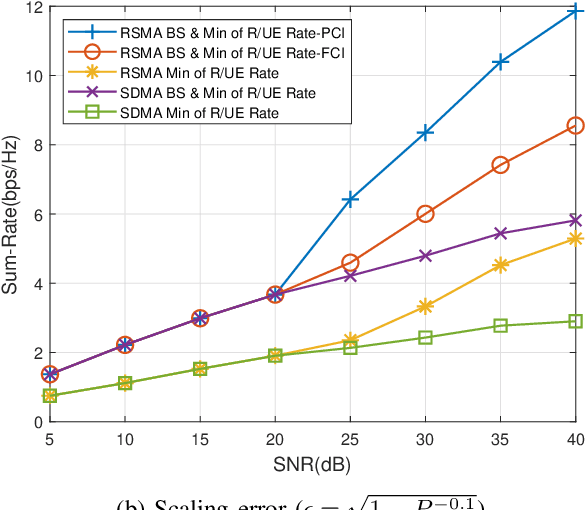
Rate-Splitting Multiple Access (RSMA) is a promising strategy for ensuring robust transmission in multi-antenna wireless systems. In this paper, we investigate the performance of RSMA in a downlink Decode-and-Forward (DF) relay scenario under two phases with imperfect Channel State Information (CSI) at the transmitter and the relay. In particular, in the first phase, the Base Station (BS) initially transmits to both BS Users (BUs) and the relay. In the second phase, the relay decodes and forwards the received signals to Relay Users (RUs) outside the BS coverage area. Furthermore, we investigate a scenario where the relay broadcasts a common stream intended for the RUs in the second phase. Due to the broadcast nature of the transmission, this stream is inadvertently received by both the RUs and the BUs. Concurrently, the BS utilizes Spatial Division Multiple Access (SDMA) to transmit private streams to the BUs, resulting in BUs experiencing residual interference from the common stream transmitted from relay. Incorporating this residual common stream interference into our model results in a significant enhancement of the overall sum-rate achieved at the BUs. We derive a tractable lower bound on the ergodic sum-rates, enables us to develop closed-form solutions for power allocation that maximize the overall sum-rate in both phases. Extensive simulations validate that our proposed power allocation algorithm, in conjunction with a low-complexity precoder, significantly improves the sum-rate performance of DF relay RSMA networks compared to the SDMA-based benchmark designs under imperfect CSI at the transmitter and relay.