 Add to Chrome
 Add to Firefox
 Add to Edge
Core-based Hierarchies for Efficient GraphRAG
Mar 05, 2026
Retrieval-Augmented Generation (RAG) enhances large language models by incorporating external knowledge. However, existing vector-based methods often fail on global sensemaking tasks that require reasoning across many documents. GraphRAG addresses this by organizing documents into a knowledge graph with hierarchical communities that can be recursively summarized. Current GraphRAG approaches rely on Leiden clustering for community detection, but we prove that on sparse knowledge graphs, where average degree is constant and most nodes have low degree, modularity optimization admits exponentially many near-optimal partitions, making Leiden-based communities inherently non-reproducible. To address this, we propose replacing Leiden with k-core decomposition, which yields a deterministic, density-aware hierarchy in linear time. We introduce a set of lightweight heuristics that leverage the k-core hierarchy to construct size-bounded, connectivity-preserving communities for retrieval and summarization, along with a token-budget-aware sampling strategy that reduces LLM costs. We evaluate our methods on real-world datasets including financial earnings transcripts, news articles, and podcasts, using three LLMs for answer generation and five independent LLM judges for head-to-head evaluation. Across datasets and models, our approach consistently improves answer comprehensiveness and diversity while reducing token usage, demonstrating that k-core-based GraphRAG is an effective and efficient framework for global sensemaking.

Better Call Graphs: A New Dataset of Function Call Graphs for Malware Classification
Dec 24, 2025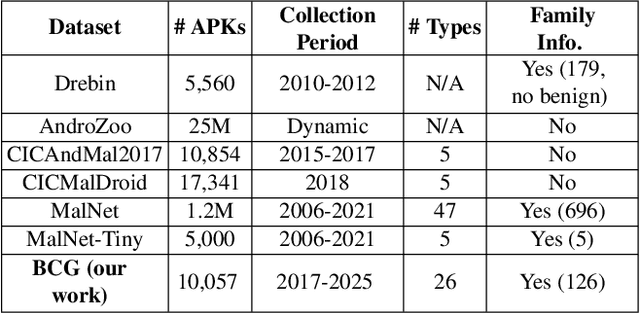
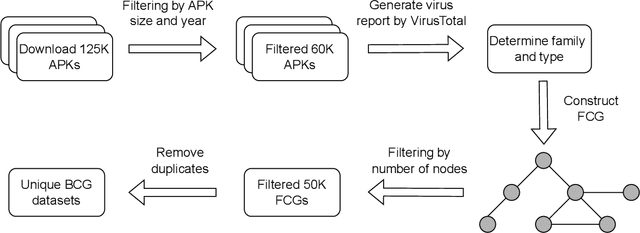
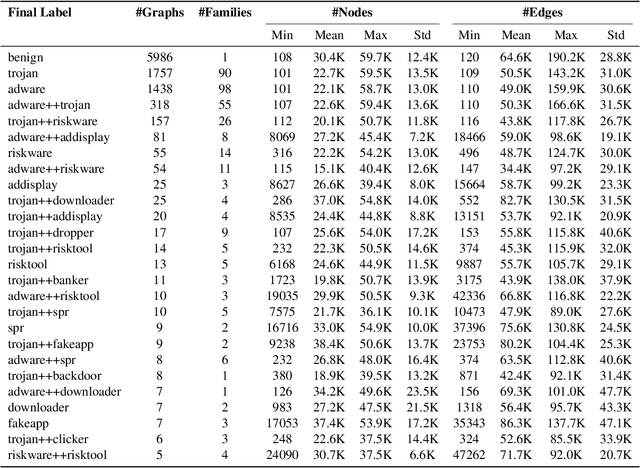
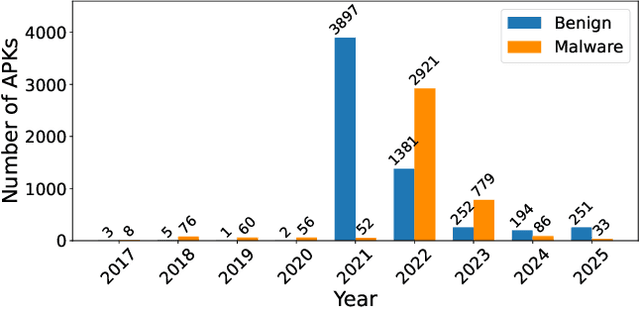
Function call graphs (FCGs) have emerged as a powerful abstraction for malware detection, capturing the behavioral structure of applications beyond surface-level signatures. Their utility in traditional program analysis has been well established, enabling effective classification and analysis of malicious software. In the mobile domain, especially in the Android ecosystem, FCG-based malware classification is particularly critical due to the platform's widespread adoption and the complex, component-based structure of Android apps. However, progress in this direction is hindered by the lack of large-scale, high-quality Android-specific FCG datasets. Existing datasets are often outdated, dominated by small or redundant graphs resulting from app repackaging, and fail to reflect the diversity of real-world malware. These limitations lead to overfitting and unreliable evaluation of graph-based classification methods. To address this gap, we introduce Better Call Graphs (BCG), a comprehensive dataset of large and unique FCGs extracted from recent Android application packages (APKs). BCG includes both benign and malicious samples spanning various families and types, along with graph-level features for each APK. Through extensive experiments using baseline classifiers, we demonstrate the necessity and value of BCG compared to existing datasets. BCG is publicly available at https://erdemub.github.io/BCG-dataset.
Quantifying Node-based Core Resilience
Jun 21, 2023
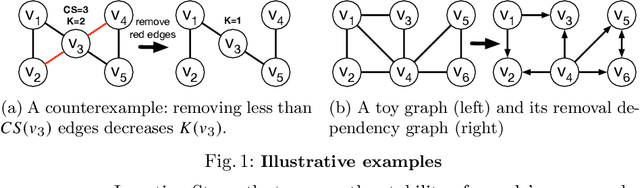
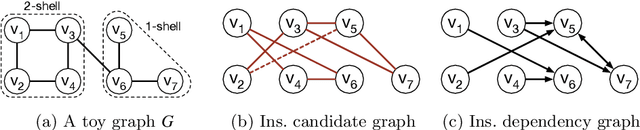
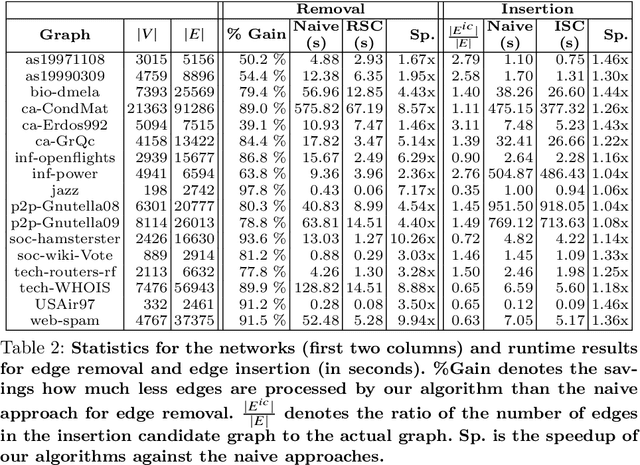
Core decomposition is an efficient building block for various graph analysis tasks such as dense subgraph discovery and identifying influential nodes. One crucial weakness of the core decomposition is its sensitivity to changes in the graph: inserting or removing a few edges can drastically change the core structure of a graph. Hence, it is essential to characterize, quantify, and, if possible, improve the resilience of the core structure of a given graph in global and local levels. Previous works mostly considered the core resilience of the entire graph or important subgraphs in it. In this work, we study node-based core resilience measures upon edge removals and insertions. We first show that a previously proposed measure, Core Strength, does not correctly capture the core resilience of a node upon edge removals. Next, we introduce the concept of dependency graph to capture the impact of neighbor nodes (for edge removal) and probable future neighbor nodes (for edge insertion) on the core number of a given node. Accordingly, we define Removal Strength and Insertion Strength measures to capture the resilience of an individual node upon removing and inserting an edge, respectively. As naive computation of those measures is costly, we provide efficient heuristics built on key observations about the core structure. We consider two key applications, finding critical edges and identifying influential spreaders, to demonstrate the usefulness of our new measures on various real-world networks and against several baselines. We also show that our heuristic algorithms are more efficient than the naive approaches.
Temporal Motifs for Financial Networks: A Study on Mercari, JPMC, and Venmo Platforms
Jan 18, 2023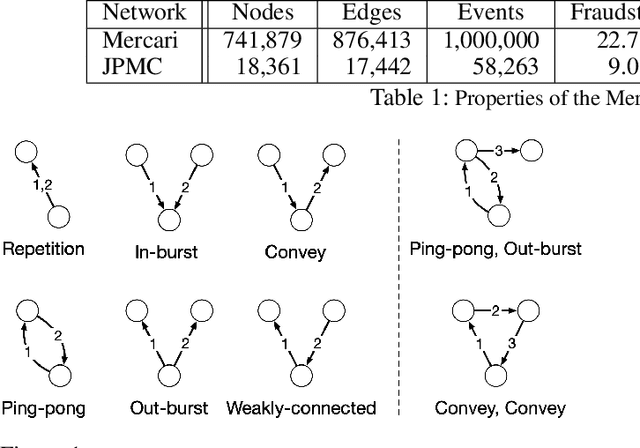
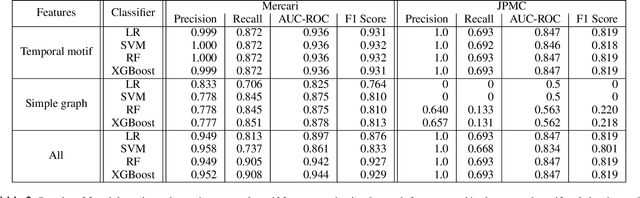
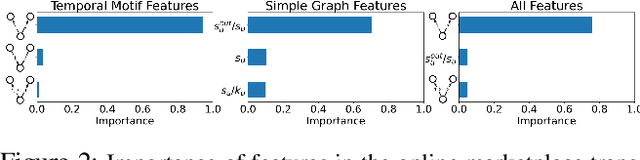
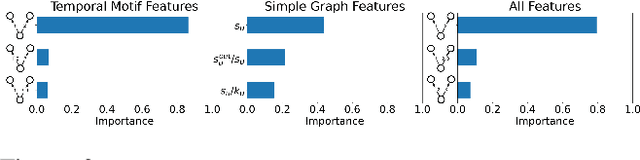
Understanding the dynamics of financial transactions among people is critically important for various applications such as fraud detection. One important aspect of financial transaction networks is temporality. The order and repetition of transactions can offer new insights when considered within the graph structure. Temporal motifs, defined as a set of nodes that interact with each other in a short time period, are a promising tool in this context. In this work, we study three unique temporal financial networks: transactions in Mercari, an online marketplace, payments in a synthetic network generated by J.P. Morgan Chase, and payments and friendships among Venmo users. We consider the fraud detection problem on the Mercari and J.P. Morgan Chase networks, for which the ground truth is available. We show that temporal motifs offer superior performance than a previous method that considers simple graph features. For the Venmo network, we investigate the interplay between financial and social relations on three tasks: friendship prediction, vendor identification, and analysis of temporal cycles. For friendship prediction, temporal motifs yield better results than general heuristics, such as Jaccard and Adamic-Adar measures. We are also able to identify vendors with high accuracy and observe interesting patterns in rare motifs, like temporal cycles. We believe that the analysis, datasets, and lessons from this work will be beneficial for future research on financial transaction networks.