 Add to Chrome
 Add to Firefox
 Add to Edge
An Image Dataset of Common Skin Diseases of Bangladesh and Benchmarking Performance with Machine Learning Models
Mar 26, 2026
Skin diseases are a major public health concern worldwide, and their detection is often challenging without access to dermatological expertise. In countries like Bangladesh, which is highly populated, the number of qualified skin specialists and diagnostic instruments is insufficient to meet the demand. Due to the lack of proper detection and treatment of skin diseases, that may lead to severe health consequences including death. Common properties of skin diseases are, changing the color, texture, and pattern of skin and in this era of artificial intelligence and machine learning, we are able to detect skin diseases by using image processing and computer vision techniques. In response to this challenge, we develop a publicly available dataset focused on common skin disease detection using machine learning techniques. We focus on five prevalent skin diseases in Bangladesh: Contact Dermatitis, Vitiligo, Eczema, Scabies, and Tinea Ringworm. The dataset consists of 1612 images (of which, 250 are distinct while others are augmented), collected directly from patients at the outpatient department of Faridpur Medical College, Faridpur, Bangladesh. The data comprises of 302, 381, 301, 316, and 312 images of Dermatitis, Eczema, Scabies, Tinea Ringworm, and Vitiligo, respectively. Although the data are collected regionally, the selected diseases are common across many countries especially in South Asia, making the dataset potentially valuable for global applications in machine learning-based dermatology. We also apply several machine learning and deep learning models on the dataset and report classification performance. We expect that this research would garner attention from machine learning and deep learning researchers and practitioners working in the field of automated disease diagnosis.

State-of-the-Art Translation of Text-to-Gloss using mBART : A case study of Bangla
Apr 03, 2025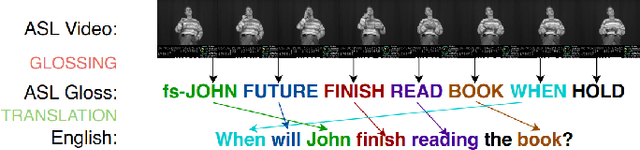
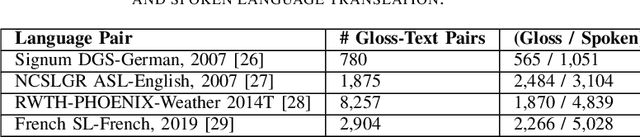

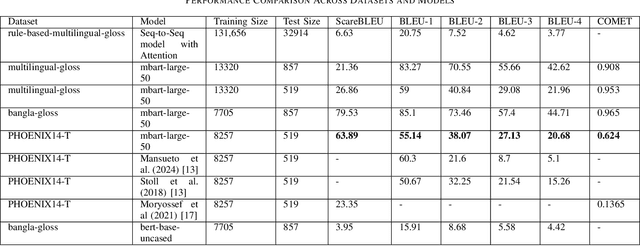
Despite a large deaf and dumb population of 1.7 million, Bangla Sign Language (BdSL) remains a understudied domain. Specifically, there are no works on Bangla text-to-gloss translation task. To address this gap, we begin by addressing the dataset problem. We take inspiration from grammatical rule based gloss generation used in Germany and American sign langauage (ASL) and adapt it for BdSL. We also leverage LLM to generate synthetic data and use back-translation, text generation for data augmentation. With dataset prepared, we started experimentation. We fine-tuned pretrained mBART-50 and mBERT-multiclass-uncased model on our dataset. We also trained GRU, RNN and a novel seq-to-seq model with multi-head attention. We observe significant high performance (ScareBLEU=79.53) with fine-tuning pretrained mBART-50 multilingual model from Facebook. We then explored why we observe such high performance with mBART. We soon notice an interesting property of mBART -- it was trained on shuffled and masked text data. And as we know, gloss form has shuffling property. So we hypothesize that mBART is inherently good at text-to-gloss tasks. To find support against this hypothesis, we trained mBART-50 on PHOENIX-14T benchmark and evaluated it with existing literature. Our mBART-50 finetune demonstrated State-of-the-Art performance on PHOENIX-14T benchmark, far outperforming existing models in all 6 metrics (ScareBLEU = 63.89, BLEU-1 = 55.14, BLEU-2 = 38.07, BLEU-3 = 27.13, BLEU-4 = 20.68, COMET = 0.624). Based on the results, this study proposes a new paradigm for text-to-gloss task using mBART models. Additionally, our results show that BdSL text-to-gloss task can greatly benefit from rule-based synthetic dataset.