 Add to Chrome
 Add to Firefox
 Add to Edge
Geometrically Consistent Multi-View Scene Generation from Freehand Sketches
Apr 15, 2026
We tackle a new problem: generating geometrically consistent multi-view scenes from a single freehand sketch. Freehand sketches are the most geometrically impoverished input one could offer a multi-view generator. They convey scene intent through abstract strokes while introducing spatial distortions that actively conflict with any consistent 3D interpretation. No prior method attempts this; existing multi-view approaches require photographs or text, while sketch-to-3D methods need multiple views or costly per-scene optimisation. We address three compounding challenges; absent training data, the need for geometric reasoning from distorted 2D input, and cross-view consistency, through three mutually reinforcing contributions: (i) a curated dataset of $\sim$9k sketch-to-multiview samples, constructed via an automated generation and filtering pipeline; (ii) Parallel Camera-Aware Attention Adapters (CA3) that inject geometric inductive biases into the video transformer; and (iii) a Sparse Correspondence Supervision Loss (CSL) derived from Structure-from-Motion reconstructions. Our framework synthesizes all views in a single denoising process without requiring reference images, iterative refinement, or per-scene optimization. Our approach significantly outperforms state-of-the-art two-stage baselines, improving realism (FID) by over 60% and geometric consistency (Corr-Acc) by 23%, while providing up to a 3.7$\times$ inference speedup.

SketchingReality: From Freehand Scene Sketches To Photorealistic Images
Feb 16, 2026Recent years have witnessed remarkable progress in generative AI, with natural language emerging as the most common conditioning input. As underlying models grow more powerful, researchers are exploring increasingly diverse conditioning signals, such as depth maps, edge maps, camera parameters, and reference images, to give users finer control over generation. Among different modalities, sketches are a natural and long-standing form of human communication, enabling rapid expression of visual concepts. Previous literature has largely focused on edge maps, often misnamed 'sketches', yet algorithms that effectively handle true freehand sketches, with their inherent abstraction and distortions, remain underexplored. We pursue the challenging goal of balancing photorealism with sketch adherence when generating images from freehand input. A key obstacle is the absence of ground-truth, pixel-aligned images: by their nature, freehand sketches do not have a single correct alignment. To address this, we propose a modulation-based approach that prioritizes semantic interpretation of the sketch over strict adherence to individual edge positions. We further introduce a novel loss that enables training on freehand sketches without requiring ground-truth pixel-aligned images. We show that our method outperforms existing approaches in both semantic alignment with freehand sketch inputs and in the realism and overall quality of the generated images.
Open Vocabulary Semantic Scene Sketch Understanding
Dec 18, 2023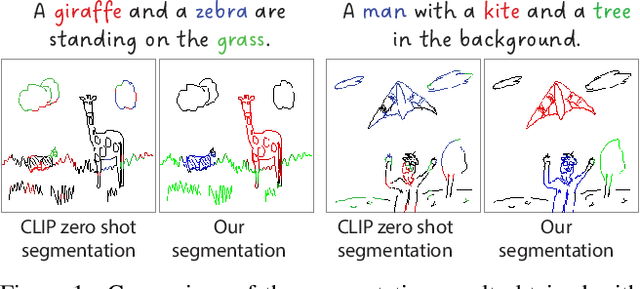
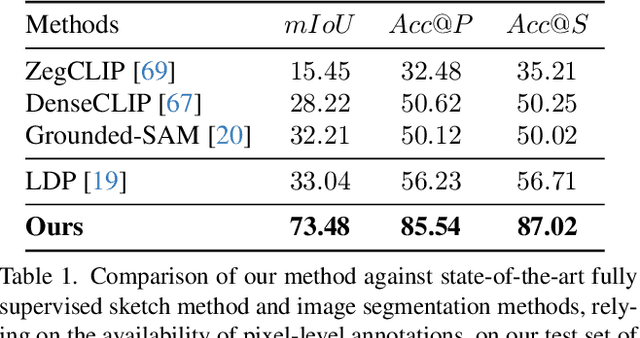
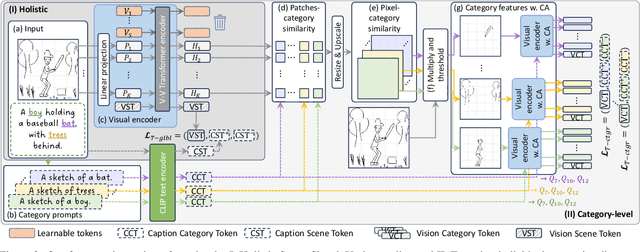
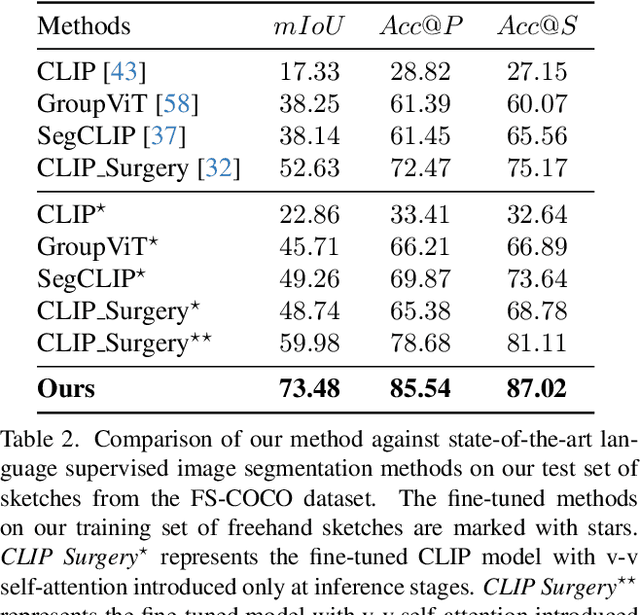
We study the underexplored but fundamental vision problem of machine understanding of abstract freehand scene sketches. We introduce a sketch encoder that results in semantically-aware feature space, which we evaluate by testing its performance on a semantic sketch segmentation task. To train our model we rely only on the availability of bitmap sketches with their brief captions and do not require any pixel-level annotations. To obtain generalization to a large set of sketches and categories, we build on a vision transformer encoder pretrained with the CLIP model. We freeze the text encoder and perform visual-prompt tuning of the visual encoder branch while introducing a set of critical modifications. Firstly, we augment the classical key-query (k-q) self-attention blocks with value-value (v-v) self-attention blocks. Central to our model is a two-level hierarchical network design that enables efficient semantic disentanglement: The first level ensures holistic scene sketch encoding, and the second level focuses on individual categories. We, then, in the second level of the hierarchy, introduce a cross-attention between textual and visual branches. Our method outperforms zero-shot CLIP pixel accuracy of segmentation results by 37 points, reaching an accuracy of $85.5\%$ on the FS-COCO sketch dataset. Finally, we conduct a user study that allows us to identify further improvements needed over our method to reconcile machine and human understanding of scene sketches.