 Add to Chrome
 Add to Firefox
 Add to Edge
Generative AI in Saudi Arabia: A National Survey of Adoption, Risks, and Public Perceptions
Jan 26, 2026
Generative Artificial Intelligence (GenAI) is rapidly becoming embedded in Saudi Arabia's digital transformation under Vision 2030, yet public awareness, adoption, and concerns surrounding these tools remain underexplored. This study provides an early snapshot of GenAI engagement among Saudi nationals. Using a nationwide survey of 330 participants across regions, age groups, and employment sectors, we examine seven dimensions of GenAI use: awareness and understanding, adoption patterns, perceived impacts, training needs, risks and barriers, data-sharing behaviors, and future expectations. Findings show that 93% of respondents actively use GenAI primarily for text-based tasks, while more advanced uses such as programming or multimodal generation are less common. Despite the prevalence of use, overall awareness and conceptual understanding remain uneven, with many reporting limited technical knowledge. Participants recognize GenAI's benefits for productivity, work quality, and understanding complex information, yet caution that sustained reliance may undermine critical thinking and key professional skills. Trust in AI-generated outputs remains cautious, with widespread concerns about privacy, misinformation, and ethical misuse, including potential job displacement. Respondents show strong interest in structured GenAI training that combines foundational skills, domain-specific applications, and clear guidance on privacy, ethics, and responsible use. These results establish a baseline for GenAI engagement in Saudi Arabia and highlight priorities for policymakers and developers: expanding AI literacy, ensuring culturally and linguistically aligned GenAI solutions, and strengthening frameworks for privacy and responsible deployment.

Assertion-Aware Test Code Summarization with Large Language Models
Nov 09, 2025Unit tests often lack concise summaries that convey test intent, especially in auto-generated or poorly documented codebases. Large Language Models (LLMs) offer a promising solution, but their effectiveness depends heavily on how they are prompted. Unlike generic code summarization, test-code summarization poses distinct challenges because test methods validate expected behavior through assertions rather than implementing functionality. This paper presents a new benchmark of 91 real-world Java test cases paired with developer-written summaries and conducts a controlled ablation study to investigate how test code-related components-such as the method under test (MUT), assertion messages, and assertion semantics-affect the performance of LLM-generated test summaries. We evaluate four code LLMs (Codex, Codestral, DeepSeek, and Qwen-Coder) across seven prompt configurations using n-gram metrics (BLEU, ROUGE-L, METEOR), semantic similarity (BERTScore), and LLM-based evaluation. Results show that prompting with assertion semantics improves summary quality by an average of 0.10 points (2.3%) over full MUT context (4.45 vs. 4.35) while requiring fewer input tokens. Codex and Qwen-Coder achieve the highest alignment with human-written summaries, while DeepSeek underperforms despite high lexical overlap. The replication package is publicly available at https://doi.org/10. 5281/zenodo.17067550
Secure Code Generation at Scale with Reflexion
Nov 05, 2025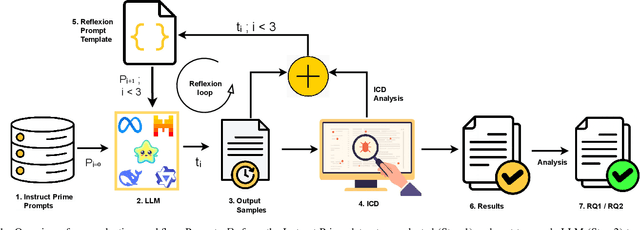
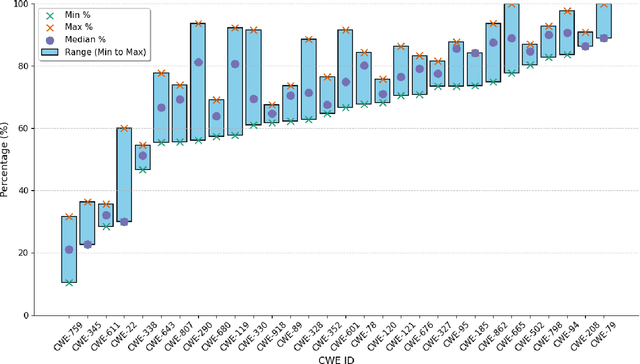
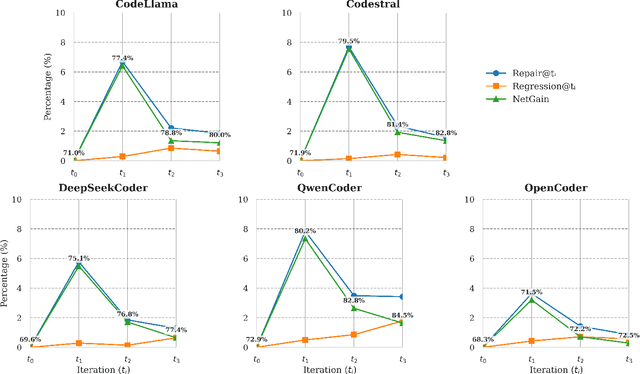

Large language models (LLMs) are now widely used to draft and refactor code, but code that works is not necessarily secure. We evaluate secure code generation using the Instruct Prime, which eliminated compliance-required prompts and cue contamination, and evaluate five instruction-tuned code LLMs using a zero-shot baseline and a three-round reflexion prompting approach. Security is measured using the Insecure Code Detector (ICD), and results are reported by measuring Repair, Regression, and NetGain metrics, considering the programming language and CWE family. Our findings show that insecurity remains common at the first round: roughly 25-33% of programs are insecure at a zero-shot baseline (t0 ). Weak cryptography/config-dependent bugs are the hardest to avoid while templated ones like XSS, code injection, and hard-coded secrets are handled more reliably. Python yields the highest secure rates; C and C# are the lowest, with Java, JS, PHP, and C++ in the middle. Reflexion prompting improves security for all models, improving average accuracy from 70.74% at t0 to 79.43% at t3 , with the largest gains in the first round followed by diminishing returns. The trends with Repair, Regression, and NetGain metrics show that applying one to two rounds produces most of the benefits. A replication package is available at https://doi.org/10.5281/zenodo.17065846.