 Add to Chrome
 Add to Firefox
 Add to Edge
BLM-SGAN: Bidirectional Language Modeling for Semantic-Spatial Text-to-Image Generation
Jun 07, 2026
Despite the success of image generation from text descriptions, it still faces challenges that are difficult to overcome in domains such as natural language processing (NLP) and computer vision (CV). Recent advancements in text-to-image (T2I) models, particularly those utilizing generative adversarial networks (GANs), have significantly improved the synthesis of realistic images across various domains. However, existing GAN-based T2I models still encounter key challenges, such as difficulty in capturing long-range dependencies, vanishing gradients, and the limitations of sequential processing. To address these issues, we introduce BLM-SGAN, a novel model that incorporates Bidirectional Language Modeling for Semantic-Spatial Text-to-Image Generation. BLM-SGAN leverages BERT's attention mechanisms to capture rich contextual information and efficiently manage extended sequences. Our model demonstrates state-of-the-art performance, with an Inception Score (IS) of 5.45 +/- 0.08, surpassing several competitive models such as SSA-GAN, DF-GAN, SD-GAN, and AttnGAN. BLM-SGAN effectively generates highly realistic images of birds from detailed text descriptions. The implementation code is available at: https://github.com/haidy-maher/BLM-SGAN-Text-to-Image-Generation.
* Published in ICACIn 2024. Appears in Advances on Intelligent Computing and Data Science II, Lecture Notes on Data Engineering and Communications Technologies, vol. 254, Springer, 2025

LLM-SEM: A Sentiment-Based Student Engagement Metric Using LLMS for E-Learning Platforms
Dec 19, 2024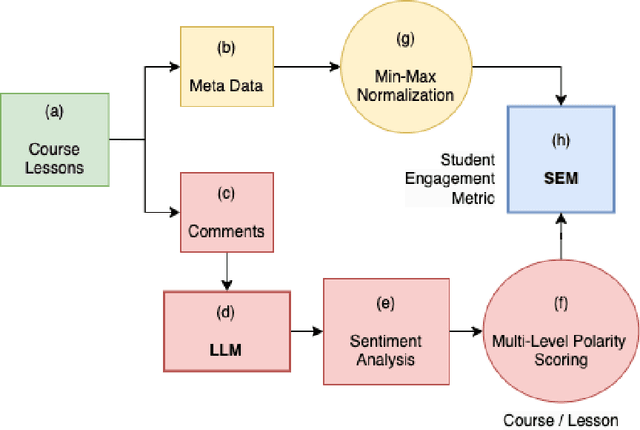
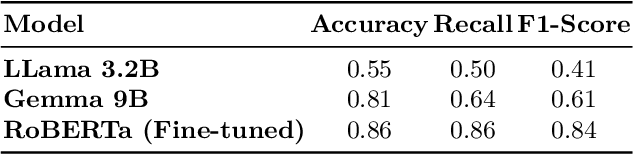
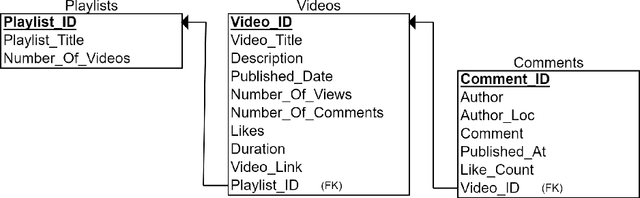
Current methods for analyzing student engagement in e-learning platforms, including automated systems, often struggle with challenges such as handling fuzzy sentiment in text comments and relying on limited metadata. Traditional approaches, such as surveys and questionnaires, also face issues like small sample sizes and scalability. In this paper, we introduce LLM-SEM (Language Model-Based Student Engagement Metric), a novel approach that leverages video metadata and sentiment analysis of student comments to measure engagement. By utilizing recent Large Language Models (LLMs), we generate high-quality sentiment predictions to mitigate text fuzziness and normalize key features such as views and likes. Our holistic method combines comprehensive metadata with sentiment polarity scores to gauge engagement at both the course and lesson levels. Extensive experiments were conducted to evaluate various LLM models, demonstrating the effectiveness of LLM-SEM in providing a scalable and accurate measure of student engagement. We fine-tuned TXLM-RoBERTa using human-annotated sentiment datasets to enhance prediction accuracy and utilized LLama 3B, and Gemma 9B from Ollama.