 Add to Chrome
 Add to Firefox
 Add to Edge
Evaluating Robustness and Adaptability in Learning-Based Mission Planning for Active Debris Removal
Feb 04, 2026
Autonomous mission planning for Active Debris Removal (ADR) must balance efficiency, adaptability, and strict feasibility constraints on fuel and mission duration. This work compares three planners for the constrained multi-debris rendezvous problem in Low Earth Orbit: a nominal Masked Proximal Policy Optimization (PPO) policy trained under fixed mission parameters, a domain-randomized Masked PPO policy trained across varying mission constraints for improved robustness, and a plain Monte Carlo Tree Search (MCTS) baseline. Evaluations are conducted in a high-fidelity orbital simulation with refueling, realistic transfer dynamics, and randomized debris fields across 300 test cases in nominal, reduced fuel, and reduced mission time scenarios. Results show that nominal PPO achieves top performance when conditions match training but degrades sharply under distributional shift, while domain-randomized PPO exhibits improved adaptability with only moderate loss in nominal performance. MCTS consistently handles constraint changes best due to online replanning but incurs orders-of-magnitude higher computation time. The findings underline a trade-off between the speed of learned policies and the adaptability of search-based methods, and suggest that combining training-time diversity with online planning could be a promising path for future resilient ADR mission planners.

Optimizing Mission Planning for Multi-Debris Rendezvous Using Reinforcement Learning with Refueling and Adaptive Collision Avoidance
Feb 04, 2026As the orbital environment around Earth becomes increasingly crowded with debris, active debris removal (ADR) missions face significant challenges in ensuring safe operations while minimizing the risk of in-orbit collisions. This study presents a reinforcement learning (RL) based framework to enhance adaptive collision avoidance in ADR missions, specifically for multi-debris removal using small satellites. Small satellites are increasingly adopted due to their flexibility, cost effectiveness, and maneuverability, making them well suited for dynamic missions such as ADR. Building on existing work in multi-debris rendezvous, the framework integrates refueling strategies, efficient mission planning, and adaptive collision avoidance to optimize spacecraft rendezvous operations. The proposed approach employs a masked Proximal Policy Optimization (PPO) algorithm, enabling the RL agent to dynamically adjust maneuvers in response to real-time orbital conditions. Key considerations include fuel efficiency, avoidance of active collision zones, and optimization of dynamic orbital parameters. The RL agent learns to determine efficient sequences for rendezvousing with multiple debris targets, optimizing fuel usage and mission time while incorporating necessary refueling stops. Simulated ADR scenarios derived from the Iridium 33 debris dataset are used for evaluation, covering diverse orbital configurations and debris distributions to demonstrate robustness and adaptability. Results show that the proposed RL framework reduces collision risk while improving mission efficiency compared to traditional heuristic approaches. This work provides a scalable solution for planning complex multi-debris ADR missions and is applicable to other multi-target rendezvous problems in autonomous space mission planning.
Revisiting Space Mission Planning: A Reinforcement Learning-Guided Approach for Multi-Debris Rendezvous
Sep 25, 2024
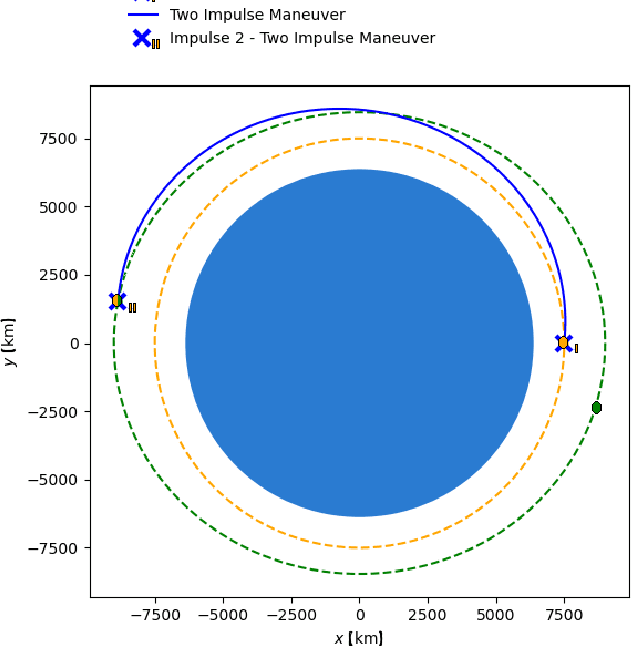


This research introduces a novel application of a masked Proximal Policy Optimization (PPO) algorithm from the field of deep reinforcement learning (RL), for determining the most efficient sequence of space debris visitation, utilizing the Lambert solver as per Izzo's adaptation for individual rendezvous. The aim is to optimize the sequence in which all the given debris should be visited to get the least total time for rendezvous for the entire mission. A neural network (NN) policy is developed, trained on simulated space missions with varying debris fields. After training, the neural network calculates approximately optimal paths using Izzo's adaptation of Lambert maneuvers. Performance is evaluated against standard heuristics in mission planning. The reinforcement learning approach demonstrates a significant improvement in planning efficiency by optimizing the sequence for debris rendezvous, reducing the total mission time by an average of approximately {10.96\%} and {13.66\%} compared to the Genetic and Greedy algorithms, respectively. The model on average identifies the most time-efficient sequence for debris visitation across various simulated scenarios with the fastest computational speed. This approach signifies a step forward in enhancing mission planning strategies for space debris clearance.