 Add to Chrome
 Add to Firefox
 Add to Edge
Injecting Image Guidance into Text-Conditioned Diffusion Models at Inference
May 24, 2026
Text-to-image diffusion models like Stable Diffusion generate high-quality images from text, but lack a way to inject visual guidance (e.g. sketches, styles) at inference without retraining. Existing methods either require computationally expensive fine-tuning or rely on style transfer techniques that risk semantic misalignment with textual prompts. We introduce Visual Concept Fusion (VCF), the first method offering dual conditioning on both an image and text prompt at inference time without any concept-specific training. VCF enables visual concept injection into Stable Diffusion by aligning CLIP image features with the text embedding space. VCF consists of three components: (1) a lightweight aligner that maps image tokens to the text embedding manifold using InfoNCE and cross-attention reconstruction losses, (2) a fusion strategy that preserves both textual and visual semantics, and (3) an optional Prompt-Noise Optimization (PNO) module for test-time refinement. Our experiments demonstrate that VCF successfully transfers visual attributes including style, composition, and color palette from reference images while maintaining prompt adherence. Quantitative results show a trade-off between text alignment (CLIP score) and visual correspondence (LPIPS), with VCF outperforming baselines in reference fidelity.

WineGraph: A Graph Representation For Food-Wine Pairing
Jun 27, 2024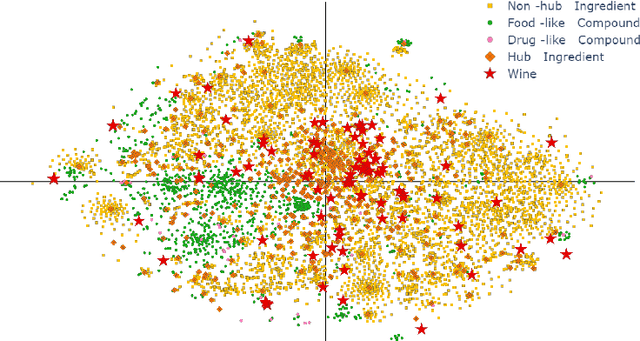
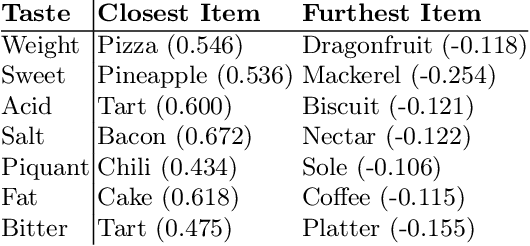

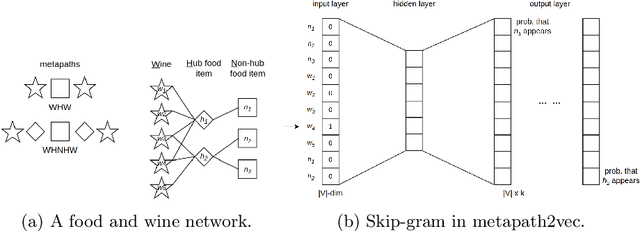
We present WineGraph, an extended version of FlavorGraph, a heterogeneous graph incorporating wine data into its structure. This integration enables food-wine pairing based on taste and sommelier-defined rules. Leveraging a food dataset comprising 500,000 reviews and a wine reviews dataset with over 130,000 entries, we computed taste descriptors for both food and wine. This information was then utilised to pair food items with wine and augment FlavorGraph with additional data. The results demonstrate the potential of heterogeneous graphs to acquire supplementary information, proving beneficial for wine pairing.