 Add to Chrome
 Add to Firefox
 Add to Edge
Federated Learning for Distributed CNC Tool Wear Prediction
Aug 11, 2026
Tool wear prediction is an important task in CNC machining, where accurate monitoring of tool condition supports product quality and process reliability. Machine learning methods have shown potential for this task, but their use in industrial environments is limited by the distributed nature of machining data and by restrictions on data sharing between machines, sites, or organizations. Federated learning offers a suitable framework for this setting by enabling collaborative model training without transferring raw operational data. This paper investigates federated learning for CNC tool wear prediction. Tool trajectories are distributed across simulated clients to represent a federated learning scenario. The federated models are compared against centralized references and local client baselines. Results show that federated learning achieves performance close to centralized learning and improves significantly over local client models. These findings indicate that federated learning can support collaborative tool wear prediction in distributed CNC manufacturing environments.

HybridFL: A Federated Learning Approach for Financial Crime Detection
Feb 22, 2026Federated learning (FL) is a privacy-preserving machine learning paradigm that enables multiple parties to collaboratively train models on privately owned data without sharing raw information. While standard FL typically addresses either horizontal or vertical data partitions, many real-world scenarios exhibit a complex hybrid distribution. This paper proposes Hybrid Federated Learning (HybridFL) to address data split both horizontally across disjoint users and vertically across complementary feature sets. We evaluate HybridFL in a financial crime detection context, where a transaction party holds transaction-level attributes and multiple banks maintain private account-level features. By integrating horizontal aggregation and vertical feature fusion, the proposed architecture enables joint learning while strictly preserving data locality. Experiments on AMLSim and SWIFT datasets demonstrate that HybridFL significantly outperforms the transaction-only local model and achieves performance comparable to a centralized benchmark.
VFL-RPS: Relevant Participant Selection in Vertical Federated Learning
Feb 20, 2025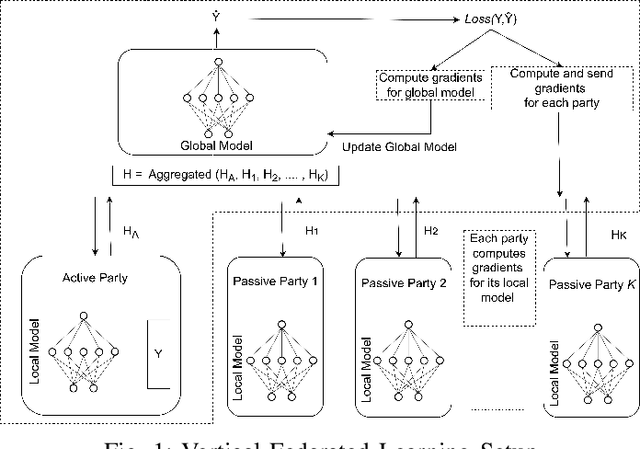
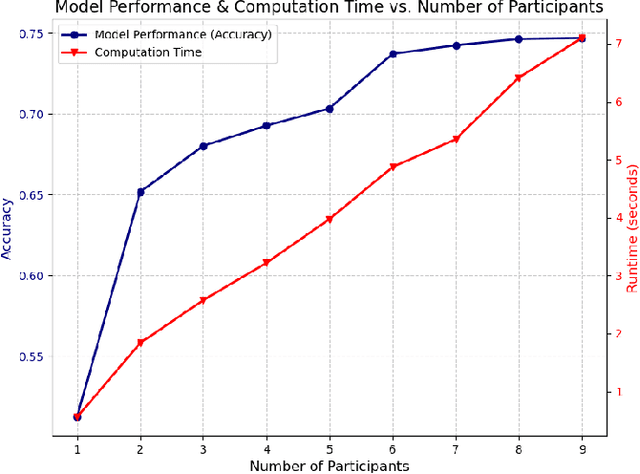
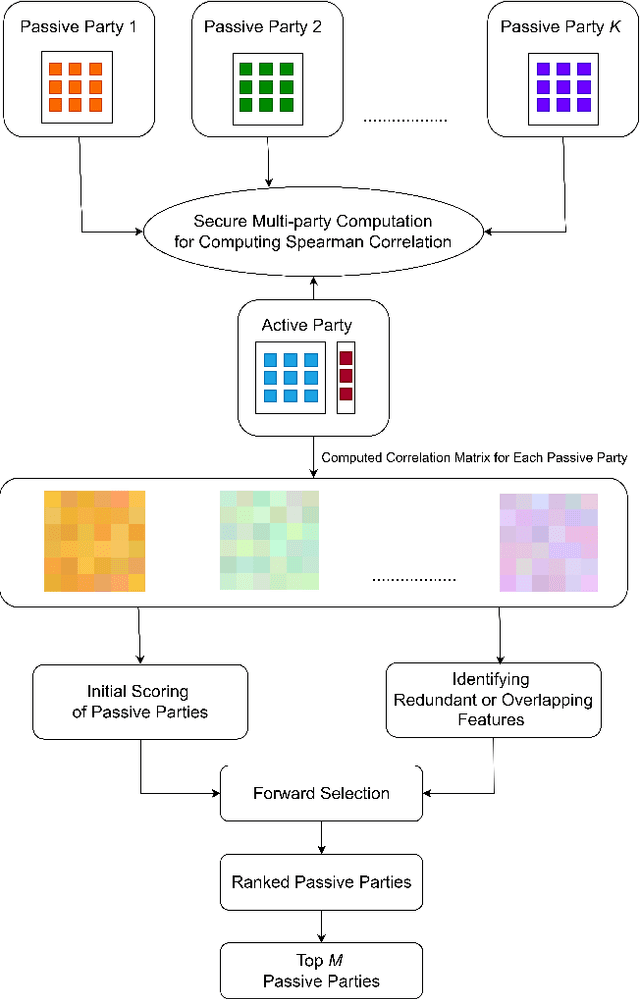
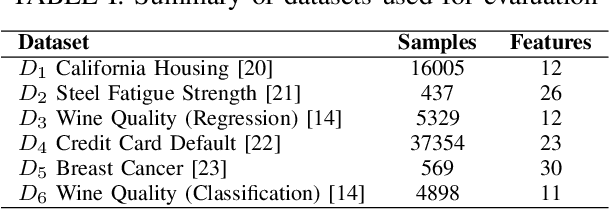
Federated Learning (FL) allows collaboration between different parties, while ensuring that the data across these parties is not shared. However, not every collaboration is helpful in terms of the resulting model performance. Therefore, it is an important challenge to select the correct participants in a collaboration. As it currently stands, most of the efforts in participant selection in the literature have focused on Horizontal Federated Learning (HFL), which assumes that all features are the same across all participants, disregarding the possibility of different features across participants which is captured in Vertical Federated Learning (VFL). To close this gap in the literature, we propose a novel method VFL-RPS for participant selection in VFL, as a pre-training step. We have tested our method on several data sets performing both regression and classification tasks, showing that our method leads to comparable results as using all data by only selecting a few participants. In addition, we show that our method outperforms existing methods for participant selection in VFL.
Incentive Allocation in Vertical Federated Learning Based on Bankruptcy Problem
Jul 07, 2023Vertical federated learning (VFL) is a promising approach for collaboratively training machine learning models using private data partitioned vertically across different parties. Ideally in a VFL setting, the active party (party possessing features of samples with labels) benefits by improving its machine learning model through collaboration with some passive parties (parties possessing additional features of the same samples without labels) in a privacy preserving manner. However, motivating passive parties to participate in VFL can be challenging. In this paper, we focus on the problem of allocating incentives to the passive parties by the active party based on their contributions to the VFL process. We formulate this problem as a variant of the Nucleolus game theory concept, known as the Bankruptcy Problem, and solve it using the Talmud's division rule. We evaluate our proposed method on synthetic and real-world datasets and show that it ensures fairness and stability in incentive allocation among passive parties who contribute their data to the federated model. Additionally, we compare our method to the existing solution of calculating Shapley values and show that our approach provides a more efficient solution with fewer computations.
Vertical Federated Learning: A Structured Literature Review
Dec 01, 2022Federated Learning (FL) has emerged as a promising distributed learning paradigm with an added advantage of data privacy. With the growing interest in having collaboration among data owners, FL has gained significant attention of organizations. The idea of FL is to enable collaborating participants train machine learning (ML) models on decentralized data without breaching privacy. In simpler words, federated learning is the approach of ``bringing the model to the data, instead of bringing the data to the mode''. Federated learning, when applied to data which is partitioned vertically across participants, is able to build a complete ML model by combining local models trained only using the data with distinct features at the local sites. This architecture of FL is referred to as vertical federated learning (VFL), which differs from the conventional FL on horizontally partitioned data. As VFL is different from conventional FL, it comes with its own issues and challenges. In this paper, we present a structured literature review discussing the state-of-the-art approaches in VFL. Additionally, the literature review highlights the existing solutions to challenges in VFL and provides potential research directions in this domain.