 Add to Chrome
 Add to Firefox
 Add to Edge
Narrative-UFET: Narrative Generation for Ultra-Fine Entity Typing
Jun 25, 2026
Ultra-fine entity typing (UFET) assigns highly specific types to entity mentions, but current approaches struggle with types in the long tail. We hypothesize that a key limitation is the reliance on sentence-level context, since disambiguating evidence is often spread across multiple sentences. Testing this has been difficult because all existing UFET resources are sentence-level. We present Narrative-UFET, a controlled extension of UFET in which each entity mention is paired with an automatically generated short, coherent narrative. Synthesizing narratives lets us isolate the effect of specific discourse properties. We experiment with two paired variants: one in which the entity's type is held constant across the narrative (Maintain) and one in which it shifts (Change). We show that narrative context yields consistent improvements on long-tail types over sentence-level baselines, with the Change variant providing the stronger signal. A comparison against naturally occurring contexts shows that synthetic narratives yield stronger gains, indicating that controlled discourse construction can surface signals that real text leaves implicit. Substantial room for improvement remains, suggesting open directions in both discourse modeling and narrative construction.

A Structured Clustering Approach for Inducing Media Narratives
Apr 11, 2026Media narratives wield tremendous power in shaping public opinion, yet computational approaches struggle to capture the nuanced storytelling structures that communication theory emphasizes as central to how meaning is constructed. Existing approaches either miss subtle narrative patterns through coarse-grained analysis or require domain-specific taxonomies that limit scalability. To bridge this gap, we present a framework for inducing rich narrative schemas by jointly modeling events and characters via structured clustering. Our approach produces explainable narrative schemas that align with established framing theory while scaling to large corpora without exhaustive manual annotation.
All Entities are Not Created Equal: Examining the Long Tail for Fine-Grained Entity Typing
Oct 22, 2024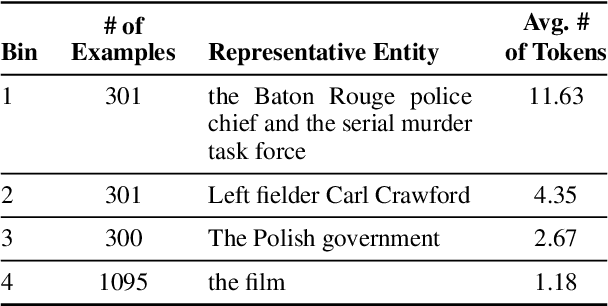
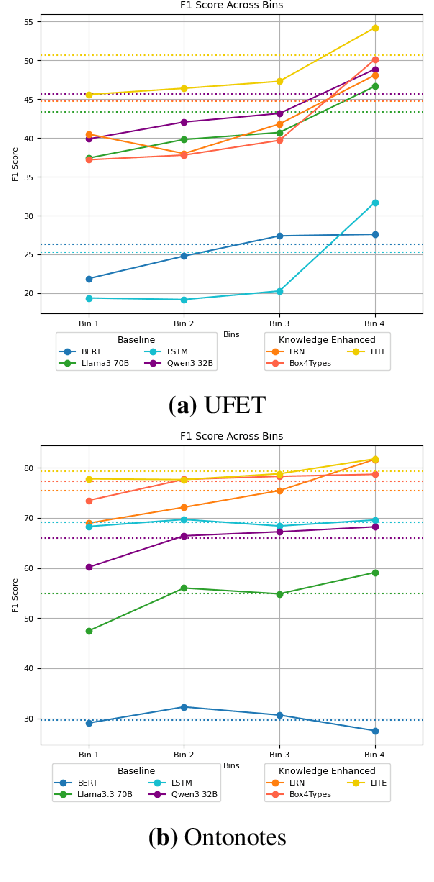
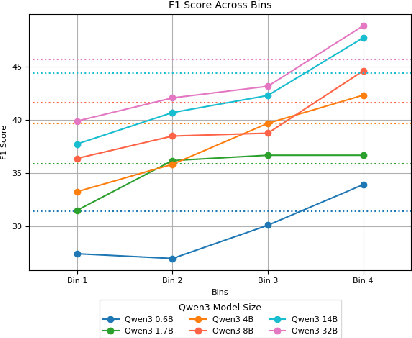
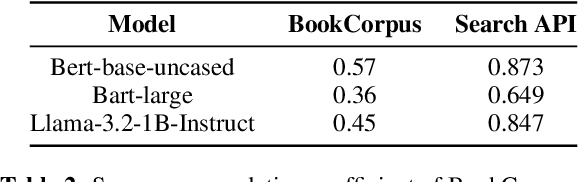
Pre-trained language models (PLMs) are trained on large amounts of data, which helps capture world knowledge alongside linguistic competence. Due to this, they are extensively used for ultra-fine entity typing tasks, where they provide the entity knowledge held in its parameter space. Given that PLMs learn from co-occurrence patterns, they likely contain more knowledge or less knowledge about entities depending on their how frequent they are in the pre-training data. In this work, we probe PLMs to elicit encoded entity probabilities and demonstrate that they highly correlate with their frequency in large-scale internet data. Then, we demonstrate that entity-typing approaches that rely on PLMs struggle with entities at the long tail on the distribution. Our findings suggests that we need to go beyond PLMs to produce solutions that perform well for rare, new or infrequent entities.