 Add to Chrome
 Add to Firefox
 Add to Edge
FlashbackCL: Mitigating Temporal Forgetting in Federated Learning
Jun 02, 2026
Federated Learning (FL) of foundation and edge models increasingly targets deployments where client data distributions drift over time, yet existing forgetting-mitigation methods assume each client's distribution is stationary. Flashback, the strongest recent FL method against cross-client (spatial) forgetting, uses monotonically accumulating per-class label counts as a knowledge proxy; this proxy becomes miscalibrated under temporal distribution shift and anchors the global model to an outdated class balance. We formalise temporal forgetting in FL with a per-phase metric isolated from protocol-level fluctuations and propose Flashback Continual Learning (FlashbackCL), a drop-in extension of Flashback with (i) temporally-decayed label counts; (ii) a device-aware replay buffer with Class-Balanced Reservoir Sampling (CBRS); and (iii) server-side active coreset curation on the public distillation set. The results show that FlashbackCL achieves 6.9% to 10.0% relative improvement relative to Flashback, on CIFAR-10 with 50 clients and three controlled temporal shift modes, while simultaneously reducing temporal forgetting by up to 68%. A 5-variant ablation identifies CBRS replay as the critical component. FlashbackCL also improves Flashback by 3.5 points on stationary CIFAR-100, suggesting that class-balanced replay regularises spatial heterogeneity as well as temporal shift.

Simulation, Modelling and Classification of Wiki Contributors: Spotting The Good, The Bad, and The Ugly
May 29, 2024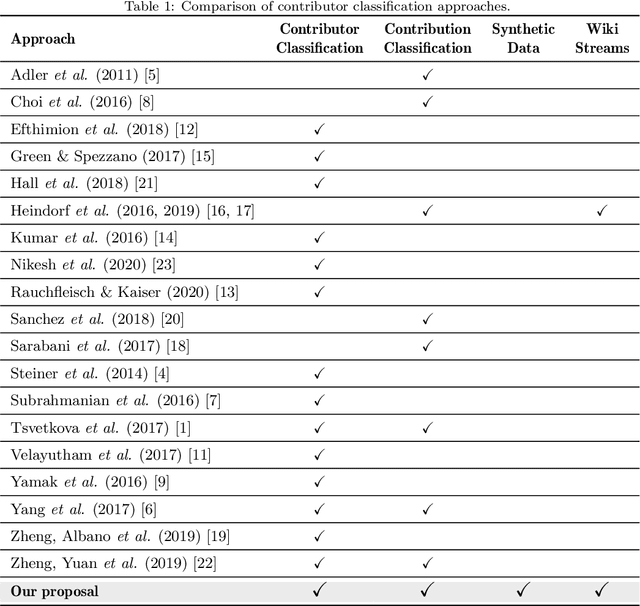
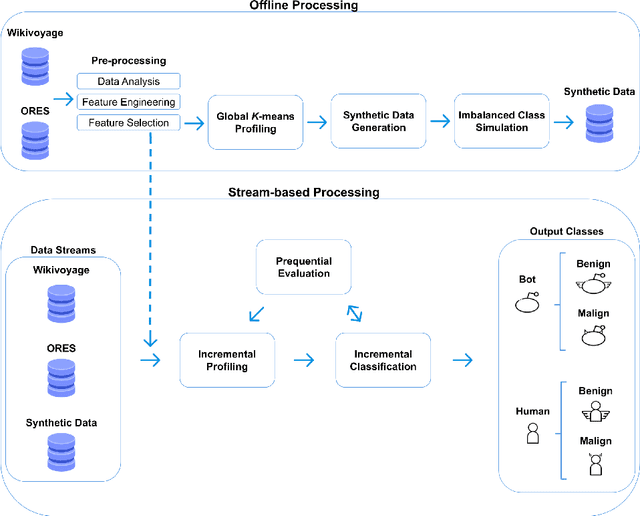
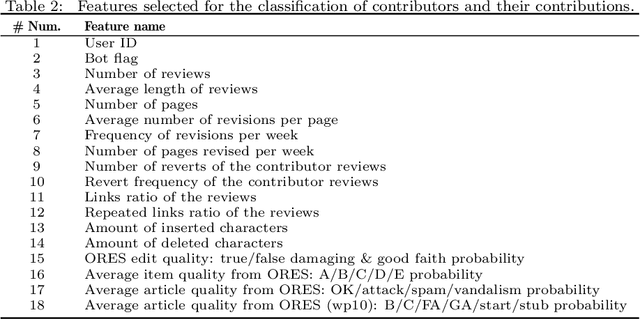
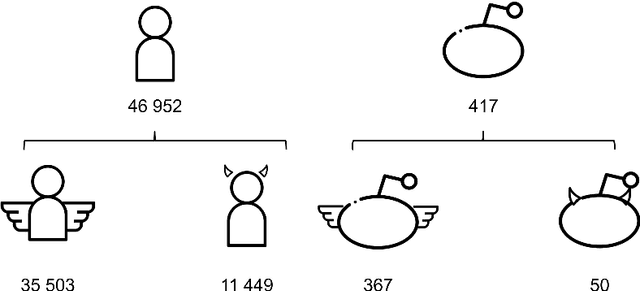
Data crowdsourcing is a data acquisition process where groups of voluntary contributors feed platforms with highly relevant data ranging from news, comments, and media to knowledge and classifications. It typically processes user-generated data streams to provide and refine popular services such as wikis, collaborative maps, e-commerce sites, and social networks. Nevertheless, this modus operandi raises severe concerns regarding ill-intentioned data manipulation in adversarial environments. This paper presents a simulation, modelling, and classification approach to automatically identify human and non-human (bots) as well as benign and malign contributors by using data fabrication to balance classes within experimental data sets, data stream modelling to build and update contributor profiles and, finally, autonomic data stream classification. By employing WikiVoyage - a free worldwide wiki travel guide open to contribution from the general public - as a testbed, our approach proves to significantly boost the confidence and quality of the classifier by using a class-balanced data stream, comprising both real and synthetic data. Our empirical results show that the proposed method distinguishes between benign and malign bots as well as human contributors with a classification accuracy of up to 92 %.