 Add to Chrome
 Add to Firefox
 Add to Edge
More Aligned, Less Diverse? Analyzing the Grammar and Lexicon of Two Generations of LLMs
May 07, 2026
This study contributes to a growing line of research in comparing LLM-generated texts with human-authored text, in this case, English news text. We focus in particular on the evaluation of syntactic properties through formal grammar frameworks. Our analysis compares two generations of LLMs in the context of two human-authored English news datasets from two different years. Employing the Head-Driven Phrase Structure Grammar (HPSG) formalism, we investigate the distributions of syntactic structures and lexical types of AI-generated texts and contrast them with the corresponding distributions in the human-authored New York Times (NYT) articles. We use diversity metrics from ecology and information theory to quantify variation in grammatical constructions and lexical types. We show that English news text has changed little in the given time frame, while newer LLMs display reduced syntactic and, especially, lexical diversity compared to older, non-instruction-tuned models. These findings point to future work in studying effects of instruction tuning, which, while enhancing coherence and adherence to prompts, may narrow the expressive range of model output.

LyS at SemEval 2025 Task 8: Zero-Shot Code Generation for Tabular QA
Aug 12, 2025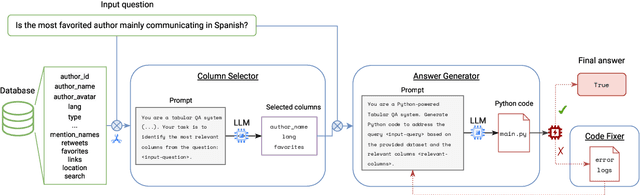
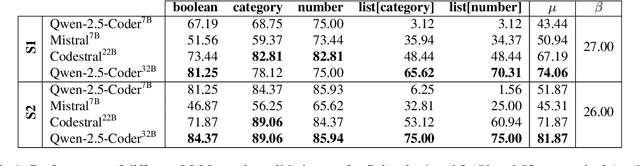
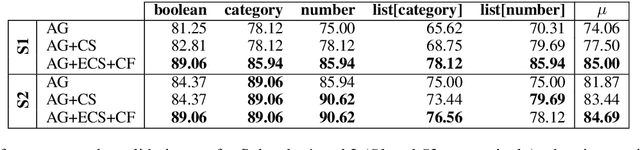
This paper describes our participation in SemEval 2025 Task 8, focused on Tabular Question Answering. We developed a zero-shot pipeline that leverages an Large Language Model to generate functional code capable of extracting the relevant information from tabular data based on an input question. Our approach consists of a modular pipeline where the main code generator module is supported by additional components that identify the most relevant columns and analyze their data types to improve extraction accuracy. In the event that the generated code fails, an iterative refinement process is triggered, incorporating the error feedback into a new generation prompt to enhance robustness. Our results show that zero-shot code generation is a valid approach for Tabular QA, achieving rank 33 of 53 in the test phase despite the lack of task-specific fine-tuning.