 Add to Chrome
 Add to Firefox
 Add to Edge
Robustness Quantification and Uncertainty Quantification: Comparing Two Methods for Assessing the Reliability of Classifier Predictions
Mar 24, 2026
We consider two approaches for assessing the reliability of the individual predictions of a classifier: Robustness Quantification (RQ) and Uncertainty Quantification (UQ). We explain the conceptual differences between the two approaches, compare both approaches on a number of benchmark datasets and show that RQ is capable of outperforming UQ, both in a standard setting and in the presence of distribution shift. Beside showing that RQ can be competitive with UQ, we also demonstrate the complementarity of RQ and UQ by showing that a combination of both approaches can lead to even better reliability assessments.

Robustness and uncertainty: two complementary aspects of the reliability of the predictions of a classifier
Dec 17, 2025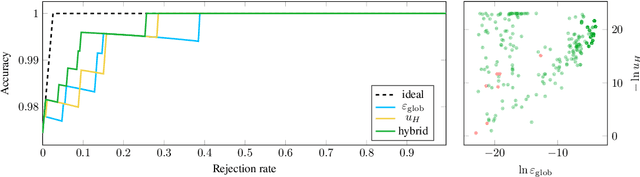
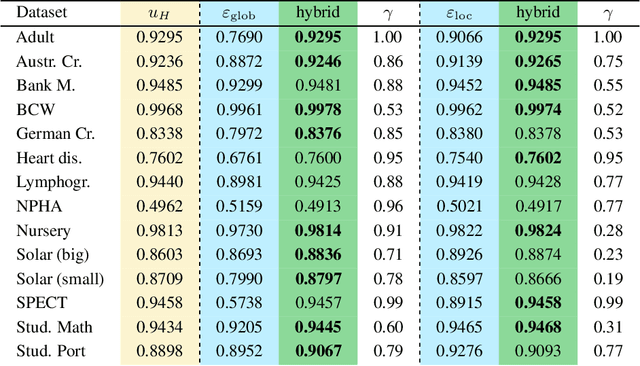
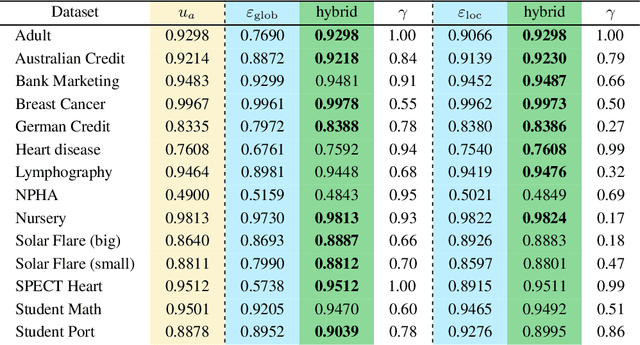
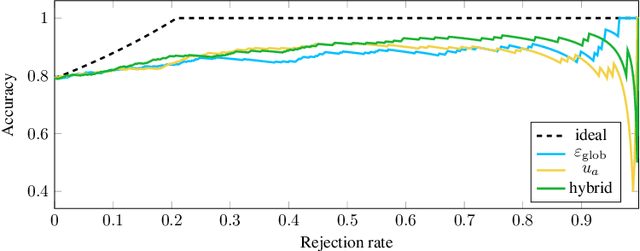
We consider two conceptually different approaches for assessing the reliability of the individual predictions of a classifier: Robustness Quantification (RQ) and Uncertainty Quantification (UQ). We compare both approaches on a number of benchmark datasets and show that there is no clear winner between the two, but that they are complementary and can be combined to obtain a hybrid approach that outperforms both RQ and UQ. As a byproduct of our approach, for each dataset, we also obtain an assessment of the relative importance of uncertainty and robustness as sources of unreliability.
Robustness quantification and how it allows for reliable classification, even in the presence of distribution shift and for small training sets
Mar 28, 2025Based on existing ideas in the field of imprecise probabilities, we present a new approach for assessing the reliability of the individual predictions of a generative probabilistic classifier. We call this approach robustness quantification, compare it to uncertainty quantification, and demonstrate that it continues to work well even for classifiers that are learned from small training sets that are sampled from a shifted distribution.