 Add to Chrome
 Add to Firefox
 Add to Edge
Towards 3D Scene Understanding of Gas Plumes in LWIR Hyperspectral Images Using Neural Radiance Fields
Mar 05, 2026
Hyperspectral images (HSI) have many applications, ranging from environmental monitoring to national security, and can be used for material detection and identification. Longwave infrared (LWIR) HSI can be used for gas plume detection and analysis. Oftentimes, only a few images of a scene of interest are available and are analyzed individually. The ability to combine information from multiple images into a single, cohesive representation could enhance analysis by providing more context on the scene's geometry and spectral properties. Neural radiance fields (NeRFs) create a latent neural representation of volumetric scene properties that enable novel-view rendering and geometry reconstruction, offering a promising avenue for hyperspectral 3D scene reconstruction. We explore the possibility of using NeRFs to create 3D scene reconstructions from LWIR HSI and demonstrate that the model can be used for the basic downstream analysis task of gas plume detection. The physics-based DIRSIG software suite was used to generate a synthetic multi-view LWIR HSI dataset of a simple facility with a strong sulfur hexafluoride gas plume. Our method, built on the standard Mip-NeRF architecture, combines state-of-the-art methods for hyperspectral NeRFs and sparse-view NeRFs, along with a novel adaptive weighted MSE loss. Our final NeRF method requires around 50% fewer training images than the standard Mip-NeRF and achieves an average PSNR of 39.8 dB with as few as 30 training images. Gas plume detection applied to NeRF-rendered test images using the adaptive coherence estimator achieves an average AUC of 0.821 when compared with detection masks generated from ground-truth test images.

Improved Background Estimation for Gas Plume Identification in Hyperspectral Images
Nov 22, 2024Longwave infrared (LWIR) hyperspectral imaging can be used for many tasks in remote sensing, including detecting and identifying effluent gases by LWIR sensors on airborne platforms. Once a potential plume has been detected, it needs to be identified to determine exactly what gas or gases are present in the plume. During identification, the background underneath the plume needs to be estimated and removed to reveal the spectral characteristics of the gas of interest. Current standard practice is to use ``global" background estimation, where the average of all non-plume pixels is used to estimate the background for each pixel in the plume. However, if this global background estimate does not model the true background under the plume well, then the resulting signal can be difficult to identify correctly. The importance of proper background estimation increases when dealing with weak signals, large libraries of gases of interest, and with uncommon or heterogeneous backgrounds. In this paper, we propose two methods of background estimation, in addition to three existing methods, and compare each against global background estimation to determine which perform best at estimating the true background radiance under a plume, and for increasing identification confidence using a neural network classification model. We compare the different methods using 640 simulated plumes. We find that PCA is best at estimating the true background under a plume, with a median of 18,000 times less MSE compared to global background estimation. Our proposed K-Nearest Segments algorithm improves median neural network identification confidence by 53.2%.
Local Background Estimation for Improved Gas Plume Identification in Hyperspectral Images
Jan 23, 2024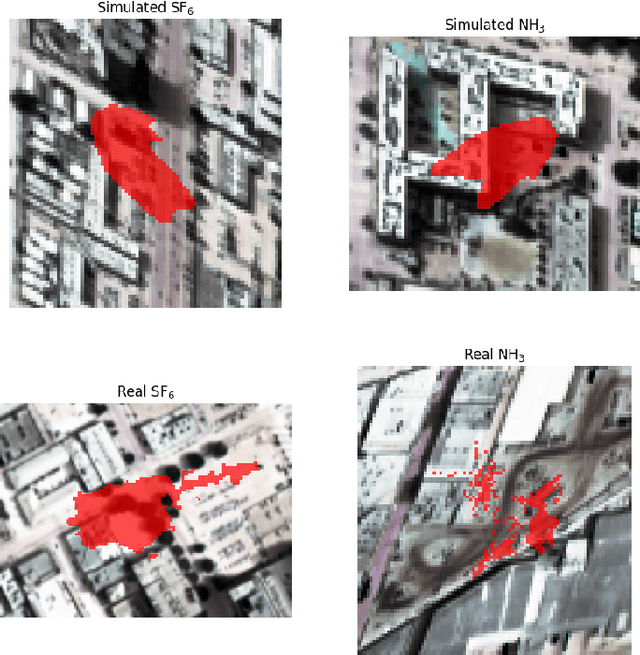
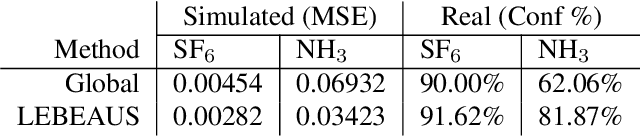
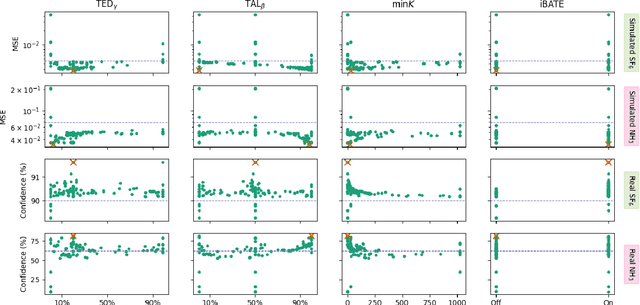
Deep learning identification models have shown promise for identifying gas plumes in Longwave IR hyperspectral images of urban scenes, particularly when a large library of gases are being considered. Because many gases have similar spectral signatures, it is important to properly estimate the signal from a detected plume. Typically, a scene's global mean spectrum and covariance matrix are estimated to whiten the plume's signal, which removes the background's signature from the gas signature. However, urban scenes can have many different background materials that are spatially and spectrally heterogeneous. This can lead to poor identification performance when the global background estimate is not representative of a given local background material. We use image segmentation, along with an iterative background estimation algorithm, to create local estimates for the various background materials that reside underneath a gas plume. Our method outperforms global background estimation on a set of simulated and real gas plumes. This method shows promise in increasing deep learning identification confidence, while being simple and easy to tune when considering diverse plumes.