 Add to Chrome
 Add to Firefox
 Add to Edge
ReasonOps: A Unified Operational Paradigm for Trustworthy Verified LLM Reasoning
May 26, 2026
Large Language Models (LLMs) have transformed artificial intelligence from primarily generative systems into increasingly capable reasoning agents. Recent advances in theorem proving, autoformalization, symbolic reasoning, and tool-augmented language models demonstrate substantial progress toward machine-assisted formal reasoning. However, current reasoning systems still suffer from hidden logical inconsistencies, hallucinated symbolic transitions, unsupported theorem applications, and limited reliability guarantees. Existing approaches remain fragmented across formal verification, runtime assurance, neuro-symbolic reasoning and trustworthy Artificial Intelligence (AI) research communities. This paper introduces ReasonOps, a unified operational paradigm for trustworthy verified reasoning systems. Inspired by operational ecosystems such as DevOps and MLOps, ReasonOps treats reasoning as a continuously monitored, verifiable, reliability-aware operational process rather than an isolated inference task. The proposed paradigm integrates semantic interpretation, autoformalization, symbolic reasoning, theorem proving, runtime assurance, probabilistic reliability estimation, and adaptive correction into a unified reasoning lifecycle. The paper further presents the ReasonOps architecture, demonstrates its workflow using an autonomous braking system analysis example, and discusses its potential role in future safety-critical autonomous AI systems. We argue that operational reasoning paradigms such as ReasonOps may become foundational infrastructure for next-generation trustworthy AI ecosystems.

Extending XReason: Formal Explanations for Adversarial Detection
Dec 31, 2024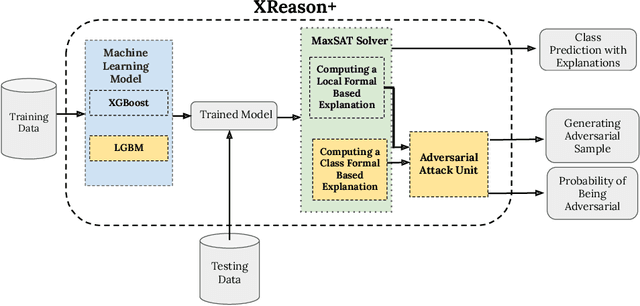
Explainable Artificial Intelligence (XAI) plays an important role in improving the transparency and reliability of complex machine learning models, especially in critical domains such as cybersecurity. Despite the prevalence of heuristic interpretation methods such as SHAP and LIME, these techniques often lack formal guarantees and may produce inconsistent local explanations. To fulfill this need, few tools have emerged that use formal methods to provide formal explanations. Among these, XReason uses a SAT solver to generate formal instance-level explanation for XGBoost models. In this paper, we extend the XReason tool to support LightGBM models as well as class-level explanations. Additionally, we implement a mechanism to generate and detect adversarial examples in XReason. We evaluate the efficiency and accuracy of our approach on the CICIDS-2017 dataset, a widely used benchmark for detecting network attacks.
Formal Modeling of Robotic Cell Injection Systems in Higher-order Logic
Jul 18, 2018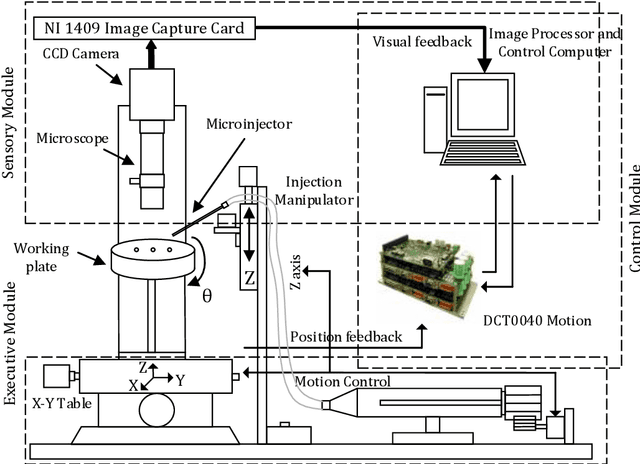
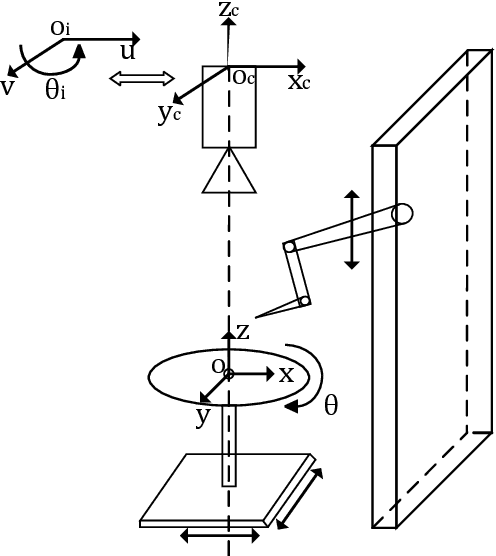
Robotic cell injection is used for automatically delivering substances into a cell and is an integral component of drug development, genetic engineering and many other areas of cell biology. Traditionally, the correctness of functionality of these systems is ascertained using paper-and-pencil proof and computer simulation methods. However, the paper based proofs can be human-error prone and the simulation provides an incomplete analysis due to its sampling based nature and the inability to capture continuous behaviors in computer based models. Model checking has been recently advocated for the analysis of cell injection systems as well. However, it involves the discretization of the differential equations that are used for modeling the dynamics of the system and thus compromises on the completeness of the analysis as well. In this paper, we propose to use higher-order-logic theorem proving for the modeling and analysis of the dynamical behaviour of the robotic cell injection systems. The high expressiveness of the underlying logic allows us to capture the continuous details of the model in their true form. Then, the model can be analyzed using deductive reasoning within the sound core of a proof assistant.