 Add to Chrome
 Add to Firefox
 Add to Edge
Transformer-Guided Graph Attention for Direct Cardiac Mesh Reconstruction: A Structural Digital Twin Framework
Jun 11, 2026
Building patient-specific cardiac models sits at the heart of precision cardiology, yet getting those models into clinical use keeps running into the same wall: mesh generation is slow, messy, and frustrating. The standard workflow -- segmenting the image, running Marching Cubes, and then manually cleaning up the result -- is time-consuming, inconsistent across operators, and demands specialist knowledge most clinical teams do not have. We take a fundamentally different approach. Instead of treating segmentation and mesh generation as two separate problems, we train a single end-to-end network that goes directly from a raw 3D medical image to a smooth, simulation-ready cardiac surface mesh. The core is a 3D Swin Transformer encoder-decoder that extracts volumetric features from CT or MRI volumes, paired with a Graph Attention Network (GAT) head that iteratively deforms a template mesh to fit the patient's cardiac boundary. We tested on the MM-WHS 2017 benchmark using both CT and MRI. Segmentation scores were competitive (Dice of 0.84 on CT, 0.83 on MRI), but the primary focus is mesh quality: mean Chamfer distance of 1.8 mm, with 95th-percentile surface distance below 5 mm. Every mesh is produced in a single forward pass -- no Marching Cubes, no smoothing filters, no manual cleanup. We argue that for cardiac digital twin pipelines, geometric fidelity and topological correctness matter more than pixel-level Dice scores. By removing the post-processing bottleneck, this approach makes patient-specific cardiac simulation substantially more accessible for clinical use.

Pedestrian Intention Classifier using ID3 Modelled Decision Trees for IoT Edge Devices
Apr 01, 2023Road accidents involving autonomous vehicles commonly occur in situations where a (pedestrian) obstacle presents itself in the path of the moving vehicle at very sudden time intervals, leaving the robot even lesser time to react to the change in scene. In order to tackle this issue, we propose a novel algorithmic implementation that classifies the intent of a single arbitrarily chosen pedestrian in a two dimensional frame into logic states in a procedural manner using quaternions generated from a MediaPipe pose estimation model. This bypasses the need to employ any relatively high latency deep-learning algorithms primarily due to the lack of necessity for depth perception as well as an implicit cap on the computational resources that most IoT edge devices present. The model was able to achieve an average testing accuracy of 83.56% with a reliable variance of 0.0042 while operating with an average latency of 48 milliseconds, demonstrating multiple notable advantages over the current standard of using spatio-temporal convolutional networks for these perceptive tasks.
Economical Quaternion Extraction from a Human Skeletal Pose Estimate using 2-D Cameras
Mar 30, 2023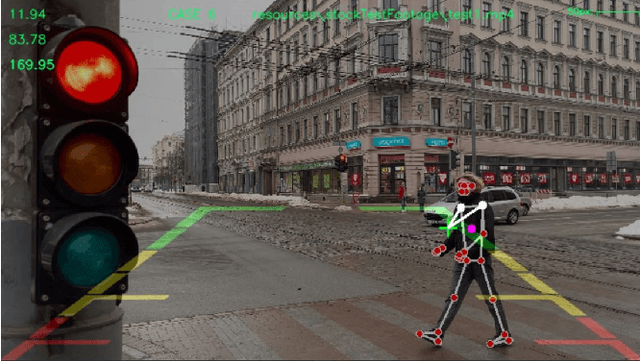
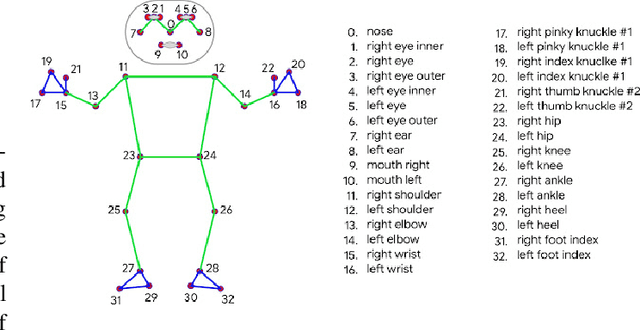
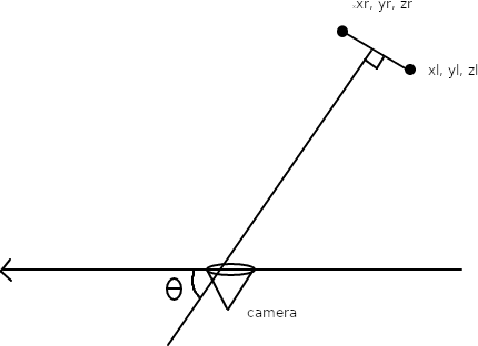
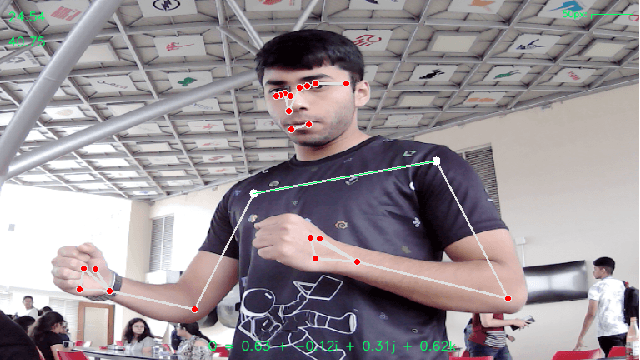
In this paper, we present a novel algorithm to extract a quaternion from a two dimensional camera frame for estimating a contained human skeletal pose. The problem of pose estimation is usually tackled through the usage of stereo cameras and intertial measurement units for obtaining depth and euclidean distance for measurement of points in 3D space. However, the usage of these devices comes with a high signal processing latency as well as a significant monetary cost. By making use of MediaPipe, a framework for building perception pipelines for human pose estimation, the proposed algorithm extracts a quaternion from a 2-D frame capturing an image of a human object at a sub-fifty millisecond latency while also being capable of deployment at edges with a single camera frame and a generally low computational resource availability, especially for use cases involving last-minute detection and reaction by autonomous robots. The algorithm seeks to bypass the funding barrier and improve accessibility for robotics researchers involved in designing control systems.